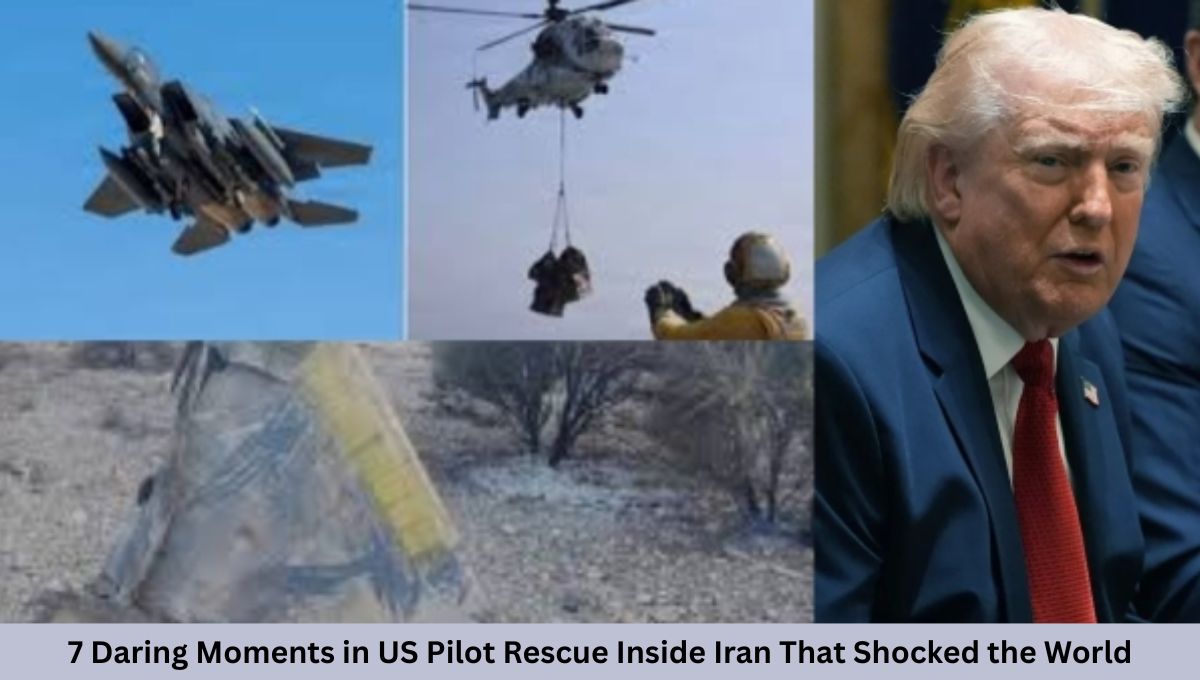
7 Daring Moments in US Pilot Rescue Inside Iran That Shocked the World — A high-risk mission. In a dramatic turn amid escalating tensions in the Middle East, the United States military executed one of the most daring combat search-and-rescue (CSAR) operations in recent history.
Deep inside hostile Iranian territory, a stranded crew member from a downed F-15E Strike Eagle was successfully rescued in a high-risk mission involving advanced aircraft, elite special forces, and real-time intelligence coordination.
The operation, confirmed by US leadership, has sparked intense global attention—not just because of its complexity, but also due to its implications for the ongoing conflict between the United States and Iran.
This was not merely a rescue.
It was a demonstration of military capability, strategic coordination, and the longstanding doctrine:
leave no soldier behind.
7 Daring Moments in US Pilot Rescue Inside Iran That Shocked the World
How the Crisis Began
Downing of the F-15E Strike Eagle
The chain of events began when Iran’s air defense systems reportedly shot down a US F-15E Strike Eagle fighter jet.
The aircraft carried two crew members:
- A pilot
- A weapons systems officer (WSO)
Both ejected successfully. However, while the pilot was rescued within hours, the WSO remained stranded deep inside Iranian territory—triggering a high-stakes rescue mission.
This development marked a rare and significant escalation.
The downing of US military aircraft by enemy forces has been exceedingly uncommon in recent decades, highlighting the intensity of the ongoing conflict.
The Missing Airman: Alone Behind Enemy Lines
The second crew member faced a nightmare scenario:
- Stranded in rugged mountainous terrain
- Surrounded by hostile forces and local militias
- Hunted amid reports of cash rewards for his capture
- Forced to rely on SERE (Survival, Evasion, Resistance, Escape) training
Despite these challenges, the airman managed to:
- Evade detection for over 24 hours
- Maintain intermittent communication
- Move strategically across difficult terrain
His survival bought crucial time for US forces to plan the rescue.
The Turning Point: Intelligence Breakthrough
Real-Time Tracking and CIA Involvement
The operation gained momentum after intelligence agencies successfully pinpointed the airman’s location.
Key elements included:
- Advanced surveillance technologies
- Signal intelligence and encrypted communications
- A deception campaign to mislead Iranian forces
The deception reportedly involved spreading misinformation that the US had already recovered the airman—buying valuable time and reducing enemy pressure in the actual location.
This phase underscores how modern warfare blends intelligence, cyber tactics, and psychological operations.
Planning the Rescue: Precision Under Pressure
High-Risk Strategic Coordination
Once the airman’s location was confirmed, planning accelerated rapidly.
Military leadership faced multiple challenges:
- Operating inside enemy air defense zones
- Avoiding detection by radar and missile systems
- Coordinating air and ground units simultaneously
- Managing time pressure as enemy forces closed in
A narrow operational window emerged—and the decision was made to act.
Forces Deployed: A Massive Military Effort
The rescue operation involved an extensive array of military assets:
Aircraft Used
- HH-60W “Jolly Green II” rescue helicopters
- A-10 Warthog attack jets
- F-35 stealth fighters
- HC-130 rescue tanker aircraft
- Black Hawk helicopters
Ground Forces
- Elite US Special Operations Forces
- Combat search-and-rescue units
Support Systems
- Real-time intelligence feeds
- Airborne surveillance platforms
- Electronic warfare support
This combination ensured air superiority, ground precision, and rapid extraction capability.
The Rescue Operation: Step-by-Step Breakdown
1. Insertion Phase
Special forces teams were inserted near the airman’s location under cover of darkness. Stealth and timing were critical to avoid detection.
2. Air Cover and Suppression
A-10 Warthogs and other aircraft provided:
- Close air support
- Enemy suppression
- Defensive perimeter security
3. Contact and Stabilization
Rescue teams reached the airman:
- Assessed injuries
- Provided immediate medical care
- Prepared for rapid extraction
4. Firefight and Escalation
Reports indicate that the operation did not go entirely as planned:
- A firefight broke out
- Enemy forces attempted interception
- US forces responded with heavy firepower
Despite this, the mission remained on track.
5. Extraction Phase
The airman was evacuated via helicopter:
- Under heavy protection
- Amid ongoing threats
- With precise coordination
6. Safe Exit
All US forces exited Iranian territory successfully, marking the mission’s completion.
Parallel Rescue: A Two-Phase Operation
What makes this event even more remarkable is that:
- The first crew member (pilot) was rescued earlier
- The second rescue occurred later, under even more dangerous conditions
This effectively turned the mission into a two-phase deep-territory rescue operation, a rare achievement in modern military history.
Technology That Made It Possible
HH-60W “Jolly Green II” Helicopter
A standout asset in the mission, this helicopter is specifically designed for combat rescue operations:
- Extended range capabilities
- Advanced sensors for night and bad weather
- Self-sealing fuel tanks
- Defensive weapon systems
- Large cabin for personnel and equipment
Its role was critical in enabling fast extraction under hostile conditions.
Challenges Faced During the Operation
The mission encountered multiple risks:
1. Enemy Detection
Operating inside Iranian territory meant constant exposure to:
- Radar tracking
- Missile threats
- Ground patrols
2. Terrain Difficulties
Mountainous landscapes complicated:
- Navigation
- Communication
- Extraction timing
3. Active Hostility
Reports suggest:
- Iranian forces were actively searching
- Local groups were mobilized
- Helicopters faced incoming fire
4. Time Pressure
The longer the airman remained stranded:
- The higher the risk of capture
- The narrower the rescue window
Why This Operation Matters Globally
1. Strategic Signal
The operation sends a strong message about US military reach and capability.
2. Escalation Risks
Such missions could:
- Increase tensions with Iran
- Trigger retaliatory actions
- Complicate diplomatic efforts
3. Military Doctrine Reinforced
The mission underscores a key principle:
No matter the cost, no soldier is left behind.
Air Superiority Debate
While the operation was successful, it has reignited debate over:
- Whether the US truly has complete air dominance
- The effectiveness of Iranian air defenses
- The vulnerability of aircraft in contested zones
The downing of advanced aircraft suggests that:
- Iran retains significant defensive capability
- The conflict remains far from one-sided
Historical Context: Rare but Not Unprecedented
The downing of US aircraft in combat is rare in recent decades.
The last comparable incidents date back to earlier conflicts where:
- Air superiority was less absolute
- Enemy defenses were more advanced
This makes the current situation particularly significant.
Human Element: Survival Against the Odds
Beyond strategy and technology, the story is also deeply human.
The stranded airman:
- Survived harsh terrain
- Evaded capture
- Maintained composure under extreme stress
His training and resilience were as critical as the rescue itself.
Iran’s Response and Silence
While Iranian media reported:
- Rewards for capturing the airman
- Claims of shooting down US aircraft
There has been limited official confirmation regarding the rescue operation.
This ambiguity adds another layer of complexity to the situation.
Impact on Global Energy and Security
The broader conflict has already:
- Disrupted the Strait of Hormuz
- Affected global oil supply chains
- Increased fears of economic instability
This rescue operation, while tactical, is part of a much larger geopolitical picture.
What Happens Next?
Several key questions remain:
- Will tensions escalate further?
- Will there be retaliatory strikes?
- Can diplomatic channels reopen?
The answers will shape the next phase of the conflict.
Conclusion: A Defining Military Moment
The rescue of the stranded F-15 crew member stands as one of the most complex and daring operations in recent military history.
It combined:
- Advanced technology
- Real-time intelligence
- Elite human capability
- High-risk decision-making
While the mission was a success, it also highlights the volatile nature of the current geopolitical landscape.
In modern warfare, victories are rarely simple—and this operation is a powerful reminder of both the capabilities and the risks involved.
Also Read: 5 Explosive Updates as Iran Downs US Jets — Pilot Hunt Intensifies
Also Read: US pilot from downed F-15E plane rescued in Iran: What we know
Related Posts:
- 5 Explosive Updates as Iran Downs US Jets — Pilot…
- 4th US Aircraft Lost: KC-135 Crash in Iraq Sparks…
- 9 Shocking Moments as Trump Invokes Faith in Iran…

- 7 Stunning Strikes: Iran Claims Destruction of US…
- 10 Explosive Warnings as Donald Trump Calls Iran…

- 3 Explosive Conditions Iran Sets to End War with US…