
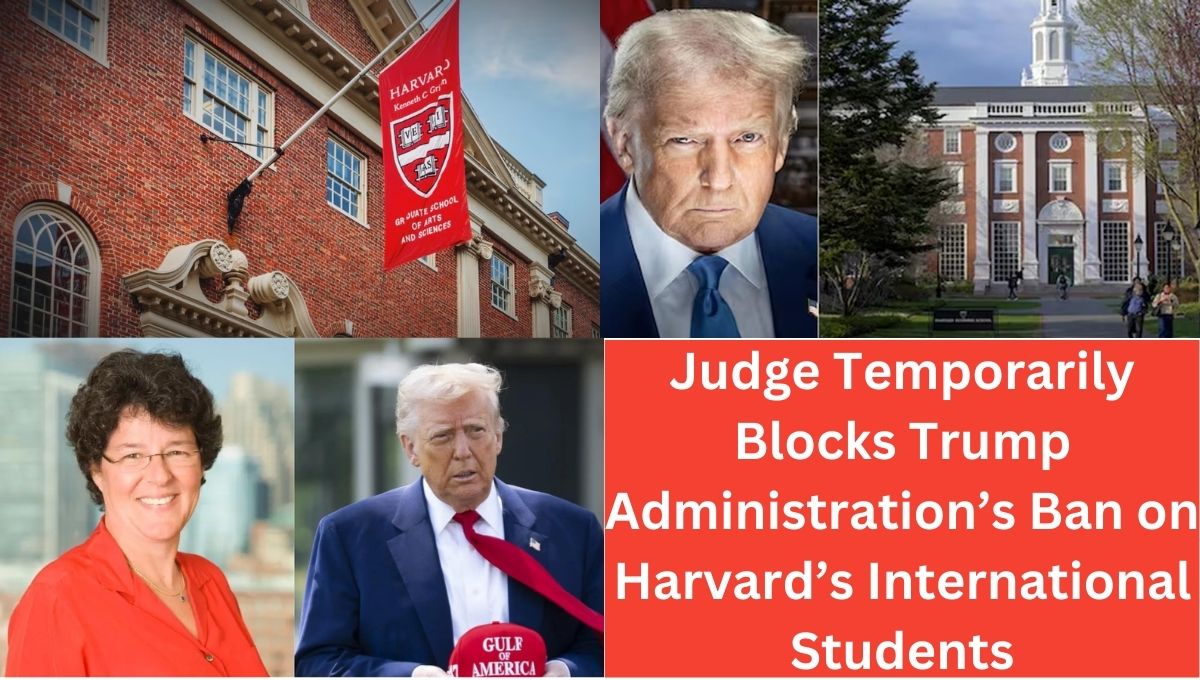
In a major legal development, Judge Temporarily Blocks Trump Administration’s Ban on Harvard’s International Students. A U.S. federal judge has temporarily blocked the Trump administration’s controversial move to revoke Harvard University’s ability to enroll international students. The decision, issued by U.S. District Judge Allison Burroughs, provides immediate relief to nearly 7,000 international students who were at risk of losing their visas and facing deportation.
Judge Temporarily Blocks Trump Administration’s Ban on Harvard’s International Students
Judge Halts Trump’s Visa Ban: Relief for Harvard’s International Students
The temporary restraining order stops the Department of Homeland Security (DHS) from enforcing its decision to strip Harvard of its Student and Exchange Visitor Program (SEVP) certification.
This ruling is a key moment in a growing conflict between academic institutions and federal authorities over immigration policy and academic freedom.
The move by the Trump administration was illegal and amounted to retaliation which affects thousands of students, Harvard said on Thursday.
The Trump Administration’s Controversial Move
In early May, DHS Secretary Kristi Noem announced the revocation of Harvard’s SEVP certification, which is required for universities to enroll international students on F-1 and J-1 visas. The order was to take effect for the 2025–2026 academic year.
Noem justified the move by accusing Harvard of fostering antisemitism and coordinating with the Chinese Communist Party a claim Harvard has categorically denied.
The order sparked outrage across the academic community, with many viewing it as an attack on academic independence and a political retaliation against one of America’s most prestigious institutions.
Harvard responded swiftly, filing a federal lawsuit arguing that the move violated the U.S. Constitution, specifically the First Amendment and the Due Process Clause.
Judge Burroughs Blocks Enforcement For Now
On Friday, Judge Burroughs granted a temporary restraining order that halts enforcement of the DHS decision while the legal challenge proceeds.
The ruling emphasized due process concerns and the abrupt nature of the policy shift, noting the significant harm it would cause to students and the university. Legal experts say this ruling is a strong indication that the court sees merit in Harvard’s case.
However, the restraining order is only temporary. A preliminary injunction hearing is expected soon, where the court will determine whether to extend the block until a final decision is reached.
International Students in Legal Limbo
Harvard’s international student body represents nearly 27% of its total enrollment. For the 2024–2025 academic year, about 6,793 international students are enrolled at Harvard.
These students contribute not only to the university’s academic diversity but also to research innovation, cultural exchange, and tuition revenue.
If the SEVP certification were revoked, these students would lose their visa eligibility. Many would be forced to transfer or leave the U.S. entirely. Those currently abroad such as rising junior Karl Molden from Austria fear they won’t be allowed to return to campus in the fall.
“This feels like being used as poker chips in a political game,” Molden said. “We’re being punished for something we had no control over.”
Fear, Anxiety, and Political Crossfire
The situation has created widespread fear and uncertainty, especially among students from conflict zones or countries with authoritarian regimes.
Maria Kuznetsova, a graduate student from Russia, said she cannot safely return home. Losing her visa could mean being stranded or facing persecution.
Others, like Pakistani student Abdullah Shahid Sial, co-president of Harvard’s international student body, described the mood on campus as “pure panic.” Students nearing graduation or applying for fall enrollment have been left in limbo.
Jewish students have also expressed concern. While Harvard has faced criticism for its handling of campus protests, many students believe the Trump administration is using antisemitism claims as a political tool rather than out of genuine concern.
Harvard’s Lawsuit: A Fight for Academic Freedom
Harvard’s legal complaint argues that the DHS order was an act of political retaliation. The university claims it fully complied with all federal inquiries and that the accusations leveled against it were arbitrary and baseless.
In a letter to the Harvard community, President Alan M. Garber stated, “Without its international students, Harvard is not Harvard.”
He emphasized the university’s commitment to academic freedom and its intention to resist political pressure aimed at shaping curriculum or controlling faculty decisions.
The lawsuit also highlights broader concerns about federal overreach into higher education governance and the use of immigration policy as a tool for ideological enforcement.
Global and Financial Ramifications
The Trump administration’s visa ban sparked international backlash. Chinese officials condemned the policy, and institutions like the Hong Kong University of Science and Technology extended offers to affected students.
Financially, the impact could be significant. International students typically pay full tuition and contribute billions to the U.S. economy.
For Harvard, losing these students could mean the loss of tuition revenue and research talent. While Harvard has a $53.2 billion endowment, much of it is restricted, and the university is already facing federal funding freezes.
Faculty warn that without international researchers, labs could shut down and innovation could stall undermining America’s leadership in science and technology.
The Next Legal Steps
The temporary restraining order is just the first step in what may become a protracted legal battle. A preliminary injunction hearing is expected soon.
If granted, it would continue to block the DHS from enforcing the ban while the lawsuit plays out.
Should the court ultimately side with Harvard, the decision could set a precedent that limits how the federal government interacts with universities over immigration and academic freedom.
If not, the ruling could open the door to further restrictions on international enrollment nationwide.
Conclusion: A Defining Moment for Higher Education
This case marks a turning point in the relationship between American universities and the federal government.
At stake are not just the futures of thousands of students, but the core values of academic independence, international exchange, and freedom of thought.
Harvard’s legal victory however temporary offers a crucial reprieve, but the uncertainty remains. As the lawsuit progresses, the world will be watching closely to see how this conflict shapes the future of international education and immigration policy in the United States.
President Garber’s closing words reflect the gravity of the moment: “We will support you as we do our utmost to ensure that Harvard remains open to the world.”
Also Read: Trump vs. Harvard: Federal Funding Cut Sparks Clash Over Antisemitism, Academic Freedom
Also Read: Meet Allison D Burroughs, judge who blocked Trump’s SEVP action against Harvard
Related Posts:
- Harvard’s SEVP Certification Revoked: What This…

- 7 Shocking Facts About Trump’s $1 Million Gold Card…

- Trump to Host 2026 G20 Summit at His Florida Golf…

- 9 Explosive Revelations as Trump Declares His Health…

- Trump Ends Harvard Feud with $500M Trade Schools Deal
- Barron Trump Rejected by Harvard? Rumors, Reactions,…
