

10 Powerful Revelations from the Trump–Putin Call on the Iran War amid volatile oil markets.As the war involving Iran, the United States, and Israel continues to reshape global geopolitics, a new diplomatic development has emerged that could influence the direction of the conflict. In a rare and closely watched phone conversation, Vladimir Putin and Donald Trump spoke for nearly an hour about the escalating war in the Middle East, the ongoing conflict in Ukraine, and the growing volatility in global energy markets.
According to the Kremlin, the conversation was initiated by Washington and was described as “frank, businesslike, and constructive.” During the call, Putin reportedly presented several proposals aimed at ending the Iran war “quickly” through political and diplomatic channels, following consultations with Gulf leaders and Iranian officials.
The call comes at a time when the war has triggered:
- intense airstrikes across Iran
- retaliatory missile attacks on Israel and Gulf states
- disruption of global oil markets
- rising fears of a broader regional war
The growing instability has pushed world leaders to explore diplomatic options that could prevent the conflict from expanding further.
Here are 10 powerful revelations from the Trump–Putin phone call and what they could mean for the wars in Iran and Ukraine, as well as the global energy crisis.
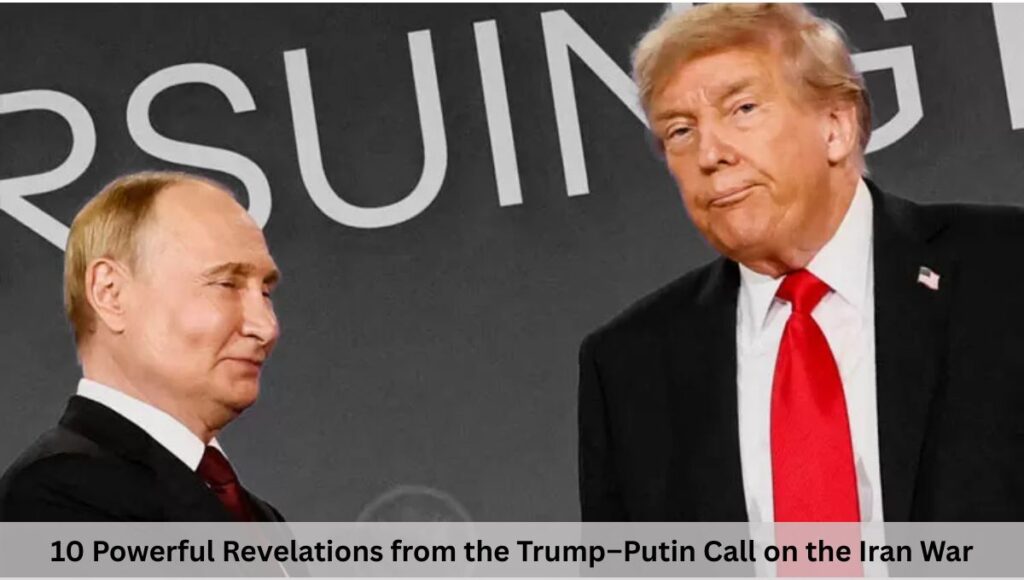
10 Powerful Revelations from the Trump–Putin Call on the Iran War
1. Trump Initiated the Phone Call
According to the Kremlin, the phone conversation between Putin and Trump was initiated by the United States.
Putin’s foreign policy adviser Yury Ushakov said the two leaders spoke for nearly an hour and exchanged what he described as “specific and useful views.”
The conversation marked the first phone call between the two leaders since December, highlighting the significance of the renewed dialogue at a moment of major global instability.
Washington reportedly wanted to discuss several urgent international issues, particularly the war in the Middle East and its impact on global energy markets.
2. Putin Proposed Ways to End the Iran War Quickly
One of the most important parts of the call involved proposals from Putin aimed at ending the Iran war quickly.
According to Ushakov, the Russian president “voiced a few ideas aimed at a quick political and diplomatic settlement” of the ongoing conflict.
Putin developed these proposals after holding discussions with several Middle Eastern leaders, including officials from Gulf states and Iran.
Russia has historically maintained diplomatic ties with both Iran and regional powers, giving it potential leverage as a mediator.
However, the Kremlin did not reveal the specific details of the proposals.
Analysts say the ideas could involve:
- ceasefire negotiations
- security guarantees for Iran
- international monitoring arrangements
- potential negotiations over nuclear or missile programs
Whether these ideas gain traction with Washington or its allies remains uncertain.
3. The Call Focused Heavily on the Iran War
The ongoing war in the Middle East dominated the discussion between the two leaders.
The conflict began with large-scale U.S. and Israeli strikes on Iranian military and nuclear facilities, followed by waves of Iranian missile and drone attacks targeting Israel and U.S. assets in the region.
The strikes reportedly killed Ali Khamenei, Iran’s long-serving supreme leader, triggering a dramatic escalation in regional tensions.
Iran later appointed Mojtaba Khamenei as the country’s new supreme leader. The leadership transition has added another layer of uncertainty to the conflict.
4. Trump Said Putin Wants to Be “Helpful”
After the call, Trump told reporters that Putin had expressed a desire to play a constructive role in resolving the crisis.
However, Trump also suggested that Russia could do more to resolve another ongoing conflict.
Speaking to journalists, Trump said:
“He wants to be helpful. But he could be more helpful by getting the Ukraine-Russia war over with.”
The comment highlighted Washington’s continued frustration over the prolonged war in Ukraine, which has now entered its fifth year.
5. Ukraine War Was Also a Major Topic
In addition to the Iran war, the two leaders discussed the ongoing conflict between Russia and Ukraine.
Putin reportedly described the situation on the battlefield, claiming that Russian forces were making significant progress along the front line.
The Russian leader also expressed support for continued negotiations aimed at ending the war.
Meanwhile, Trump reiterated his interest in achieving a rapid ceasefire and long-term settlement in Ukraine.
Despite multiple rounds of negotiations between Russia, Ukraine, and international mediators, no major breakthrough has yet been achieved.
6. The Global Energy Crisis Shaped the Discussion
Another major topic of the call was the growing instability in global energy markets.
The war involving Iran has triggered fears that oil shipments through the Strait of Hormuz could be disrupted.
The strait is one of the world’s most important energy corridors, carrying roughly 20 percent of global oil supplies.
Recent fighting and threats to shipping in the region have caused oil prices to surge dramatically.
At one point, prices climbed above $100 per barrel, with analysts warning they could reach $150 if the crisis continues.
7. Venezuela and Global Oil Supplies Were Also Discussed
The two leaders also discussed the situation in Venezuela and its impact on the global energy market.
Russia has historically supported the Venezuelan government led by Nicolás Maduro, which has maintained close ties with Moscow.
The collapse of Maduro’s government earlier this year dealt a significant blow to Russian influence in Latin America.
However, the global energy crisis created by the Iran war could give Russia new opportunities to expand its influence in energy markets.
8. Russia May Benefit From Higher Oil Prices
While the Iran war poses major risks for global stability, it may also bring economic benefits to Russia.
Russia is one of the world’s largest oil exporters and holds vast reserves of natural gas.
Higher oil prices could significantly increase Russian government revenues at a time when the country faces rising inflation and budget pressures.
Putin recently emphasized the reliability of Russian energy supplies, telling advisers that global competition for stable oil and gas sources is intensifying.
9. Trump Considers Easing Russian Oil Sanctions
Amid the turmoil in global energy markets, the Trump administration is reportedly considering easing certain sanctions on Russian oil exports.
The move would aim to increase global oil supply and stabilize markets following disruptions linked to the Iran conflict.
Officials are reportedly exploring options such as allowing certain countries—including India—to purchase Russian oil without facing U.S. penalties.
However, the proposal could complicate Washington’s efforts to reduce Russia’s financial resources for its war in Ukraine.
10. Putin Sees Opportunity in the Crisis
Many analysts believe Putin is using the Iran war to strengthen Russia’s geopolitical position.
By presenting himself as a potential mediator, Putin can maintain influence in the Middle East while also preserving his relationship with Trump.
Experts say this strategy allows Russia to remain diplomatically relevant even as global attention shifts away from the Ukraine war.
The Kremlin has condemned U.S. and Israeli strikes on Iran but has avoided directly criticizing Trump.
This careful diplomatic approach suggests that Putin is trying to balance support for Iran with the strategic benefits of maintaining communication with Washington.
A Complex Diplomatic Chessboard
The Trump–Putin phone call highlights the complex geopolitical dynamics created by the Iran war.
The conflict now intersects with several major global issues:
- the war in Ukraine
- global energy markets
- U.S.–Russia relations
- Middle East security
- international nuclear diplomacy
Each of these factors makes finding a diplomatic solution significantly more complicated.
Oil Markets and Economic Impact
The economic implications of the war have been immediate.
Oil prices surged sharply after the conflict began, reflecting fears that energy shipments through the Persian Gulf could be disrupted.
However, markets later stabilized somewhat after prices dropped from nearly $120 per barrel to below $90.
The volatility illustrates how sensitive global markets are to developments in the Middle East.
Energy disruptions could have ripple effects across the global economy, affecting everything from transportation costs to inflation.
The Strategic Importance of the Strait of Hormuz
The Strait of Hormuz remains one of the most critical flashpoints in the current crisis.
The narrow waterway connects the Persian Gulf to the Gulf of Oman and serves as a vital route for oil exports from several major producers, including:
- Saudi Arabia
- Iraq
- Kuwait
- the United Arab Emirates
- Qatar
If the strait were closed or heavily disrupted, global oil markets could face severe shortages.
This risk is one reason the United States and its allies are closely monitoring the situation in the region.
Could Russia Mediate the Iran War?
Some analysts believe Russia could play a role in mediating the conflict.
Moscow maintains diplomatic relations with:
- Iran
- Israel
- Gulf states
- several regional governments
This network of relationships could allow Russia to act as an intermediary in negotiations.
However, the success of any mediation effort would depend on the willingness of all parties involved to engage in diplomacy.
At the moment, the war continues to intensify, making a quick settlement unlikely.
Ukraine War Risks Being Overshadowed
Another consequence of the Iran war is that global attention has shifted away from Ukraine.
While the world focuses on the Middle East crisis, fighting continues across Ukrainian cities and front lines.
Russian drone and missile strikes have continued to target Ukrainian infrastructure, but these developments have received less international attention.
For Moscow, this shift in focus may provide strategic advantages on the battlefield.
Trump’s Balancing Act
For President Trump, the overlapping crises in Iran and Ukraine present a complex diplomatic challenge.
The United States is simultaneously trying to:
- manage a major conflict in the Middle East
- stabilize global energy markets
- pressure Russia over Ukraine
- maintain alliances across Europe and Asia
Balancing these priorities will require careful diplomacy and strategic decision-making.
Conclusion: Diplomacy Amid Escalating Conflict
The phone call between Donald Trump and Vladimir Putin underscores the growing urgency of diplomatic efforts to address the Iran war and other global conflicts.
While the Kremlin claims Putin has offered proposals to end the war quickly, it remains unclear whether those ideas will lead to concrete negotiations.
For now, the world faces a period of heightened uncertainty.
The Iran war continues to escalate, the Ukraine conflict remains unresolved, and global energy markets are under intense pressure.
In this volatile environment, diplomatic conversations like the Trump–Putin call may play an increasingly important role in shaping the next phase of global politics.
Also Read: 7 Explosive Claims: Putin’s Sacred War Rhetoric Shocks the World
Also Read: Donald Trump says call with Putin was ‘very good’, discussed Ukraine war and Iran conflict
Related Posts:
- 3 Explosive Conditions Iran Sets to End War with US…
- 7 Powerful Measures: Trump Sanctions Russian Oil…

- 9 Explosive Claims as Trump Says US Winning Iran War
- Trump’s 20-Point Gaza Peace Plan Gains Urgent Global…

- Trump's 3 Blunt Warnings to China and Russia Over…
- Can the EU and NATO Impose Tariffs on India and…
