

9 Explosive Signals as Netanyahu Says Israel Is Close to “Freeing Iran” and urges Iranians to rise against the regime. Israeli Prime Minister Benjamin Netanyahu has declared that Israel’s war against Iran will continue with “full force and without compromise,” while claiming that Israeli and American forces have nearly achieved total control of Iranian airspace.
In a dramatic televised address, Netanyahu told the Iranian public that “the moment of truth is drawing near,” urging them to rise against their government and suggesting that Israel’s military campaign could ultimately lead to the collapse of the Iranian regime.
The speech came amid an intensifying regional conflict involving Israel, Iran, the United States, and multiple Middle Eastern states, following a joint US-Israeli military operation launched against Iran on February 28.
Netanyahu’s remarks signal that Israel may be preparing for a prolonged campaign aimed not only at weakening Iran’s military but potentially reshaping the political order in Tehran.
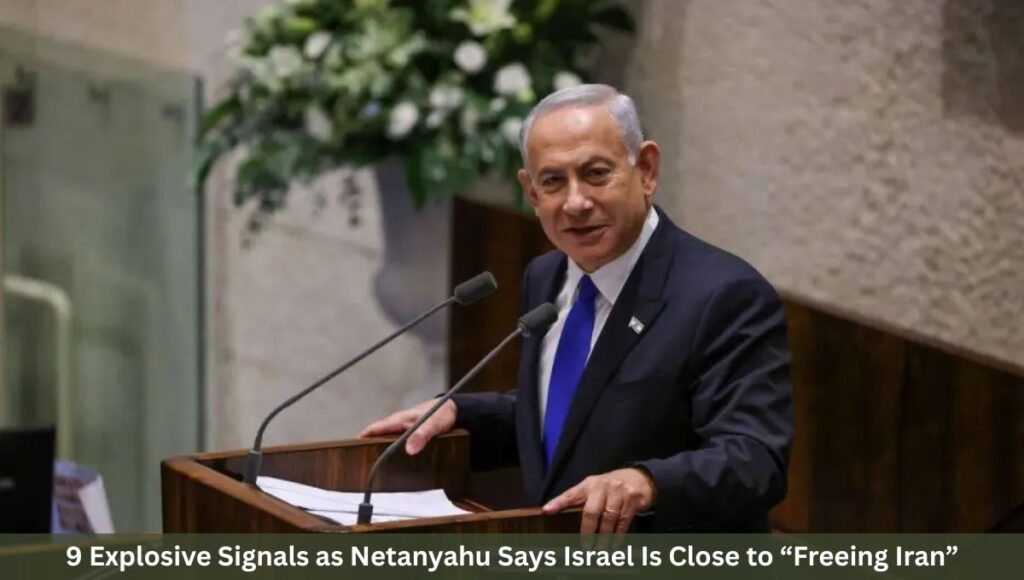
9 Explosive Signals as Netanyahu Says Israel Is Close to “Freeing Iran”
Netanyahu Declares War Will Continue “Without Compromise”
In his address, Netanyahu made clear that Israel’s military operations against Iran will not slow down. “The war against Iran will continue unabated and without compromises,” he said.
The Israeli leader emphasized that the campaign is part of a broader strategy to eliminate what he described as an existential threat to Israel and the wider region.
According to Netanyahu, Iran’s leadership has long sought to develop nuclear weapons and build massive missile arsenals capable of striking Israel and other countries.
“We are facing an extremely evil regime that is plotting to destroy us with atomic bombs and tens of thousands of missiles,” he said.
He argued that Israel had no choice but to act before those capabilities could be fully deployed.
Israel Claims Near-Total Control of Iranian Airspace
One of the most striking claims in Netanyahu’s speech was that Israel and the United States have nearly secured dominance over Iran’s skies.
“We achieved almost complete control over the skies of Tehran,” he said. If accurate, such air superiority would represent a major strategic breakthrough in the conflict.
Control of airspace allows attacking forces to conduct operations with far fewer risks while targeting military infrastructure, missile launch sites, and command centers across the country.
Israeli officials have said that early strikes destroyed large parts of Iran’s air defense systems, enabling Israeli aircraft to operate more freely.
Operation “Rising Lion”
Netanyahu described the ongoing military campaign as Operation Rising Lion, a joint operation between Israel and the United States designed to neutralize Iran’s military capabilities.
“In Operation Rising Lion, we combined forces to remove immediate danger from Israel,” he said. The prime minister said the operation had already achieved several significant military objectives.
According to Netanyahu, Israeli and US forces have destroyed hundreds of Iranian ballistic missile launchers and critical military facilities.
“In the first week, we eliminated the dictator Khamenei and destroyed hundreds of ballistic missile launchers,” he claimed.
These strikes, he argued, have significantly reduced the threat Iran poses to Israel.
Netanyahu Warns the Iranian Regime
Netanyahu’s speech included a direct warning to Iran’s leadership and security forces. He said members of the Islamic Revolutionary Guard Corps (IRGC) were now in Israel’s sights.
“To the Revolutionary Guards operatives: you are also in our crosshairs,” Netanyahu warned. He offered a stark choice to Iranian forces.
“Whoever lays down his weapon, no harm will come to him. Whoever does not do that, his blood is on his head.”
The message appeared designed to encourage defections within Iran’s security apparatus while signaling that Israel intends to continue targeting military leadership.
A Message to the Iranian People
Perhaps the most unusual part of Netanyahu’s speech was his direct appeal to the Iranian public.
Turning to the camera, he told Iranian citizens that the future of their country ultimately depends on them. “To the Iranian people – we seek to liberate Iran,” he said.
However, he added that Israel alone cannot determine the country’s political future. “At the end of the day, liberation from tyranny will depend on you, the Iranian people.”
Netanyahu predicted that if the Iranian population rises against its leadership, relations between Israel and Iran could dramatically improve.
“I believe the day will come when Israel and Iran return to being brave friends,” he said.
Netanyahu Credits Trump for Strategic Partnership
Netanyahu also praised US President Donald Trump for supporting Israel during the conflict.
He described Trump’s leadership as “historic” and said the alliance between the two countries has never been stronger.
“President Trump told me we must stop Iran at any cost from obtaining a nuclear weapon,” Netanyahu said.
He argued that cooperation between Washington and Jerusalem has allowed the two countries to confront Iran’s military threat more effectively.
The Israeli prime minister also suggested that many other countries are quietly supporting Israel’s actions.
“Many Nations Are Turning to Israel”
Netanyahu claimed that governments across the world increasingly recognize Israel’s strategic role in confronting Iran. “Many nations are turning to us for cooperation,” he said.
According to him, these countries see Israel as a reliable partner capable of confronting regional threats. He described Israel as “a lighthouse of power and hope” in a region facing instability.
Netanyahu said that military strength would allow Israel to expand regional peace agreements and economic partnerships in the future.
Warning to Lebanon Over Hezbollah
Netanyahu also issued a strong warning to Lebanon regarding the activities of the Iran-backed militant group Hezbollah.
He said the Lebanese government must enforce the existing ceasefire agreement and disarm the group. “It is your responsibility to disarm Hezbollah,” he said.
If Lebanon fails to act, Netanyahu warned that Hezbollah attacks could trigger severe consequences.
“If you do not do this, Hezbollah’s aggression will have disastrous consequences for Lebanon.”
The warning reflects growing concerns that the conflict could spread further into Lebanon.
The Strategic Shift in Netanyahu’s Leadership
The current conflict also reflects a major shift in Netanyahu’s leadership style.
For many years, the Israeli prime minister favored covert operations and diplomatic pressure rather than open war with Iran.
Israel carried out numerous clandestine sabotage missions targeting Iran’s nuclear program, including cyberattacks and intelligence operations.
However, the October 7, 2023 Hamas attack on Israel marked a turning point. After the massacre, Netanyahu pledged to dramatically reshape Israel’s security strategy.
“As I promised two days after October 7, we are changing the face of the Middle East,” he said in his recent address.
From Covert War to Open Conflict
Before 2024, Israel’s strategy toward Iran focused on containment. That approach relied on sanctions, covert sabotage, and international diplomacy aimed at slowing Iran’s nuclear development.
Netanyahu himself once warned that initiating open war with Iran would be extremely difficult to control. “Ending these kinds of operations is much harder than starting them,” he wrote in his memoir.
But the geopolitical environment shifted dramatically after the Hamas attacks and the subsequent regional escalation.
Israel began targeting Iran’s proxy groups, including Hamas and Hezbollah, and eventually launched direct strikes on Iranian territory.
Critics Once Called Netanyahu Too Cautious
Interestingly, Netanyahu was often criticized in earlier years for being too cautious. Some political rivals argued that he missed opportunities to strike Iran’s nuclear facilities.
In 2014, a senior US official reportedly mocked him as overly hesitant in dealing with Tehran.
Even Donald Trump once suggested that Netanyahu backed away from a planned strike against Iranian commander Qassem Soleimani.
Those criticisms highlight how dramatically Netanyahu’s strategy has evolved.
Personal History and Political Calculations
Netanyahu’s earlier caution was partly shaped by personal history. His older brother, Yonatan Netanyahu, was killed during the famous 1976 Entebbe hostage rescue operation.
That experience deeply influenced the prime minister’s approach to risk and military intervention.
He also witnessed how previous Israeli leaders were politically damaged by prolonged wars, particularly the conflict in Lebanon during the 1980s.
As a result, Netanyahu traditionally favored intelligence operations and diplomatic pressure over large-scale military campaigns.
A Turning Point in Israeli Strategy
The current war with Iran suggests that Netanyahu now believes the strategic environment has changed.
Israeli officials argue that Iran’s expanding missile arsenal and nuclear program created an urgent threat that could not be managed through covert measures alone.
The joint US-Israeli operation launched in February marked the first large-scale direct military confrontation between Israel and Iran.
For Netanyahu, the campaign represents both a strategic gamble and an attempt to reshape regional power dynamics.
Regional Implications
The conflict has already triggered major geopolitical consequences.
Several Middle Eastern countries have been drawn into the confrontation after Iranian attacks targeted US bases and energy infrastructure in the Gulf.
Israel’s operations in Lebanon against Hezbollah have also intensified.
Meanwhile, global energy markets have been shaken by fears that the conflict could disrupt oil shipments through the Strait of Hormuz.
Diplomatic tensions have also increased at the United Nations, where several countries have criticized the expanding war.
What Comes Next
Despite growing international concern, Netanyahu indicated that Israel is preparing for the next phase of the conflict.
He hinted that Israel has “many surprises” planned as part of its broader strategy against Iran.
Analysts believe those plans could involve additional strikes on Iranian military infrastructure, cyber operations, or attempts to destabilize the country’s leadership.
At the same time, the Israeli prime minister suggested that the ultimate outcome may depend on internal developments within Iran.
“If you stand up at the moment of truth,” he told the Iranian people, “the day will come when our nations can live in peace.”
Conclusion
Benjamin Netanyahu’s latest speech underscores how dramatically the conflict between Israel and Iran has escalated.
By claiming near-total control of Iranian airspace and calling on the Iranian public to challenge their government, Netanyahu signaled that Israel’s objectives extend far beyond short-term military gains.
The Israeli leader now appears to be pursuing a strategy aimed at weakening — or potentially transforming — Iran’s political system.
Whether that strategy succeeds or triggers an even wider regional war remains uncertain.
What is clear is that the Middle East is entering one of its most volatile periods in decades, with global security, energy markets, and diplomatic relations all hanging in the balance.
Also Read: 7 Explosive Ways Trump’s Pardon Push for Netanyahu Is Shaking Israel’s Rule of Law
Also Read: Exactly Why Is It that All American Presidents Dance to Bibi’s Tune?
Related Posts:
- 3 Explosive Conditions Iran Sets to End War with US…
- 7 Powerful Facts About Ayatollah Ali Khamenei’s…
- 5 Major Takeaways from the US Supreme Court's…

- 7 Heartbreaking Facts About Venezuela's Earthquake Disaster

- 9 Explosive Claims as Trump Says US Winning Iran War

- 7 Dead in Explosive Iran Protests as Economic Anger…
