
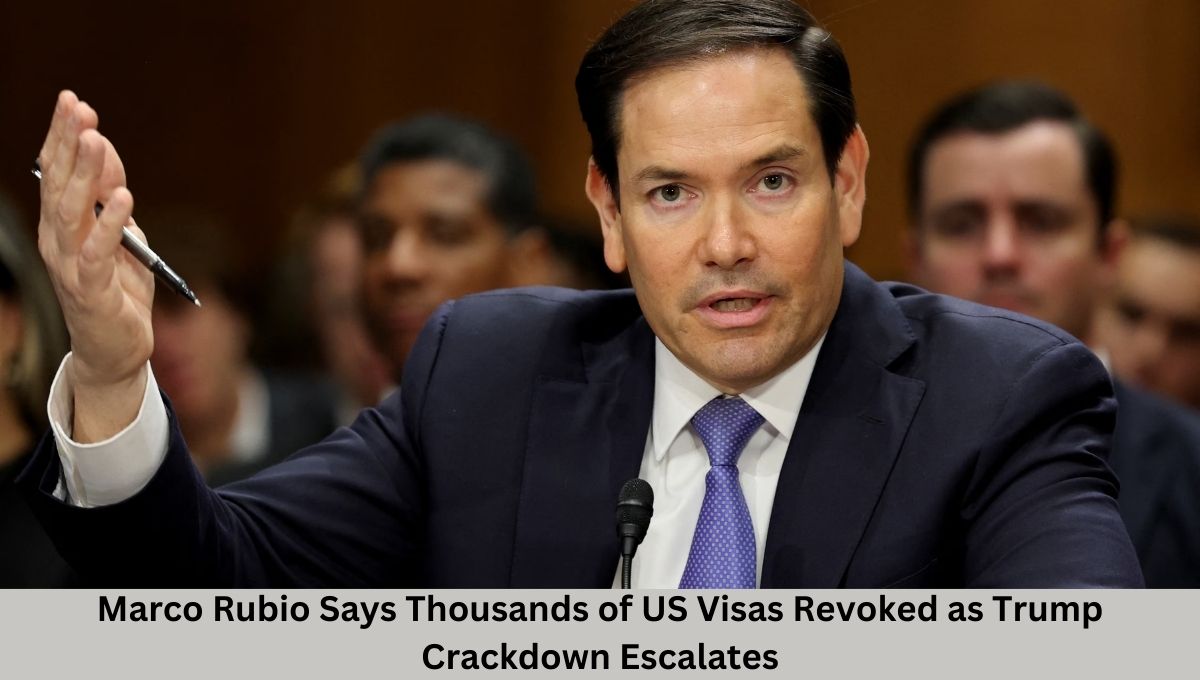
In a fiery Senate hearing on Tuesday, Marco Rubio Says Thousands of US Visas Revoked as Trump Crackdown Escalates. U.S. Secretary of State Marco Rubio revealed that his department has likely revoked thousands of U.S. visas, primarily targeting foreign students and visitors involved in campus protests critical of Israel.
Rubio emphasized that the effort is part of President Donald Trump’s immigration crackdown, a sweeping agenda that has drawn sharp criticism from Democratic lawmakers and civil rights advocates.
Marco Rubio Says Thousands of US Visas Revoked as Trump Crackdown Escalates
Visa Revocations Tied to Campus Protests and Gaza War Criticism
Rubio told the Senate Appropriations Subcommittee on Foreign Affairs that the visa revocations stem from actions deemed contrary to U.S. foreign policy interests.
According to Rubio, “A visa is not a right it’s a privilege,” underscoring his belief that foreign nationals who engage in campus activism or criticize U.S. allies, particularly Israel, should not be granted the privilege of staying in the country.
The crackdown comes amid heightened tensions surrounding student protests against Israel’s military actions in Gaza, with some demonstrations being labeled as disruptive by Republican leaders.
Targeting Students Over Speech: Civil Liberties Groups Raise Alarm
At the center of the backlash is the case of Rumeysa Ozturk, a Turkish doctoral student at Tufts University, who was detained for more than six weeks in an immigration center in Louisiana.
Her offense? Co-authoring an opinion piece critical of her university’s stance on the Israel-Gaza conflict.
Senator Chris Van Hollen (D-MD) strongly condemned Rubio’s actions, accusing the Secretary of State of using national security as a smokescreen to punish free speech.
“This isn’t about national security. It’s about punishing free speech,” Van Hollen charged during the hearing. He also referenced Ozturk’s arrest by “masked agents” and her eventual release after a federal judge ruled in her favor.
Heated Senate Clash: Rubio Defends Revocations Amid Bipartisan Backlash
Rubio defended the policy aggressively, stating that students “came to lead campus crusades, take over libraries, and try to burn down buildings.”
These allegations were quickly dismissed by Van Hollen, who called Rubio’s remarks “pathetic” and compared his behavior to that of Joseph McCarthy during the infamous Communist witch hunts of the 1950s.
“Have you no decency?” Van Hollen asked, echoing the iconic condemnation of McCarthy.
Democratic Senator Jeff Merkley also challenged Rubio on due process violations, warning that arbitrary visa revocations based on predicted behavior violate constitutional protections. “This seems to me an extraordinary violation of due process,” Merkley said.
Legal Experts: Visa Crackdown Faces Court Challenges
Legal analysts suggest that the visa revocation policy could face serious constitutional challenges. Critics argue that targeting individuals based on political expression violates the First Amendment and undermines America’s commitment to human rights and academic freedom.
A growing number of civil liberties organizations and immigration lawyers are rallying behind affected students, claiming that the crackdown disproportionately impacts pro-Palestinian voices on U.S. campuses.
Rubio Unfazed: “There Are More Coming”
Despite the growing controversy, Rubio signaled that the effort is far from over. “We’re going to do more. There are more coming,” he said, reaffirming his commitment to revoking visas of individuals he claims are “disrupting our higher education facilities.”
Rubio emphasized that all visa revocations were personally signed by him, a detail that underscores how central the issue has become in the broader Trump administration policy on immigration and campus activism.
Background: Trump Administration’s Hardline Immigration Agenda
The visa revocation policy is just one facet of President Donald Trump’s broader immigration crackdown, which has focused on ramping up deportations, limiting asylum access, and targeting visa holders deemed hostile to U.S. interests.
While supporters argue that the measures enhance national security, detractors insist that they chill free expression and violate civil liberties.
The administration has particularly targeted student visa holders, green card holders, and those perceived as pro-Palestinian, often conflating criticism of Israel with support for terrorism a claim that has been widely debunked.
Bipartisan Fallout: Van Hollen Regrets Rubio Confirmation
Rubio, a former U.S. Senator from Florida, was confirmed unanimously to his current post a rare act of bipartisanship in a polarized Washington. However, the events of Tuesday’s hearing have led to second thoughts.
Senator Van Hollen expressed deep regret over his vote to confirm Rubio, stating he mistakenly believed they shared a commitment to defending democracy and human rights abroad.
What Comes Next?
With the number of revoked visas now estimated in the thousands and likely to grow, the debate over the limits of executive power, student rights, and free speech is expected to intensify.
Lawsuits are already in motion, and judges will ultimately determine the legality of these actions.
In the meantime, foreign students and scholars are left uncertain and anxious, unsure if expressing political opinions could lead to deportation or detention.
The United States once seen as a global beacon of academic freedom and civil liberty now finds itself at the center of a legal and moral reckoning.
Conclusion: A Defining Moment for Free Speech and Immigration in America
Marco Rubio’s vow to continue revoking student visas marks a significant and controversial development in the United States’ approach to immigration enforcement and free expression on campus.
As critics draw parallels to historical overreach and authoritarianism, the country now faces urgent questions: Who gets to define a threat? And can expressing political opinions still be safe for foreign students in America?
The courts may have the final say but for now, the chilling effect on student activism, academic freedom, and immigration rights is already being felt across U.S. universities.
Also Read: Scoop: State Dept. to use AI to revoke visas of foreign students who appear “pro-Hamas”
Related Posts:
- Trump Administration is Scrutinizing 55 million US…

- Trump’s 2025 Gaza Peace Plan Signing and Historic…

- 5 Powerful Highlights as Trump Lands Second Nobel…

- 9 Explosive Revelations as Trump Declares His Health…
- 7 Shocking Facts About Trump’s $1 Million Gold Card…

- Trump’s 20-Point Gaza Peace Plan Gains Urgent Global…
