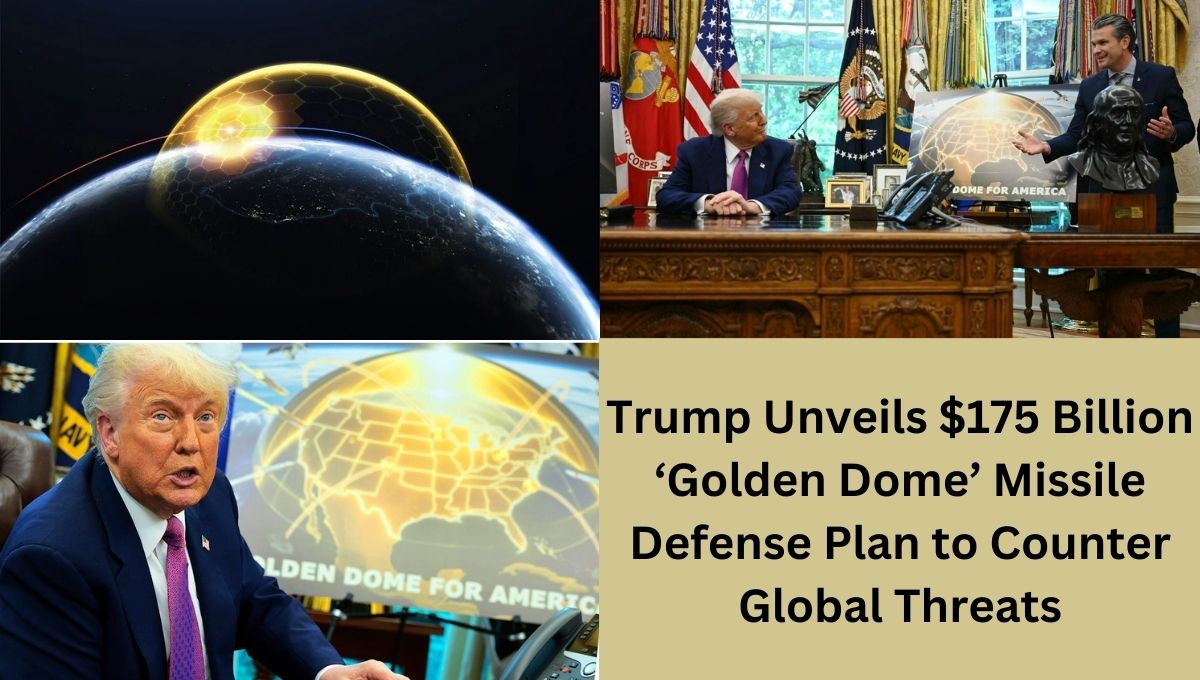
In one of his ambitious and a bold Step Trump Unveils $175 Billion ‘Golden Dome’ Missile Defense Plan to Counter Global Threats. On May 20, 2025, U.S. President Donald Trump unveiled a new missile defense initiative dubbed the “Golden Dome”, a $175 billion project aimed at shielding the American homeland from a wide spectrum of missile and drone threats.
The system, inspired by Israel’s successful Iron Dome, will leverage next-generation space-based technology to counter advanced threats from adversaries such as Russia, China, North Korea, and Iran.
Trump Unveils $175 Billion ‘Golden Dome’ Missile Defense Plan to Counter Global Threats
Trump Announces $175 Billion ‘Golden Dome’ Missile Defense Shield
Speaking from the Oval Office, President Trump emphasized the strategic importance of the plan: “In the campaign, I promised the American people I would build a cutting-edge missile defense shield. Today I am pleased to announce we have officially selected the architecture for this state-of-the-art system.”
According to the president, $25 billion in initial funding has been allocated, with a targeted completion by January 2029, the end of his potential second term.
Trump reiterated the system’s primary purpose is to intercept missiles even if launched from the other side of the world or from space.
Golden Dome: Inspired by Israel’s Iron Dome, But Vastly Superior
Unlike Israel’s Iron Dome which is designed to intercept short-range rockets the Golden Dome missile defense plan aims to deploy hundreds of satellites that can detect, track, and neutralize a wide variety of airborne threats.
These include cruise missiles, ballistic missiles, hypersonic weapons, AI-powered drones, and nuclear threats.
Pentagon Chief Pete Hegseth, who stood alongside the president during the announcement, stated: “Golden Dome is focused on protecting the homeland from all types of modern threats whether they are conventional or nuclear.”
General Michael Guetlein to Lead Project
President Trump named U.S. Space Force General Michael Guetlein as the lead program manager of the Golden Dome initiative.
Guetlein, currently Vice Chief of Space Operations, will oversee the coordination of satellite deployment, sensor integration, and defense system procurement.
The U.S. Department of Defense (DoD) is set to begin testing and contracting for the required missiles, space sensors, and interceptor systems.
Canada Shows Interest in Participation
Interestingly, the president confirmed that Canada has expressed interest in joining the Golden Dome initiative.
“Canada wants to have protection also,” Trump noted.
A statement from Canadian Prime Minister Mark Carney’s office later confirmed ongoing discussions with U.S. officials on joint security efforts and a possible strengthening of NORAD, which could include collaboration on Golden Dome.
Political and Budgetary Hurdles
Despite the grand announcement, the Golden Dome program faces significant political and fiscal challenges.
Democratic lawmakers have raised concerns over the procurement process, particularly given the involvement of Trump allies and high-profile companies like Elon Musk’s SpaceX, Palantir, and Anduril.
Republican lawmakers have proposed bundling the initial $25 billion funding into a larger $150 billion defense package, but the allocation is tied to a contentious reconciliation bill facing resistance in Congress.
Industry experts, such as Tom Karako from the Center for Strategic and International Studies, estimate the full cost could rise to $831 billion over two decades, significantly higher than the official projections.
“The new datapoint is the $175 billion, but the question remains over what period of time? It’s probably 10 years,” said Karako.
Major Contractors and Job Opportunities
Several top U.S. defense companies have already been named as potential collaborators, including Lockheed Martin, L3Harris Technologies, and RTX Corp. These firms are expected to produce many of the early systems from existing production lines.
The project is also expected to generate major economic activity and job creation in states like Alaska, Florida, Georgia, and Indiana.
For example, L3Harris has invested over $150 million in its Indiana facility, where it manufactures Hypersonic and Ballistic Tracking Space Sensor satellites.
A “System of Systems” for Future Warfare
At its core, the Golden Dome represents a transformative shift in how the U.S. approaches national defense.
The project is being designed as a “System of Systems,” integrating autonomous components like AI-powered surveillance, real-time tracking, and precision-guided interceptor systems.
Each layer of the system will communicate with the others through advanced command-and-control networks, making it possible to react in seconds to evolving threats.
“The new autonomous space-age defense ecosystem is more about Silicon Valley than it is about ‘big metal,’” said Senator Kevin Cramer, referring to the increasing role of software companies over traditional defense giants.
Global Backlash: Russia and China Object
Predictably, Russia and China have condemned the Golden Dome missile defense shield as “deeply destabilizing.”
The Kremlin released a statement after high-level talks, warning that the initiative risks turning space into a battlefield and represents a major escalation in the global arms race.
This criticism echoes warnings in the 2022 Missile Defense Review, which outlined the growing danger posed by advanced missiles and drones.
It also warned of North Korea’s and Iran’s expanding capabilities and the threat from non-state actors.
Is Golden Dome a Gamechanger?
If completed as envisioned, Golden Dome could become the centerpiece of the U.S. Integrated Air and Missile Defense (IAMD) strategy.
The inclusion of hypersonic glide vehicles (HGVs) and AI-equipped drones in its target list positions it as a next-generation defense solution unmatched by any system currently in use.
Trump compared the initiative to Ronald Reagan’s “Star Wars” defense plan from the 1980s, but emphasized that the technology is now viable: “Ronald Reagan wanted it many years ago, but they didn’t have the technology. Now we do.”
Final Thoughts
The Golden Dome missile defense plan could redefine U.S. national security and global military balance. However, the road ahead is fraught with budget debates, political opposition, and international pushback.
Whether this $175 billion vision becomes reality will depend heavily on Congressional support, private sector execution, and geopolitical negotiations.
One thing is clear:
President Trump has staked a significant part of his military legacy on making Golden Dome a reality.
Also Read: North Korea Slams Trump’s $175 Billion ‘Golden Dome’ Missile Shield as “Nuclear War in Space”
Also Read: Golden Dome: what Trump should learn from Reagan’s ‘Star Wars’ missile defence system plan
Related Posts:
- Trump’s 2025 Gaza Peace Plan Signing and Historic…

- 5 Powerful Highlights as Trump Lands Second Nobel…

- 7 Shocking Reasons FIFA’s Peace Prize for Trump…

- Dramatic Moments Behind Trump’s Gaza Peace Push and…

- 9 Explosive Revelations as Trump Declares His Health…

- 7 Crucial Insights Into Trump and Xi’s High-Stakes…