7 Explosive Takeaways as India Observes Trump’s Bold Board of Peace — A controversial new global body. India has quietly but significantly entered a new chapter of global diplomacy by attending the first-ever meeting of the Board of Peace, a controversial international body launched by Donald Trump.
While New Delhi stopped short of becoming a full member, its presence as an observer underscores a carefully calibrated strategy: engage without committing, influence without endorsing, and observe without aligning.
This article unpacks what the Board of Peace is, why India chose observer status, what happened at the inaugural meeting, and how this body could reshape the future of Gaza, the United Nations, and global conflict resolution.
7 Explosive Takeaways as India Observes Trump’s Bold Board of Peace
What Is Trump’s Board of Peace?
The Board of Peace is a US-led international mechanism unveiled by President Trump at the World Economic Forum in Davos earlier this year.
Initially framed as a temporary oversight body for the Gaza ceasefire, its ambitions have expanded rapidly.
According to Trump, the Board aims to:
- Oversee Gaza’s post-war reconstruction
- Supervise ceasefire enforcement
- Facilitate disarmament of Hamas
- Coordinate an International Stabilization Force (ISF)
- Potentially address other global conflict “hotspots”
Critics argue the Board’s open-ended mandate, US dominance, and Trump’s personal veto power undermine traditional multilateralism.
India’s Observer Role: A Strategic Signal
India was represented at the Washington meeting by Namgya C. Khampa, Charge d’Affaires at the Indian Embassy in the US.
The choice of representation itself was deliberate—high enough to signal seriousness, restrained enough to avoid overcommitment.
Why Observer Status Matters
India’s observer participation suggests:
- Willingness to engage with new diplomatic frameworks
- Desire to shape outcomes without formal obligations
- Caution toward initiatives that may sideline the United Nations
New Delhi had earlier declined to attend the Board’s launch in Davos, stating it was “reviewing” the US proposal.
Attendance at the first meeting now confirms that review has entered a practical engagement phase.
India’s Official Position on the Board of Peace
Speaking earlier, Indian Foreign Ministry spokesperson Randhir Jaiswal emphasized India’s consistent support for peace initiatives in West Asia, including Gaza.
India’s position rests on three pillars:
- Support for long-term regional peace
- Respect for international law and institutions
- Avoidance of unilateral or personality-driven global mechanisms
By attending but not joining, India keeps its strategic autonomy intact.
Who Attended the First Board of Peace Meeting?
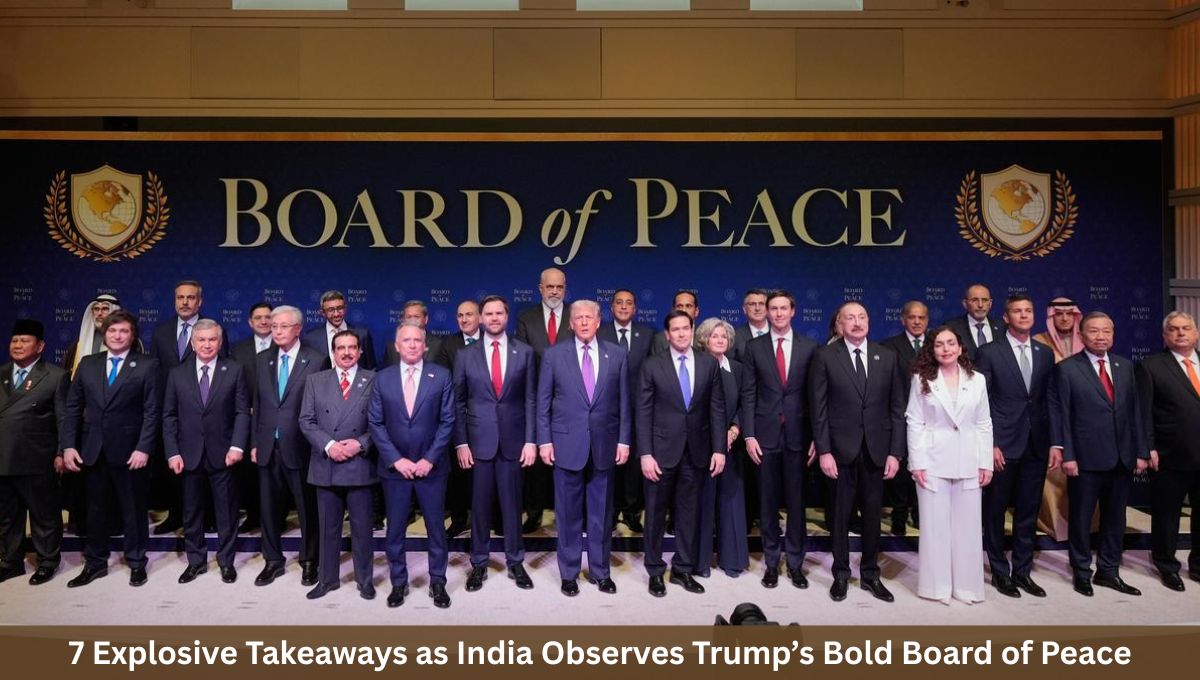
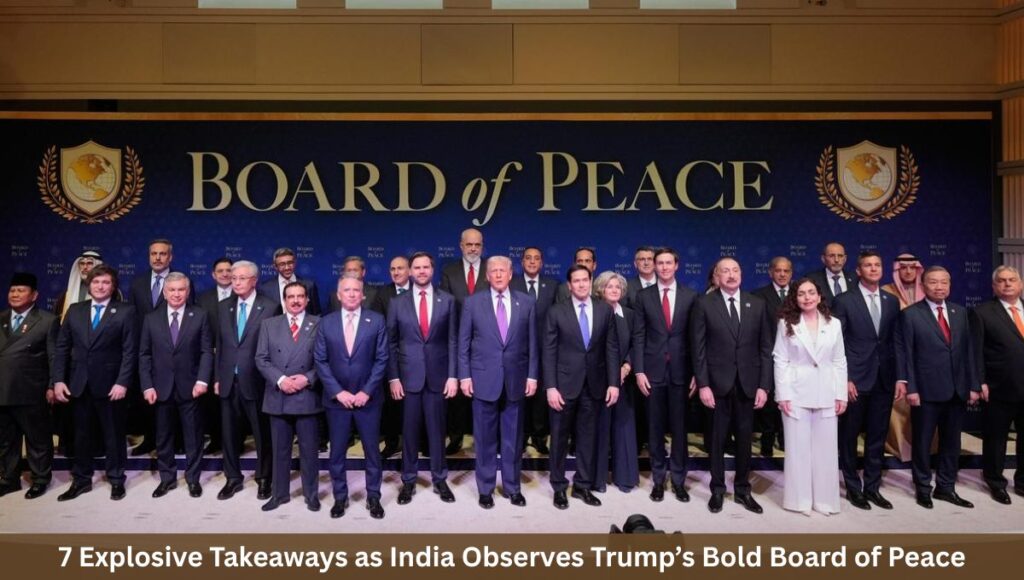
The inaugural meeting, held at the former US Institute of Peace in Washington, brought together officials from nearly 50 countries.
Full Members (27 Countries Include)
- Israel
- Pakistan
- Saudi Arabia
- Qatar
- United Arab Emirates
- Turkey
- Indonesia
- Egypt
- Hungary
- Azerbaijan
- Uzbekistan
- Morocco
Observers (Including)
- India
- European Union
- United Kingdom
- Japan
- Germany
- Italy
- Norway
The sharp divide between members and observers reflects global uncertainty over the Board’s legitimacy and long-term role.
$17 Billion in Pledges: Big Numbers, Big Questions
One of the most dramatic announcements from the meeting was financial.
Gaza Funding Commitments
- $7 billion pledged by nine member states including UAE, Saudi Arabia, Qatar, and Kazakhstan
- $10 billion pledged by the United States
Trump did not clarify:
- Where the US funds would come from
- Whether Congressional approval is required
- How or when the money would be disbursed
Experts note that Gaza’s reconstruction costs are estimated at $70 billion, raising questions about sufficiency and sustainability.
International Stabilization Force: Troops for Gaza
The Board also discussed plans for deploying an International Stabilization Force (ISF) to Gaza.
Countries Committing Troops
- Indonesia (up to 8,000 troops)
- Morocco
- Kazakhstan
- Kosovo
- Albania
Supporting Roles
- Egypt and Jordan to provide training
- US military leadership with international deputies
However, deployment remains conditional on Hamas disarmament, which remains unresolved.
The Hamas Disarmament Dilemma
The Board’s entire framework hinges on a single, unresolved issue:
disarmament of Hamas.
Trump claimed Hamas had “promised” to disarm, a statement Hamas has not publicly confirmed.
Hamas leaders insist:
- Disarmament is tied to Israeli withdrawal
- Ceasefire violations must stop first
Without disarmament:
- Reconstruction cannot begin
- Troop deployment is stalled
- Governance structures remain theoretical
No Palestinian Representation: A Critical Gap
One of the Board’s most criticized aspects is the absence of Palestinian representatives.
Analysts argue:
- No legitimacy without Palestinian voices
- Governance plans risk appearing imposed
- Reconstruction without political inclusion is unsustainable
Even allies of the initiative acknowledge this as a structural weakness.
Is the Board of Peace a Rival to the United Nations?
Trump has openly suggested the Board could “look over” the United Nations, triggering alarm in diplomatic circles.
At the meeting, he attempted to reassure critics:
- Promised closer cooperation with the UN
- Pledged financial support to UN operations
- Claimed the Board would “strengthen” global institutions
Yet concerns remain, especially given:
- Trump’s sole veto power
- Membership fees of up to $1 billion
- Indefinite chairmanship
Why Many Western Allies Stayed Away
Countries such as France, Canada, and Germany declined membership, citing:
- Lack of clarity in mandate
- Risk of undermining multilateral norms
- Over-centralization of authority
France even questioned why the European Commission attended without a mandate from member states.
India’s Calculated Diplomacy: Engage, Observe, Influence
India’s approach mirrors its broader foreign policy doctrine:
- Multi-alignment, not bloc politics
- Engagement without entanglement
- Institutional legitimacy over ad-hoc bodies
As an observer, India can:
- Track developments
- Influence discussions informally
- Avoid reputational risk if the Board falters
What This Means for India–US Relations
India’s attendance also reflects the evolving India–US strategic partnership:
- Willingness to engage US-led initiatives
- Retention of independent decision-making
- Quiet signalling without public endorsement
This balance allows India to cooperate with Washington while maintaining credibility with the Global South and the UN system.
Global Reactions: Skepticism Meets Pragmatism
Experts describe the Board as:
- Ambitious but vague
- Well-funded but poorly defined
- Potentially useful but politically fragile
Many countries appear to view it as the “only game in town” for Gaza relief—participating cautiously while hedging their bets.
Can the Board of Peace Actually Deliver Peace?
The Board’s success depends on:
- Enforcing a real ceasefire
- Securing Hamas disarmament
- Preventing Israeli violations
- Including Palestinians in governance
- Coordinating with—not replacing—the UN
Without these, critics warn the Board risks becoming:
- A performative diplomatic exercise
- A personality-driven institution
- Another failed peace experiment
Conclusion: India Watches, the World Waits
India’s observer presence at Trump’s Board of Peace meeting sends a clear message:
New Delhi is willing to engage, but not blindly commit.
As Gaza remains unstable, the UN’s role uncertain, and Trump’s ambitions expansive, the Board of Peace stands at a crossroads between historic innovation and geopolitical overreach.
For now, India is watching closely—measuring words against actions, pledges against realities, and ambition against accountability.
Also Read: 11 Explosive Facts About Trump’s Gaza “Board of Peace” and India’s Crucial Invite
Also Read: Why joining Trump’s ‘Board of Peace’ could be tricky for India