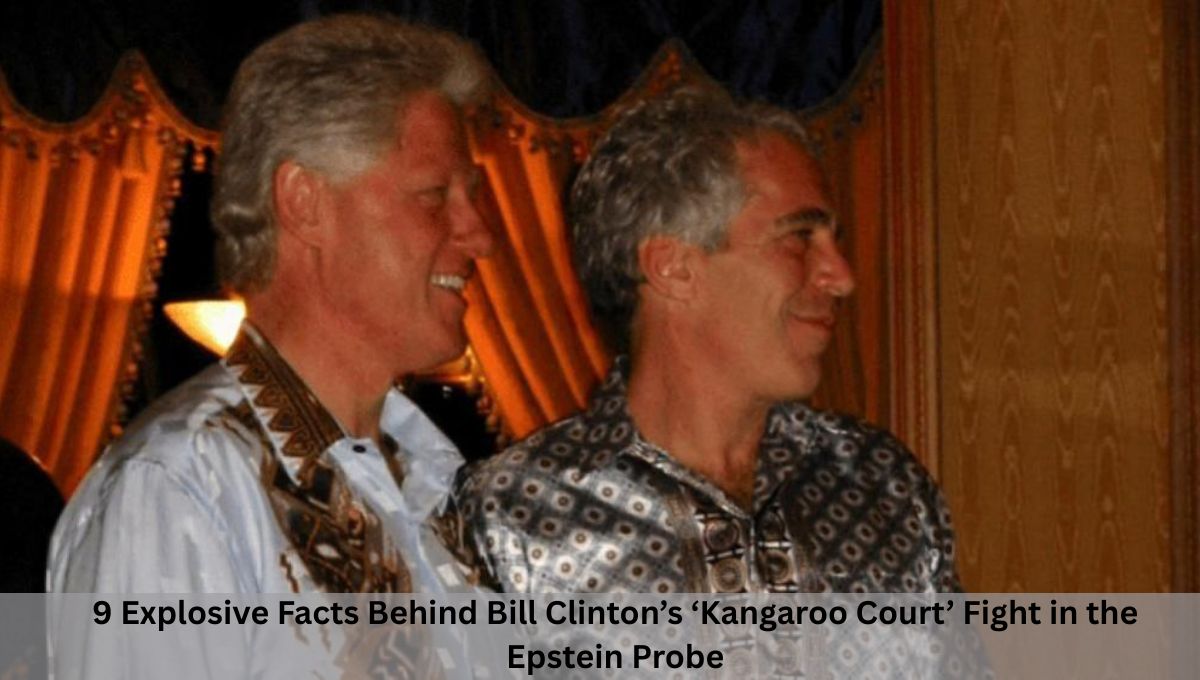
9 Explosive Facts Behind Bill Clinton’s ‘Kangaroo Court’ Fight in the Epstein Probe as global scrutiny intensifies. Former U.S. President Bill Clinton has escalated his confrontation with Republican lawmakers by demanding that his testimony in the House Oversight Committee’s investigation into Jeffrey Epstein be held publicly and on camera, rather than behind closed doors.
Calling the current approach a “kangaroo court,” Clinton accused Republicans of weaponising the Epstein investigation for partisan gain, even as renewed document releases have reignited global scrutiny of Epstein’s powerful network.
The dispute has placed one of America’s most prominent political families at the centre of a debate about transparency, accountability, victims’ rights, and congressional power, drawing worldwide attention far beyond Washington.
This article breaks down what Clinton is demanding, why Republicans are resisting, how Hillary Clinton fits into the standoff, and what the Epstein files mean for global audiences.
9 Explosive Facts Behind Bill Clinton’s ‘Kangaroo Court’ Fight in the Epstein Probe
The Core of the Dispute: Public Hearing vs Closed-Door Deposition
At the heart of the controversy is how Bill Clinton and former Secretary of State Hillary Clinton should testify.
Republicans leading the House Oversight and Government Reform Committee, chaired by Rep. James Comer (R-Kentucky), insist on closed-door depositions, a standard investigative tool in congressional probes. These sessions are recorded and transcribed but conducted without public access.
Bill Clinton, however, has rejected this format as unfair and politically motivated.
“This is not fact-finding. It’s pure politics,” Clinton wrote in a series of posts on X. “I will not sit idly as they use me as a prop in a closed-door kangaroo court.”
Clinton argues that if lawmakers genuinely seek truth and justice for Epstein’s victims, testimony should take place in open hearings, allowing the public to judge credibility firsthand.
Clinton’s Case: Transparency and Victims
Bill Clinton says he has already taken several steps to cooperate:
- Submitted a sworn written statement
- Called for the full public release of Epstein-related files
- Agreed to testify in person before Congress
Yet, he contends Republicans continue to move the goalposts.
“Who benefits from this arrangement?” Clinton asked. “It’s not Epstein’s victims. It’s not the public. It serves only partisan interests.”
For Clinton, the optics matter. A public hearing, he says, would prevent selective leaks, partisan framing, and misrepresentation of testimony — concerns that resonate internationally in an era of deep political polarization.
Hillary Clinton Joins the Push for Public Testimony
Hillary Clinton has echoed her husband’s stance, accusing Republicans of turning accountability into political theatre.
“For six months, we engaged Republicans on the Oversight Committee in good faith,” she wrote on X. “They ignored all of it and turned accountability into an exercise in distraction.”
She directly challenged Chairman Comer:
“You love to talk about transparency. There’s nothing more transparent than a public hearing, cameras on. We will be there.”
Her involvement has further elevated the political stakes, given her former roles as U.S. Secretary of State, First Lady, and presidential candidate.
Republicans Push Back: ‘No Special Treatment’
Republicans reject accusations of partisanship, arguing that closed-door depositions are standard practice and that the Clintons are being treated no differently from other witnesses.
Chairman Comer has been blunt:
“Depositions are always the preferred means of getting information from a witness. Public hearings may be entertaining, but they’re not very substantive.”
Comer has said that transcripts, audio, and video of the depositions will eventually be released, and that public hearings could follow after depositions conclude.
From the GOP perspective, Clinton’s resistance appears less about transparency and more about controlling the narrative.
Threat of Contempt of Congress
The standoff intensified when the committee threatened to hold Bill and Hillary Clinton in contempt of Congress for failing to comply with subpoenas.
Contempt charges, while rare at this level, can carry serious consequences:
- Referral to the U.S. Justice Department
- Potential fines
- Possible jail time, though prosecutions are uncommon
Facing this pressure, the Clintons ultimately agreed to appear for depositions scheduled for February 26 (Hillary Clinton) and February 27 (Bill Clinton) — while continuing to publicly demand open hearings.
Why Bill Clinton Is in the Epstein Files
The controversy stems from Bill Clinton’s documented association with Jeffrey Epstein, the disgraced financier who died in jail in 2019 while awaiting trial on federal sex trafficking charges.
Court records and flight logs show that:
- Clinton flew on Epstein’s private jet multiple times in the early 2000s
- The trips occurred after Clinton left the White House
- Epstein maintained contact with Clinton during that period
Clinton has repeatedly said he knew nothing of Epstein’s crimes, regrets the association, and cut ties before Epstein was charged in 2006.
Importantly, no Epstein survivor has accused Bill Clinton or Hillary Clinton of wrongdoing, and neither has been charged with any crime.
The Epstein Files: Why the World Is Watching
The renewed controversy follows the release of a massive cache of Epstein-related court documents, often referred to as the “Epstein files.”
These include:
- Depositions
- Flight logs
- Emails and investigative records
- Witness testimonies
The documents name a global network spanning:
- Politics
- Business
- Finance
- Academia
- Technology
While inclusion in the files does not imply guilt, the revelations have reignited demands for transparency across multiple countries.
For global audiences, the Epstein case represents a broader reckoning with elite impunity, abuse of power, and failures of institutions meant to protect vulnerable people.
Trump’s Unexpected Defense of Bill Clinton
In a surprising twist, President Donald Trump expressed sympathy for Bill Clinton during a recent interview.
“It bothers me that somebody is going after Bill Clinton. I like Bill Clinton,” Trump said, while adding more reserved praise for Hillary Clinton.
The remarks underscore the unusual political dynamics surrounding the Epstein investigation, where traditional party lines sometimes blur under public pressure.
A Rare Moment: Former Presidents Before Congress
It is extremely rare for former U.S. presidents to testify before Congress.
The last such instance occurred in 1983, when Gerald Ford testified before a Senate subcommittee.
That rarity amplifies the symbolic weight of Bill Clinton’s appearance, regardless of whether it occurs behind closed doors or in public.
Media, Politics, and Public Trust
Clinton’s “kangaroo court” remark has resonated globally because it touches on a broader crisis of trust in democratic institutions.
Supporters argue:
- Closed-door processes invite manipulation
- Public hearings reinforce accountability
Critics counter:
- Depositions are essential for detailed fact-finding
- Public hearings risk grandstanding
The debate mirrors similar controversies in parliaments and legislatures worldwide, from Europe to South Asia.
What Happens Next
As of now:
- The Clintons are scheduled for closed-door depositions
- Republicans maintain control over the format
- Public hearings remain possible but uncertain
Whether testimony is eventually aired live could shape public perception of both the Clintons and the integrity of the investigation itself.
Conclusion: Politics, Power, and the Search for Truth
Bill Clinton’s clash with House Republicans over the Epstein probe is about more than one man’s testimony.
It reflects deeper tensions over how democracies investigate power, how victims are honoured, and how truth is established in an age of polarization.
For global audiences, the episode offers a window into the American political system — its strengths, its flaws, and its ongoing struggle to balance transparency with process.
Whether held behind closed doors or under the glare of cameras, the testimony will remain a pivotal chapter in the long and troubling legacy of Jeffrey Epstein.
Also Read: 16 Files Vanish: Explosive Epstein Documents Spark Victims’ Fury
Also Read: Former President Bill Clinton makes case for public hearing in House Epstein probe