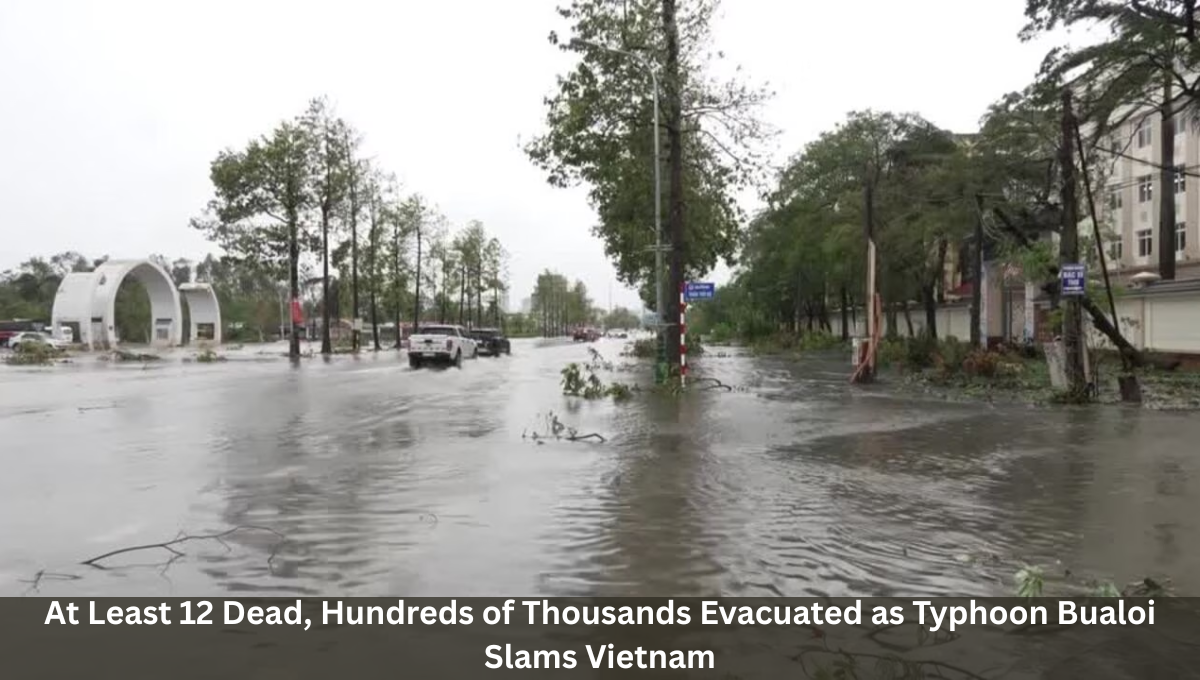
Winds up to 133 km/h, At Least 12 Dead, Hundreds of Thousands Evacuated as Typhoon Bualoi Slams Vietnam. Typhoon Bualoi, the 10th major storm to hit Vietnam in 2025, made landfall early Monday, unleashing destructive winds, torrential rains, and massive waves that caused flooding, power outages, and widespread evacuations. At least 12 people have been confirmed dead, and 17 remain missing, according to state media. The storm arrived with winds up to 133 km/h (83 mph) and waves towering as high as 8 metres (26 feet), before weakening into a tropical storm that moved inland toward Laos.
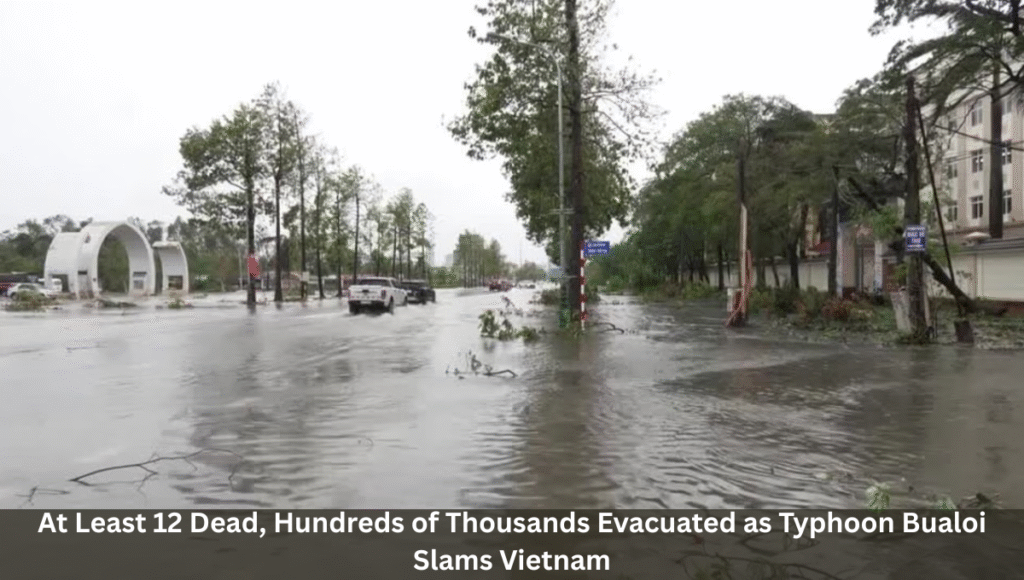
At Least 12 Dead, Hundreds of Thousands Evacuated as Typhoon Bualoi Slams Vietnam
Widespread Destruction as Storm Strikes
Authorities reported that the storm swept away temporary bridges, submerged city streets, and destroyed homes across several provinces. Floodwaters cut off access to highland communities, leaving many residents stranded without power or communication.
In Hue City, Thanh Hoa, and Ninh Binh, strong winds tore off roofs and collapsed homes. Vehicles were submerged in flooding cities, and hundreds of fishing boats were stranded.
In Quang Tri province, a fishing boat lost its anchor ropes, leaving nine crew members adrift; only four managed to swim ashore, while the rest remain missing. In Gia Lai province, families reported losing contact with eight people who were on a fishing trip.
State media confirmed that over 347,000 households lost electricity just before the storm’s landfall.
Evacuations on an Unprecedented Scale
Vietnam’s government responded with one of its largest evacuation efforts in years. More than 250,000 residents were relocated from vulnerable coastal and low-lying areas.
In Da Nang, the country’s largest city, over 210,000 residents were moved to safer ground, while in Hue, more than 32,000 coastal residents were evacuated.
In Ha Tinh, a key industrial hub, authorities relocated 15,000 residents to schools and medical centers converted into emergency shelters.
Prime Minister Pham Minh Chinh called for the “highest level of readiness”, warning that the typhoon’s fast movement and wide impact zone could trigger simultaneous disasters such as flooding, flash floods, landslides, and coastal inundation.
Also Read: Airports shut, thousands flee as storm slams Vietnam
Airports Shut, Transport Paralyzed
To minimize risks, Vietnam shut down four major coastal airports, including Danang International Airport. Hundreds of flights were either cancelled or delayed, stranding thousands of travelers.
Road networks also faced severe disruption. Flooded highways and collapsed bridges cut off rescue teams from reaching several isolated communities.
Fishing boats across central and northern regions were ordered back to harbor, while residents in coastal towns secured vessels to withstand high tides and storm surges.
Voices from the Ground
For residents, Typhoon Bualoi was a terrifying ordeal.
Nguyen Tuan Vinh, from Nghe An province, told Reuters:
“It was one of the strongest storms I’ve experienced. The winds shook everything.”
Another resident, Ho Van Quynh, described a sleepless night:
“I stayed awake the whole night fearing the door would be pulled off by strong winds.”
In Quang Tri, Le Hang recounted to VNExpress:
“No one dares to go out. The gusts were terrible, roofs were ripped off, and the rain just kept pounding.”
Deaths and Missing Persons
State media and rescue officials confirmed at least 12 fatalities. Among the dead was a 16-year-old boy in Quang Tri province, killed by electrocution during heavy rainfall while traveling on a rural road.
Search and rescue teams are still looking for 17 missing fishermen across several provinces. In Ho Chi Minh City, three fishermen went missing after their vessel sank, though eight others were rescued.
In Gia Lai, families have lost contact with another eight fishermen. Rescue boats have been deployed, but rough seas continue to complicate efforts.
Impact Beyond Vietnam
Typhoon Bualoi struck just days after battering the Philippines, where it killed at least 20 people, mostly from drowning and falling trees, and forced 23,000 families into evacuation shelters.
The storm also came on the heels of Typhoon Ragasa, which wreaked havoc in the northern Philippines, Taiwan, and China, leaving at least 28 people dead.
Economic and Infrastructure Damage
While full assessments are ongoing, early reports suggest damages could reach billions of dollars. The Ministry of Agriculture and Rural Development revealed that Vietnam already suffered $3.3 billion in losses from Typhoon Yagi in 2024, and Bualoi could push 2025 losses even higher.
Industrial hubs like Ha Tinh, known for steel production, face disruptions due to flooding and mass evacuations. Power outages affecting hundreds of thousands of households further strained businesses and hospitals.
Climate Change Connection
Scientists warn that climate change is intensifying storms across Southeast Asia. Warmer ocean temperatures provide tropical storms with more fuel, making them stronger, wetter, and faster.
Dr. Hoang Phuc Lam, deputy director of Vietnam’s National Center for Hydro-Meteorological Forecasting, said Bualoi’s unusual speed and broad impact zone reflected a growing trend of unpredictable and extreme storms.
The storm underscores warnings from climate scientists that typhoons in Asia are becoming deadlier, putting coastal communities, infrastructure, and food systems at greater risk.
Government and Military Response
Vietnam mobilized nearly 100,000 military personnel to assist with evacuations, rescue missions, and recovery efforts. Troops worked with local authorities to reinforce coastlines using sandbags, bamboo stakes, and stones, especially in Da Nang and Hue.
Medical teams were dispatched to temporary shelters, while the Ministry of Health urged hospitals to prepare for an influx of storm-related injuries.
Authorities also stockpiled food, drinking water, and relief supplies in storm-hit provinces.
A Nation on Alert
This year alone, more than 100 people have been killed or gone missing in Vietnam due to natural disasters, highlighting the country’s extreme vulnerability to storms, floods, and landslides.
Residents, already shaken by the deadly July 2025 Ha Long Bay boat tragedy that killed at least 37 during a sudden storm, say resilience is wearing thin.
“I feel anxious, but I hope we will survive this one too,” said Nguyen Cuong, a 29-year-old resident of Ha Tinh, referencing the recent Typhoon Kajiki.
Regional Storm Season Intensifies
With its long coastline facing the South China Sea, Vietnam is among the countries most exposed to tropical storms. Typhoon Bualoi is just the latest in a string of powerful storms slamming Southeast Asia in 2025, reflecting a troubling regional trend.
Experts caution that as global warming accelerates, storms will continue to bring heavier rainfall, faster winds, and rising death tolls, demanding urgent investment in disaster preparedness and climate adaptation.
Conclusion
Typhoon Bualoi has left Vietnam grappling with deadly floods, collapsed homes, power outages, and mass evacuations. With at least 12 confirmed dead, 17 missing, and hundreds of thousands displaced, the storm is another reminder of the increasing severity of climate-fueled disasters in Southeast Asia.
As rescue operations continue and recovery begins, Vietnam faces not just the immediate challenge of rebuilding but also the longer-term task of strengthening climate resilience for the future.
Also Read: Texas Flash Floods Kill 24; 23 Girls Missing from Camp Mystic as Guadalupe River Surges