
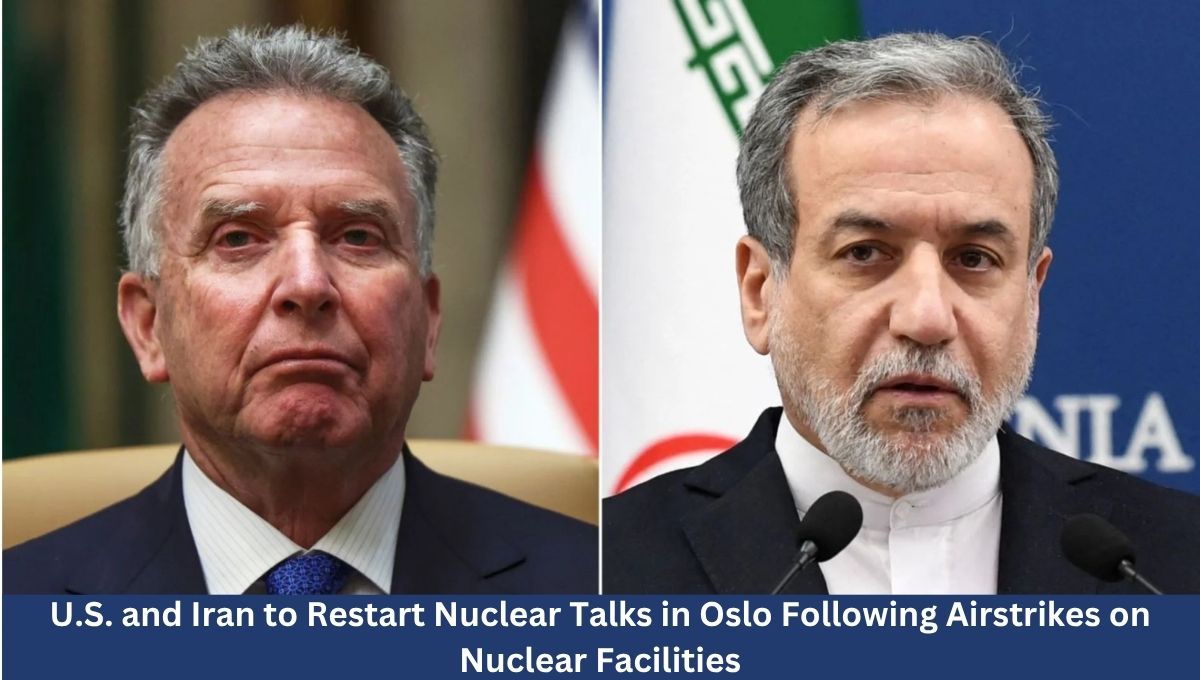
Next week U.S. and Iran to Restart Nuclear Talks in Oslo Following Airstrikes on Nuclear Facilities. The United States and Iran are reportedly set to resume nuclear negotiations next week in Oslo, Norway, in what would mark the first high-level engagement since a series of U.S. airstrikes on Iranian nuclear facilities last month.
According to a report by Axios, White House envoy Steve Witkoff is expected to meet Iranian Foreign Minister Abbas Araghchi in an attempt to revive the stalled nuclear talks. The reported meeting comes amid heightened tensions and deepening mistrust, as Iran has suspended cooperation with the International Atomic Energy Agency (IAEA) and is threatening to withdraw from the Non-Proliferation Treaty (NPT) both key components of international nuclear oversight.
U.S. and Iran to Restart Nuclear Talks in Oslo Following Airstrikes on Nuclear Facilities
Background: U.S. Strikes Rock Iran’s Nuclear Sites
The push for new diplomacy follows the June 22 U.S. airstrikes that targeted Iran’s major nuclear facilities in Fordow, Natanz, and Isfahan.
The Pentagon deployed 14 GBU-57 “bunker buster” bombs and over 30 Tomahawk cruise missiles in what was described as one of the most forceful attacks on Iran’s nuclear infrastructure to date.
U.S. President Donald Trump justified the action by claiming it had “set back Iran’s nuclear program by decades.” However, IAEA chief Rafael Grossi countered that assessment, stating Iran could resume uranium enrichment within months.
“They suffered a lot of damage from the military attack, but they also realized they could survive such an attack,” said Jeffrey Lewis, a nuclear arms expert at the Middlebury Institute of International Studies.
Iran’s Retaliation: Ends Cooperation with IAEA
In a retaliatory move, Iranian President Masoud Pezeshkian approved a parliamentary law suspending cooperation with the IAEA, citing the agency’s failure to condemn Israeli and U.S. aggression.
The decision, backed by Iran’s constitutional watchdog, means that international inspections of Iran’s nuclear sites are now suspended, significantly reducing transparency.
Iranian Foreign Minister Abbas Araghchi criticized the IAEA in a post on X (formerly Twitter):
“After years of cooperation that led to the closure of the ‘possible military dimension’ file, Iran is once again unfairly accused of non-compliance.” He added that European powers (E3) were taking “malign action” instead of working diplomatically.
Concerns Over Enriched Uranium Stockpiles
The U.S. Defense Department has said that Iran’s 60% enriched uranium stockpile, estimated at 400 kilograms, is now inaccessible due to the airstrikes. However, experts question whether the most sensitive materials were even stored at the bombed sites.
“Most of the enriched uranium was not at Fordow,” said Lewis. “It’s typically transported to a second location near Isfahan.”
With Iran now refusing IAEA inspections, the exact status of the uranium is unknown — a development that has sparked alarm among nuclear watchdogs and diplomats alike.
Diplomatic Channels Reopen Despite Escalation
Despite recent hostilities, both nations are making tentative diplomatic overtures. Iranian Foreign Ministry spokesman Esmaeil Baghaei confirmed “backchannel efforts” involving regional intermediaries like Oman, Qatar, and Saudi Arabia.
“Diplomacy must not be abused as a tool for psychological warfare,” Baghaei said in an interview with Sky News. “The U.S. must show it truly wants peace.”
Baghaei also blamed the U.S. for supporting what he called “Zionist aggression” during sensitive periods of past nuclear negotiations.
Trump Open to Talks: ‘Let Them Be a Country Again’
President Donald Trump has signaled his willingness to engage directly with Tehran. Speaking to reporters at Joint Base Andrews, he said:
“Iran does want to speak. I think they’d like to speak to me, and it’s time they do. We’re not looking to hurt them. We’re looking to let them be a country again.”
Trump’s remarks follow a meeting with Saudi Defense Minister Prince Khalid bin Salman, who reportedly discussed de-escalation efforts and back-channel diplomacy.
This follows Trump’s earlier public claim that no uranium could have been moved from the sites before the airstrikes, suggesting his administration believes Iran’s capabilities are severely impaired a claim yet to be confirmed independently.
Nuclear Experts Warn of Risky Precedents
While some U.S. officials praise the effectiveness of the military strikes, nonproliferation experts are concerned that such aggressive tactics could have the opposite effect.
An ABC News report highlighted fears that Iran, facing sabotage and military pressure, could abandon peaceful avenues entirely and pursue nuclear weapons more aggressively.
There is also growing speculation that Iran may withdraw from the NPT, a cornerstone treaty that restricts nuclear weapons development to recognized nuclear states.
“If Iran exits the NPT, global nuclear diplomacy will face a massive blow,” warned Hamid Reza Azizi of the Science and Policy Foundation in Berlin.
JCPOA: Dead or Dormant?
The Joint Comprehensive Plan of Action (JCPOA) the landmark 2015 nuclear deal has been largely in limbo since the U.S. withdrawal in 2018 under the Trump administration.
Iran began reducing its commitments a year later and now refuses to fully report its activities to the IAEA.
While European leaders have called for renewed engagement, progress has been minimal. France, Germany, and the UK the so-called E3 are reportedly coordinating with the U.S. ahead of the Oslo talks, but skepticism runs deep.
“Diplomacy is not dead, but it is on life support,” said one EU diplomat familiar with the preparations.
Iran’s Strategic Position: Damaged, But Not Defeated
According to satellite data and intelligence assessments, the U.S. strikes damaged large portions of Iran’s underground facilities, but failed to fully eliminate its nuclear infrastructure.
President Trump insists the strikes were successful and “surgical,” but arms control analysts say Iran’s technical capabilities remain largely intact though some delays are expected.
“The program is bruised, but not broken,” said an unnamed senior U.S. intelligence official.
Regional Implications: Saudi Arabia’s Growing Role
The reported meeting between Saudi Defense Minister Prince Khalid bin Salman and President Trump signals Riyadh’s increasing influence in the nuclear standoff.
Saudi Arabia has played an informal mediating role in past U.S.-Iran tensions and may again help bridge the gap.
Sources say Saudi officials are urging restraint, concerned that a broader conflict could destabilize Gulf trade routes and energy exports.
What to Expect in Oslo
The planned Oslo talks, while not yet officially confirmed, could be pivotal. If Steve Witkoff and Abbas Araghchi meet as expected, it would be the first direct engagement between U.S. and Iranian officials since the military escalation.
The key issues on the table:
- Restoration of IAEA inspections
- Limits on uranium enrichment
- Recommitment to JCPOA terms
- Lifting of U.S. sanctions
- Security guarantees for Iran’s nuclear sites
“This is a moment where diplomacy and force are colliding,” said Middle East policy analyst Randa Slim. “Both sides are testing the limits.”
Conclusion: High Stakes, Fragile Hopes
The upcoming nuclear talks in Oslo offer a rare chance to reduce tensions between Washington and Tehran. But with trust broken, inspections halted, and nuclear progress unchecked, the path forward is treacherous.
Diplomacy may not end the confrontation overnight, but experts agree it is the only sustainable way to prevent a nuclear-armed Iran and avoid another war in the Middle East. As President Trump weighs his options, the world watches hoping dialogue will triumph over devastation.
Also Read: Israel’s Airstrikes on Iran Shatter U.S. Nuclear Talks: Diplomacy in Crisis
Also Read: Putin urges Iran to accept ‘zero enrichment’ nuclear deal with US – Axios
Related Posts:
- 7 Powerful Facts About Ayatollah Ali Khamenei’s…
- 3 Explosive Conditions Iran Sets to End War with US…
- 9 Explosive Claims as Trump Says US Winning Iran War

- Iran Defiant on Nuclear Enrichment Despite US-Israel…
- 5 Major Takeaways from the US Supreme Court's…

- 11 Explosive Warnings as Trump Vows to ‘Knock the…
