
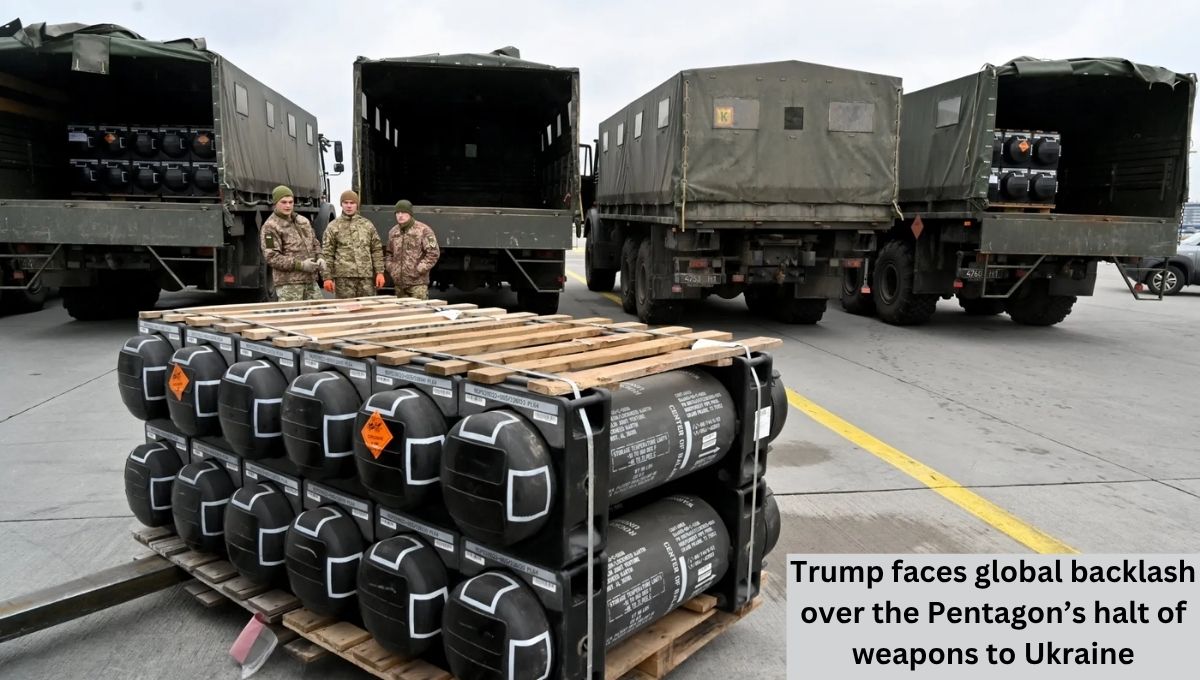
Amid concerns over Russian gains in the ongoing war, Trump faces global backlash over the Pentagon’s halt of weapons to Ukraine. The Trump administration is under mounting domestic and international scrutiny following a Pentagon decision to pause key weapons shipments to Ukraine, citing concerns over U.S. military stockpiles and national readiness.
The unexpected move has triggered strong backlash from lawmakers, diplomats, military experts, and Ukrainian leaders, who warn the decision could embolden Russia’s military campaign and severely weaken Ukraine’s air defense capabilities. The announcement, confirmed by Pentagon spokesperson Sean Parnell on Wednesday, comes amid an internal review of U.S. munitions allocations. The pause affects some of Ukraine’s most critical defense supplies including Patriot missile interceptors, Howitzer munitions, grenade launchers, and Stinger air-defense systems, according to reports from NBC, Politico, and Reuters.
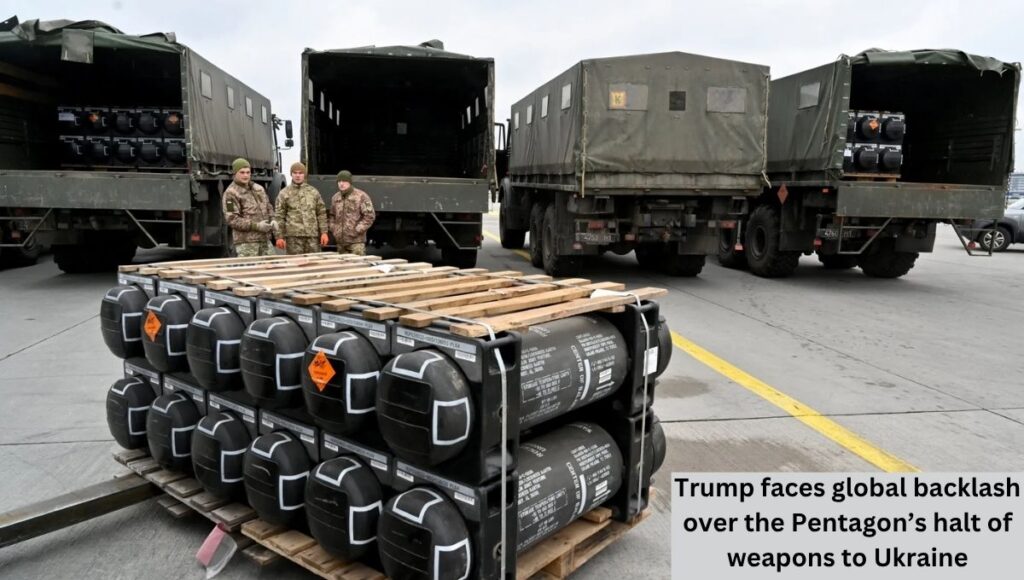
Trump faces global backlash over the Pentagon’s halt of weapons to Ukraine
What Prompted the Pentagon’s Pause?
Pentagon officials say the halt is part of a broader strategic evaluation of U.S. defense resources. Parnell emphasized the Pentagon’s responsibility to prioritize national security amid growing global threats.
“We’re always assessing our munitions and where we’re sending them,” Parnell said. “We can’t give weapons to everybody all around the world.”
Pentagon policy chief Elbridge Colby, who ordered the review, said the decision is about preserving U.S. force readiness.
“The department is rigorously adapting its approach to supporting Ukraine while maintaining our ability to meet defense priorities elsewhere,” Colby said.
White House: ‘America’s Interests Come First’
Echoing the Pentagon’s reasoning, White House Deputy Press Secretary Anna Kelly emphasized that the move is not an abandonment of Ukraine, but a recalibration of U.S. defense priorities.
“It’s about putting America’s interests first,” she said. “We are making smart, strategic decisions to avoid compromising U.S. security.”
Despite these reassurances, the pause has already shaken Kyiv’s leadership and raised alarm among European allies, many of whom rely on continued U.S. leadership in countering Russian aggression.
Ukraine: The Pause Encourages Russian Aggression
Ukraine’s reaction was swift and pointed. The Ukrainian Foreign Ministry summoned the acting U.S. envoy in Kyiv, John Ginkel, in an urgent diplomatic meeting a rare gesture typically reserved for adversarial nations.
The ministry issued a strongly worded statement, warning: “Any delay in military support will only encourage the aggressor to continue war and terror, rather than seek peace.”
Ukrainian President Volodymyr Zelenskyy, who is expected to hold a high-stakes call with President Donald Trump, said both governments are now working to “clarify the details on supplies.”
Ukraine’s Air Defense in Critical Condition
The timing of the pause couldn’t be more precarious. In June, Russia launched over 500 drones and dozens of ballistic and cruise missiles in its largest aerial campaign since 2022.
Civilians were killed in multiple Ukrainian cities, and the strain on Ukraine’s air defense systems is showing.
“Without continued U.S. support, defending against these attacks becomes exponentially harder,” a senior Ukrainian military official told AFP.
Patriot missile systems, which intercept fast-moving ballistic threats, are a cornerstone of Ukraine’s urban air defense and their supply has now been disrupted.
Lawmakers and Experts Slam the Move
The decision drew immediate criticism from U.S. lawmakers and foreign policy experts. Senator Richard Blumenthal (D-CT) argued:
“There are threats in the Indo-Pacific and the Middle East, but the solution is to produce more, not withhold weapons from Ukraine.”
Former U.S. Ambassador to Ukraine John Herbst said the move undermines recent commitments Trump made during the NATO summit to strengthen alliance capabilities.
Critics also questioned the justification that U.S. stockpiles are running dangerously low.
Former National Security Adviser Jake Sullivan wrote in The New York Times that much of Ukraine’s weaponry comes from the Ukraine Security Assistance Initiative (USAI) a program that sources weapons directly from manufacturers, not U.S. reserves.
“This looks more like a political decision than a logistical necessity,” Sullivan wrote. “The administration may not want to say it, but the reality appears to be that the president is winding down U.S. security assistance to Ukraine.”
Trump’s Balancing Act: Readiness vs. Responsibility
President Trump has walked a tightrope between pledging support for Ukraine and insisting on a policy of “America First.”
“Biden emptied out our whole country giving them weapons,” Trump said earlier this week. “We have to make sure we have enough for ourselves.”
He added that military aid to Ukraine is not being completely cut, saying: “We’re giving weapons we’ve given so many but we are giving weapons.”
His remarks have only deepened the confusion, especially after he suggested during the NATO summit that additional Patriot systems might still be sent.
Russia Celebrates as Ukraine Scrambles
Unsurprisingly, the Kremlin greeted the Pentagon’s announcement with satisfaction. Kremlin spokesman Dmitry Peskov declared:
“The fewer the number of weapons delivered to Ukraine, the closer the end of the special military operation.”
Russia has interpreted the U.S. decision as a sign of waning Western unity. President Vladimir Putin told French President Emmanuel Macron in a rare phone call that the West “ignored Russia’s security concerns for years.”
Moscow has recently claimed full control of Ukraine’s Luhansk region, though this remains unverified by independent observers.
Russian forces continue to bombard key Ukrainian cities, while demanding Kyiv cede more territory in exchange for any ceasefire.
European Allies Struggle to Fill the Gap
While European nations have provided billions in aid, they lack the production capacity to match U.S. supply lines. Fedir Venislavskyi, a Ukrainian lawmaker, called the U.S. pause “painful” and “unfortunate.”
Czech President Petr Pavel, a former top NATO general, told BBC Russian that his country’s future support is uncertain.
“I can’t guarantee continued support. It depends on who wins the next election,” he said. A CSIS report in May warned that Europe has made only modest progress in scaling up defense production and still heavily relies on U.S. logistics and manufacturing capabilities.
Strategic Pause or Start of a Withdrawal?
The Pentagon insists the pause is temporary. State Department spokeswoman Tammy Bruce emphasized: “This is not a cessation of all support. It’s one event, and we’ll address future decisions case by case.”
Still, many analysts fear this could mark the beginning of a broader withdrawal from Ukraine, as Trump re-evaluates U.S. military commitments overseas.
Retired Rear Admiral Mark Montgomery from the Foundation for Defense of Democracies warned: “Vladimir Putin will view this Pentagon decision as a green light to escalate.”
Public Reaction: A Nation Left Vulnerable
On the streets of Kyiv, anxiety is growing. Igor Stambol, a 36-year-old resident, told AFP:
“We had gotten used to seeing America as a country of values. But now, there’s a fear we’re being abandoned.”
Four major attacks struck Kyiv in June, killing more than 40 civilians and injuring many more. Ukrainian defenses were barely able to fend off waves of Shahed-136 drones and cruise missiles systems that U.S. aid helps neutralize.
Looking Ahead: A Call That Could Decide Ukraine’s Fate
All eyes are now on the upcoming call between President Trump and President Zelenskyy. According to the Financial Times, the Ukrainian leader will ask for clarification and press for renewed arms commitments.
The outcome of that conversation may determine whether this pause is truly strategic and short-term or if it represents a longer-term scaling back of U.S. involvement in the conflict.
Conclusion: Ukraine’s Fate Hinges on Shifting U.S. Calculations
As Ukraine’s war against Russia enters its fourth year, the Pentagon’s pause on weapons shipments marks a critical turning point. While Trump administration officials insist it’s a tactical reassessment, allies fear it signals fatigue, retreat, or a change in America’s strategic vision.
For Ukraine, the stakes couldn’t be higher. Its ability to defend its people, cities, and sovereignty remains tightly bound to Washington’s decisions and those decisions are now caught in the crosswinds of domestic politics and global power plays.
Also Read: Rubio, Lavrov Hold Candid Talks as Ukraine War Escalates
Also Read: Why the Pentagon’s ‘pause’ on weapons to Ukraine backfired
Related Posts:
- Trump’s 20-Point Gaza Peace Plan Gains Urgent Global…

- China Hosts SCO Summit 2025 and Military Parade as…

- Israel–Hamas Ceasefire Under Strain: 4 More Hostage…

- 7 Explosive Reactions as Trump Threatens Military…

- 7 Alarming Facts About Super Typhoon Fung-wong

- Putin’s Shocking Risks Ahead of Trump–Hungary Summit 2025
