Nuclear diplomacy derails as Israel’s Airstrikes on Iran Shatter U.S. Nuclear Talks: Diplomacy in Crisis. The sixth round of indirect U.S.-Iran nuclear talks, which was scheduled for Sunday in Muscat, Oman, has been abruptly canceled following a massive escalation between Israel and Iran. The breakdown in diplomacy comes after Israel launched hundreds of airstrikes inside Iran, targeting military and nuclear infrastructure. Iran has responded with missile attacks on Israeli cities, heightening fears of an all-out regional war in the Middle East.
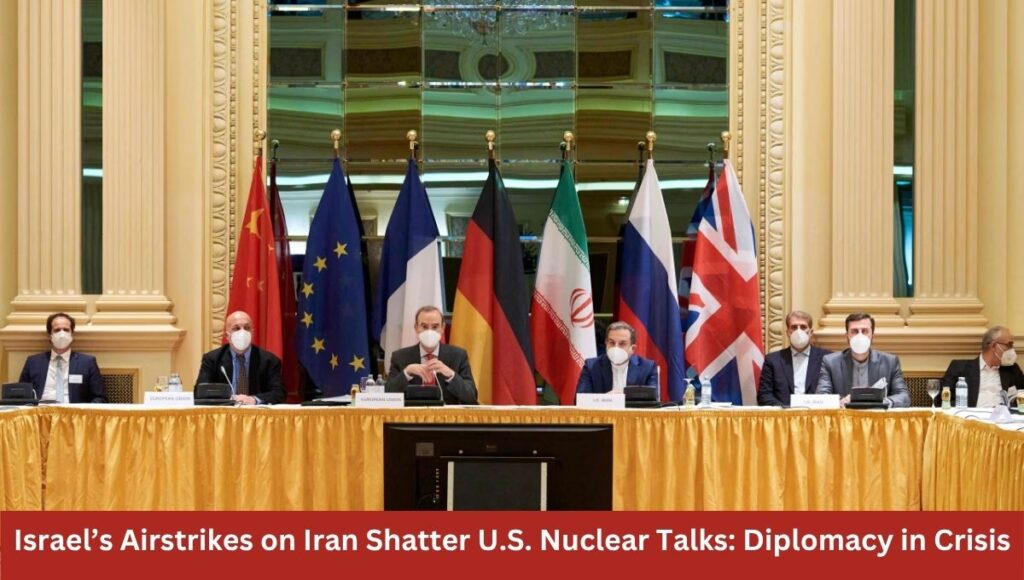
Israel’s Airstrikes on Iran Shatter U.S. Nuclear Talks: Diplomacy in Crisis
Israel’s Largest Military Operation Inside Iran
On Friday and Saturday, Israel carried out its most expansive military strike ever on Iranian soil, with over 400 confirmed airstrikes, including at least 40 in Tehran alone. Israeli fighter jets reportedly targeted nuclear sites in Natanz and Isfahan, alongside command-and-control centers and weapons depots.
Satellite images and statements from the U.N. nuclear watchdog chief Rafael Grossi confirmed above-ground damage at Natanz, though key underground uranium enrichment systems were mostly left intact. Israeli intelligence sources estimated that it could take Iran “more than a few weeks” to restore critical operations.
The targeting of Iran’s nuclear infrastructure was reportedly a part of a “pre-planned operation” aimed at crippling Iran’s nuclear ambitions a claim that Tehran vehemently denies, maintaining that its nuclear program is for civilian purposes only.
Iran Suffers Heavy Military Losses
Among the dead in the Israeli strikes were several of Iran’s top military commanders, including Gen. Mohammad Bagheri, head of Iran’s armed forces, Gen. Hossein Salami, the powerful commander of the Revolutionary Guard, and Gen. Amir Ali Hajizadeh, who oversaw Iran’s missile and aerospace programs.
Iran quickly appointed Gen. Majid Mousavi as the new aerospace division chief, but the deaths have left a visible void in Iran’s military leadership. Analysts describe it as the most devastating blow to Iran’s command structure in over a decade.
Iran Retaliates With Missile Barrage on Israel
In response, Iran launched waves of ballistic missiles and drones toward major Israeli cities, including Jerusalem, Tel Aviv, and Rishon Lezion.
At least three civilians were killed, over 70 injured, and Israel’s main international airport was shut down after missiles caused structural damage nearby.
Seven Israeli soldiers were also wounded, and U.S. forces in the region activated defense systems to intercept additional incoming attacks. The tit-for-tat escalation has pushed the region closer to full-scale war, with both countries promising more action.
Israeli Drone Targets Iran’s South Pars Gas Field
In a potentially game-changing move, Israel appears to have struck Iran’s energy sector for the first time. Iranian outlets Tasnim and Fars reported that an Israeli drone targeted Phase 14 of the South Pars gas field, a critical site for Iran’s natural gas production and one of the largest fields globally, shared with Qatar.
Though the damage remains unverified, experts warn that targeting energy infrastructure could drag global energy markets into the conflict, further increasing the geopolitical and economic stakes of the Israel-Iran standoff.
Nuclear Talks Officially Cancelled
Iran’s Foreign Minister Abbas Araghchi confirmed to Al Jazeera that Sunday’s nuclear talks in Muscat are officially canceled. “Yes,” he said in response to whether the meeting would go ahead, echoing a similar announcement from Oman’s Foreign Minister Badr Albusaidi.
The cancellation is being directly tied to Israel’s military aggression and what Tehran sees as U.S. complicity. Iran’s foreign ministry called the strikes “barbarous” and accused Washington of supporting the Israeli campaign, despite U.S. denials.
Esmaeil Baghaei, spokesperson for Iran’s Foreign Ministry, was quoted by the semi-official Tasnim news agency, saying: “You cannot claim to negotiate and at the same time divide work by allowing the Zionist regime to target Iran’s territory.”
Trump Urges Iran to Return to the Table
Despite the military escalation, U.S. President Donald Trump continues to press Iran to return to the negotiating table. In a strongly worded post on Truth Social, Trump warned: “Iran must make a deal, before there is nothing left.”
He also praised the Israeli airstrikes as ‘excellent’, describing the situation as a “second chance” for Iran to save itself from devastation. Trump’s administration insists it remains committed to diplomacy, but critics say the aggressive tone only deepens the divide.
Trump added: “Israel has the best and most lethal military equipment anywhere in the world, BY FAR, and they know how to use it.”
Tehran’s Response: “Dialogue Is Meaningless”
From Tehran, the sentiment was unequivocal: talks are off the table. Iran’s leadership declared ongoing negotiations with the United States “meaningless” under current conditions.
Supreme Leader Ayatollah Ali Khamenei vowed further retaliation, accusing Israel of war crimes and the U.S. of silent approval. According to political analyst Hamed Mousavi from Tehran University, the public mood in Iran is “defiant,” not fearful.
He told Al Jazeera: “The Israelis essentially killed the diplomatic solution… What was surprising was the Americans were fully coordinating with the Israelis.” So far, no widespread unrest or protest has occurred within Iran, despite Israeli hopes of provoking internal instability.
Global Reactions: Warnings and Mediation Efforts
International leaders have reacted with alarm and urgency, warning that further military action could ignite a regional war. Middle Eastern nations, particularly Lebanon, Jordan, Iraq, and Qatar, have condemned Israel’s offensive.
European leaders have urged both sides to de-escalate and return to negotiations. Oman, once the region’s key mediator, remains committed to diplomacy. Foreign Minister Albusaidi stated:
“Diplomacy and dialogue remain the only pathway to lasting peace.” But as both Iran and Israel appear poised for more strikes, the road back to diplomacy is steep and uncertain.
Conclusion: A Dangerous Turning Point
The collapse of the U.S.-Iran nuclear negotiations amid the most intense military clash between Israel and Iran in decades marks a dangerous turning point for the Middle East.
With diplomacy abandoned, military options rising, and nuclear facilities under fire, the risk of prolonged conflict and global fallout is higher than ever.
Whether the international community can step in to revive talks and prevent a regional war remains to be seen. For now, the region teeters on the edge where one more missile may close the door on peace for years to come.
Also Read: Israel’s Operation Rising Lion: Satellite Images Confirm Strikes on Iran’s Nuclear Sites
Also Read: Iran rules out nuclear talks amid Israeli airstrikes and civilian casualties
Related Posts:
- 3 Explosive Conditions Iran Sets to End War with US…
- 11 Explosive Warnings as Trump Vows to ‘Knock the…

- 10 Explosive Warnings as Donald Trump Calls Iran…
- 10 Explosive Strikes: Israel Bombs Tehran Oil Depots…

- 9 Explosive Signals as Netanyahu Says Israel Is…
- 10 Explosive Signals Trump Says Iran War Could End…