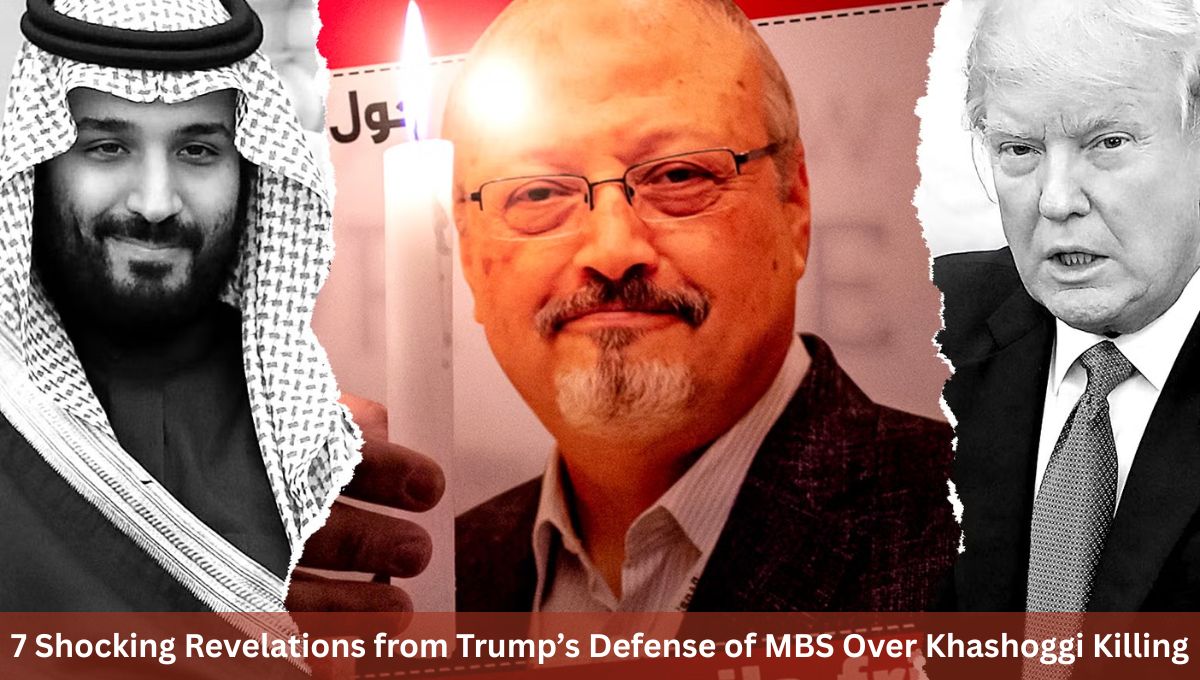
7 Shocking Revelations from Trump’s Defense of MBS Over Khashoggi Killing, reigniting global outrage. The 2018 murder of Saudi journalist Jamal Khashoggi inside the Saudi consulate in Istanbul remains one of the most disturbing political assassinations of the modern era. Though seven years have passed, the incident continues to shape global politics, US-Saudi relations, and debates around human rights.
The controversy reignited this week when US President Donald Trump openly dismissed US intelligence findings and declared that Saudi Crown Prince Mohammed bin Salman (MBS) “knew nothing” about the killing.
Trump’s remarks—made in the presence of the Saudi Crown Prince during his first US visit since the assassination—have triggered intense backlash, revived painful memories for Khashoggi’s widow, and raised serious questions about Washington’s geopolitical priorities. This in-depth article breaks down the entire episode, the reactions, and the far-reaching implications.
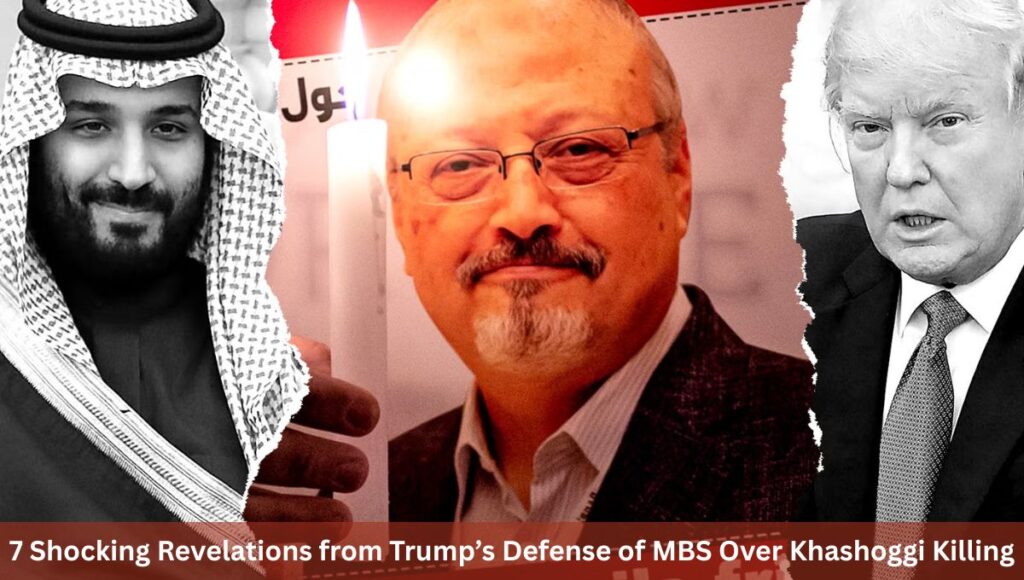
7 Shocking Revelations from Trump’s Defense of MBS Over Khashoggi Killing
A Warm White House Welcome Amid a Dark History
Saudi Crown Prince Mohammed bin Salman’s Washington visit came with a ceremonial flair reminiscent of a state visit: handshakes, smiles, military band performances, and a flyover by US military planes.
It was a striking contrast to the diplomatic frost that followed the murder of Jamal Khashoggi. Trump greeted the Crown Prince with an arm over his shoulder, calling him “a friend of mine for a very long time”.
His warm embrace signaled an unmistakable reset in US-Saudi ties—now framed as strategic, economic, and future-focused. But embedded within the pageantry was a glaring omission: human rights.
Trump Dismisses US Intelligence and Rewrites the Narrative
In one of his most controversial statements of the year, Trump rejected the declassified 2021 US intelligence report—released under President Biden—which concluded with high confidence that MBS personally approved the operation to “capture or kill” Jamal Khashoggi.
Instead, Trump insisted:
“He knew nothing about it. And we can leave it at that.”
When a reporter attempted to ask about the killing, Trump rebuked him, saying:
“You don’t have to embarrass our guest.”
This marked a dramatic contradiction of his own 2018 administration’s internal findings and the CIA’s assessment. Trump also described Khashoggi as:
“extremely controversial… a lot of people didn’t like that gentleman.”
This remark, downplaying Khashoggi’s reputation while excusing the circumstances of his death, sparked immediate outrage.
“Things Happen”: Trump’s Most Alarming Justification Yet
Perhaps the most widely discussed remark was Trump’s casual justification:
“Whether you like him or didn’t like him, things happen.”
For critics, this was an alarming normalization of a state-sponsored murder of a journalist who was a US resident, a Washington Post columnist, and a leading critic of the Saudi monarchy.
His words evoked comparisons to other controversial political comments that brushed aside atrocities as accidents of history rather than deliberate acts of violence.
MBS Responds—“A Painful Mistake”, but No New Details
Crown Prince Mohammed bin Salman took a muted tone on the issue, calling the killing:
“painful” and “a huge mistake.”
He insisted Saudi Arabia took the “right steps” to investigate the murder, though human rights organizations argue the probe was more about shielding senior officials than uncovering the truth.
Notably, MBS did not contradict Trump’s assertion that he had “no knowledge” of the plot—despite previously telling CBS’s 60 Minutes in 2019 that he took “full responsibility” as the kingdom’s leader.
Jamal Khashoggi’s Widow: “This Is Not Justification to Murder Him”
The most emotional response came from Hanan Elatr Khashoggi, the widow of the slain journalist.
In interviews with CNN and BBC, she said she was stunned and deeply hurt by Trump’s remarks, especially his characterization of her late husband as “controversial.”
Her words were powerful:
“The kind of justifying the crime by presenting Jamal this way… does not mean to kidnap him, torture him, and take his life.”
She also directly challenged Trump’s portrayal of Jamal:
“Jamal was a transparent man, a kind one, and loved by many.”
On X (formerly Twitter), she wrote a message addressed to Trump:
“There is no justification to murder him… I wish to meet you and introduce you to the real Jamal.”
Her call for accountability didn’t stop at Trump. Speaking to BBC Newsnight, she emphasized that the Crown Prince himself had publicly taken responsibility in 2019 and must “meet me, apologize, and compensate me.”
Her voice added a deeply human element to an otherwise geopolitical discussion.
Human Rights Groups Condemn Trump’s Defense of MBS
Trump’s remarks sparked immediate condemnation from global human rights organizations.
Groups including Human Rights Watch and Amnesty International reiterated that Saudi Arabia:
- continues to jail dissidents
- suppresses free speech
- arrests human rights activists
- carries out rising numbers of executions
Robert Weissman, co-president of Public Citizen, stated:
“Trump’s shameful and disgusting comments cannot be separated from his personal business interests with the Saudi regime.”
Analysts pointed to billions in Saudi investments linked to Trump’s family, including:
- a $2 billion investment in Jared Kushner’s private equity fund
- multiple Trump-branded real estate projects planned in Riyadh and Jeddah
For critics, the optics were hard to ignore.
Strategic Motives: Is China the Real Concern?
Some geopolitical analysts argued that Trump’s warm approach to MBS had less to do with absolving the Crown Prince and more to do with countering China’s influence in the Middle East.
Saudi Arabia has strengthened ties with Beijing in recent years, including:
- joining BRICS
- expanding energy cooperation
- increasing Chinese investment
- exploring military technology partnerships
Analyst Pyotr Kurzin quipped:
“All to ensure China doesn’t get more influence.”
Trump’s approval of exploring F-35 fighter jet sales—long resisted by some US officials and Israel—fed speculation that Washington wants to keep Riyadh firmly aligned with American interests.
F-35 Fighter Jet Sale Raises Alarms in Israel
One of the major revelations from the Trump–MBS meeting was discussion about the potential sale of advanced F-35 jets to Saudi Arabia. Trump emphasized he expected a deal with Lockheed Martin to move forward.
This immediately caused concern in Israel, which currently has the region’s only F-35 fleet. Israeli officials worry that selling the same jets to Saudi Arabia could erode its “qualitative military edge” guaranteed under US law.
Trump dismissed these concerns, saying:
“As far as I’m concerned, they are both at a level where they should get top of the line.”
This shift in policy could mark a major realignment of military power in the Middle East.
Trump’s Prior Comments to Bob Woodward Resurface
The debate intensified when legendary American journalist Bob Woodward resurfaced an explosive claim from one of his interviews with Trump.
Woodward said Trump privately told him regarding MBS:
“I saved his a*.”*
The resurfaced quote went viral, raising further suspicion about the motivations behind Trump’s staunch defence of the Crown Prince.
Business Interests Further Complicate the Picture
Questions around Trump’s personal financial stakes in Saudi Arabia have long lingered. The latest meeting revived those concerns.
Some notable connections include:
- Saudi-backed LIV Golf hosted events at Trump-owned properties
- Jared Kushner’s firm received a $2 billion investment from a Saudi sovereign wealth fund
- multiple planned Trump real estate projects in Saudi Arabia
- previous reports of lucrative hotel bookings by Saudi-linked groups
Critics argue these connections undermine the credibility of Trump’s statements about Khashoggi.
A Stark Contrast to Biden’s “Pariah” Promise
As a candidate, Joe Biden vowed to make Saudi Arabia a “pariah” over the Khashoggi killing.
But geopolitical realities forced a recalibration:
Biden visited the kingdom in 2022 and exchanged a now-infamous fist bump with MBS.
Still, Biden maintained sanctions on some Saudi officials and released the CIA report that Trump had refused to publish.
Trump’s reversal of that position now represents a dramatic swing in US policy—highlighting the deep divide between administrations.
A Journalist’s Legacy vs. Geopolitical Interests
Jamal Khashoggi was not just a critic of the Saudi royal family; he was a respected journalist, a former insider, and later a dissident whose writings challenged authoritarianism in the Middle East.
His final columns for The Washington Post advocated:
- transparency
- freedom of expression
- political reform
- accountability in the Arab world
His brutal murder—reportedly involving dismemberment with a bone saw—shocked the world. For his widow and supporters, Trump’s portrayal of Khashoggi as “controversial” was not only false but a deliberate attempt to shift attention away from Saudi responsibility.
The Future of US–Saudi Relations
Trump and MBS jointly framed their meeting around:
- massive Saudi investments rising from $600 billion to $1 trillion
- cooperation in AI, energy, nuclear power
- military partnerships
- counterterrorism
- regional stability
These priorities suggest a future in which realpolitik may overwhelm moral considerations.
Saudi Arabia remains:
- the world’s largest oil exporter
- a key regional power
- central to Middle East diplomacy
- an investor in major US tech and defense sectors
For Washington, the strategic value appears too high to jeopardize—no matter the moral cost.
Cristiano Ronaldo in Washington? A Symbol of Saudi Soft Power
A lighter but symbolic element of the visit was the presence of Portuguese football star Cristiano Ronaldo, who plays in the Saudi Pro League. His appearance at the White House underscored Saudi Arabia’s broader push to reinvent its global image through:
- sports investments
- global entertainment
- tourism initiatives
- mega infrastructure projects under Vision 2030
Ronaldo’s presence was another reminder that Saudi Arabia is reshaping its influence worldwide—not just politically, but culturally.
Conclusion: A Moment That Will Shape Global Politics
The Trump–MBS meeting, and the remarks made about Jamal Khashoggi, represent far more than a diplomatic exchange. They symbolize the collision between:
- human rights and geopolitical strategy
- truth and political narrative
- personal interests and national policy
- justice and realpolitik
For Jamal Khashoggi’s widow, the pain remains raw. For activists, Trump’s comments reflect a dangerous disregard for press freedom. For analysts, the meeting signals a major recalibration of US-Saudi ties—potentially reshaping Middle East politics for years to come.
One thing is certain:
The murder of Jamal Khashoggi will continue to haunt global diplomacy until accountability is achieved.
Also Read: 7 Ways Saudi Investments Are Transforming US Tech
Related Posts:
- 7 Stunning Signs Trump and Musk Are Repairing Their…

- 7 Powerful Ways the US–Saudi $1 Trillion Partnership…
- Trump’s 2025 Gaza Peace Plan Signing and Historic…

- Shocking Claim: Trump Warned About Bin Laden Before 9/11

- 7 Shocking Reasons FIFA’s Peace Prize for Trump…

- 9 Explosive Revelations as Trump Declares His Health…