7 Explosive Choices Facing Trump as Iran Standoff Nears Breaking Point, tensions surge. The United States and Iran are once again staring into the abyss of open conflict. Aircraft carriers steam toward the Persian Gulf, diplomatic channels hum with urgency, and millions of Iranians brace for the possibility of war. At the center of it all stands US President Donald Trump — confronting a paradox that has defined his foreign policy from the start.
Thank you for reading this post, don't forget to subscribe!Iran is weaker than it has been in decades. Yet Trump’s choices have rarely been more difficult.
This is not a classic superpower standoff. It is what some analysts describe as “bubble-gum foreign policy” — an approach favoring sharp, high-impact moments over prolonged engagement. Trump thrives on decisive gestures, dramatic headlines, and singular acts of force that dominate a news cycle. What he has consistently avoided are messy aftermaths, nation-building, or wars without a clear exit ramp. And yet, Iran does not offer clean endings.
As protests rock Iranian cities, the Islamic Republic’s leadership clamps down violently, even as its military and economic foundations show strain. The regime is under pressure at home, isolated abroad, and battered from last year’s 12-day war with Israel and US strikes on nuclear facilities.
But pressure does not equal collapse — and weakening an adversary does not automatically simplify strategy. In fact, it may do the opposite.
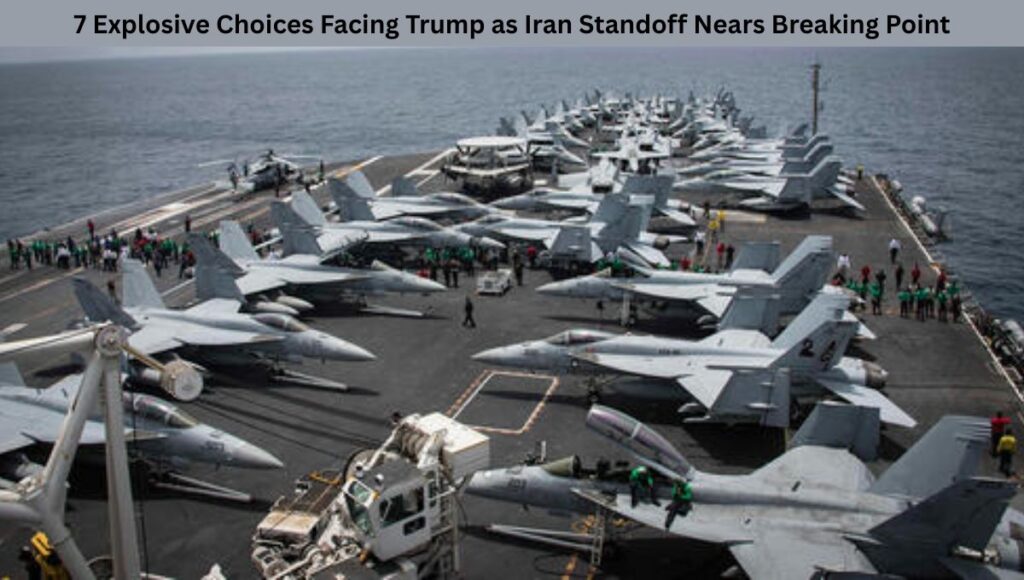
7 Explosive Choices Facing Trump as Iran Standoff Nears Breaking Point
A Weakened Iran, a Narrowing US Playbook
Trump’s current posture toward Iran reflects both escalation and hesitation. Naval assets have been deployed in a visible show of force, including the aircraft carrier USS Abraham Lincoln, accompanied by additional military capabilities across the region.
But this buildup has come with a cost.
The Element of Surprise Is Gone
For nearly three weeks, Trump has openly signaled the possibility of military action. From Truth Social posts warning that “HELP IS ON ITS WAY” to public threats of intervention, the administration has made little effort to conceal its intent.
Open-source intelligence trackers can now follow US naval movements almost in real time. Iran, meanwhile, has been on heightened alert for months — particularly since Israel’s surprise assault last year crippled key military and nuclear assets.
In short, Tehran is not caught off guard. It is braced.
Iran’s missile stockpiles have been depleted, and its command structure damaged. But the regime has survived worse.
Its leadership understands that this moment is existential — and survival, not compromise, remains the overriding goal.
Lesson One: Trump May Do Nothing at All
One of the most underappreciated lessons of Trump’s presidency is that threats do not always culminate in action.
Earlier this year, Trump’s aggressive rhetoric over Greenland led many analysts to conclude that he had boxed himself into a corner.
Yet the confrontation evaporated almost overnight, not through diplomacy, but through distraction. The crisis simply fell out of the headlines.
This pattern is familiar.
Trump often uses spectacle as leverage. The performance itself — the threat, the post, the buildup — can be the objective.
Analysts have coined shorthand to describe the cycle:
is this a FAFO moment (“find out”) or another TACO (“Trump always chickens out”)?
With Iran, the possibility remains that the White House ultimately changes the subject.
But the risks of miscalculation are far higher this time.
The Appeal — and Danger — of the “One-Night Strike”
If Trump chooses military action, history suggests he will favor singular, high-impact operations rather than extended campaigns.
His previous uses of force follow a pattern:
- The assassination of Qassem Soleimani
- The US strike on Iran’s nuclear facilities in June
- The dramatic capture of Venezuela’s Nicolás Maduro
Each operation shared three characteristics:
- Precision
- Overwhelming superiority
- Minimal concern for the aftermath
They dominated headlines, showcased US military power, and avoided prolonged entanglement — at least initially.
But Iran presents a different challenge.
Option One: Targeting Iran’s Leadership
One possible course would be decapitation strikes against senior figures in the Islamic Revolutionary Guard Corps (IRGC), or even Supreme Leader Ayatollah Ali Khamenei himself.
Such an attack could be framed as retribution for the regime’s brutal crackdown on protesters — a crackdown that Trump initially cited when threatening intervention.
Yet this path is riddled with uncertainty.
Who Comes After Khamenei?
Khamenei is not the regime; he is its symbol. The Islamic Republic is a system — layered, institutionalized, and resilient. Removing one figure does not dismantle the machinery beneath.
Any successor would likely be:
- More hardline, not less
- Eager to demonstrate anti-American resolve
- Backed by a regime closing ranks for survival
Rather than moderating Iran’s behavior, such a strike could accelerate radicalization.
Option Two: Hitting Iran’s Nuclear Program — Again
Another strike on nuclear facilities would align with longstanding US policy goals. But it raises an uncomfortable question: why bomb the same targets twice?
Trump previously declared the June strikes a success. Revisiting those facilities risks undercutting his own narrative — unless new intelligence suggests Iran has rebuilt faster than anticipated.
Moreover, Iran’s nuclear expertise cannot be erased with bombs alone. Knowledge survives even when infrastructure does not.
Option Three: A Wider Bombing Campaign
A broader campaign targeting military and security infrastructure could degrade Iran’s ability to respond. But history offers sobering lessons.
Collateral Damage Is Strategic Damage
Millions of Iranians depend on state institutions for their livelihoods. Tens of thousands serve in the security forces.
Prolonged bombing would inevitably kill civilians, creating widows and orphans who are unlikely to view US actions as liberation.
Rather than weakening the regime, such a campaign could entrench it.
It is a persistent fallacy of modern warfare that regimes can be bombed out of existence. The record — from Iraq to Libya — suggests otherwise.
Iran’s Likely Response: Asymmetric and Regional
Iran does not need to defeat the United States militarily to exact a cost.
Its options include:
- Missile and drone attacks on US bases
- Targeting Israel
- Activating regional proxies
- Disrupting shipping in the Strait of Hormuz
Even limited retaliation could kill American soldiers — a scenario that would force Trump into further escalation, precisely what his political base fears most.
Carrier Coercion or Strike Packaging?
At present, the US lacks sufficient forces in theater for a sustained bombing campaign. A ground invasion is politically unthinkable and strategically disastrous.
This leaves Trump with two primary tools:
- Carrier coercion — using military presence to force talks
- Strike packaging — preparing limited attacks while signaling restraint
Both rely heavily on perception.
Trump’s foreign policy often exists in the eye of the beholder. The signal matters as much as the substance. A carrier group can be a threat, a bluff, or a bargaining chip — sometimes all three simultaneously.
The Diplomatic Scramble to Prevent War
As Washington escalates rhetorically, regional and global powers are racing to cool tensions.
Regional Actors Step In
- Turkey is hosting high-level Iranian talks
- Pakistan has reaffirmed sovereignty and non-interference
- Saudi Arabia and the UAE have pledged not to allow their airspace to be used against Iran
- Egypt is quietly mediating between Washington and Tehran
- India has sent senior security officials to Tehran
These efforts reflect a shared fear:
war would devastate regional stability and global energy markets.
China and Russia Push Restraint
Both Beijing and Moscow have publicly urged negotiation, warning that military adventurism would plunge the region into chaos.
China, in particular, has framed the crisis in economic terms — arguing that conflict would disrupt oil supplies and harm the global economy, including the United States.
This is language Trump may understand.
Europe’s Uneasy Position
European leaders have focused largely on Iran’s human rights abuses rather than directly confronting US military plans.
The EU’s designation of the IRGC as a terrorist organization marks a significant escalation — but it stops short of opposing war outright.
This ambivalence reflects Europe’s declining leverage in Middle Eastern security decisions.
Inside Iran: Fear, Preparation, and Resignation
While diplomats maneuver, ordinary Iranians prepare for the worst.
Across Tehran and beyond:
- Windows are being sealed
- Food, water, and medicine are being stockpiled
- Social media is flooded with survival advice
The fear is not abstract. Many Iranians lived through last year’s war and know what modern bombardment looks like.
As one resident put it:
“When they bomb, there will be no difference between the regime and the opposition.”
A President of Peace at a Crossroads
Trump has styled himself as a president who avoids endless wars. Yet his reliance on dramatic, high-stakes gestures risks pulling him into precisely the kind of conflict he claims to reject.
A single Iranian missile killing American troops could transform a “one-night strike” into months of retaliation — and another foreign entanglement with no clear end.
Iran may be weakened. But weakness does not equal surrender.
Conclusion: When the Show Becomes the Strategy
The US–Iran standoff underscores a defining truth of Trump’s foreign policy:
the performance often is the policy.
Threats, posts, fleets, and headlines become instruments of statecraft. Sometimes they work. Sometimes they spiral.
As the world watches Trump’s next move — thumb up or thumb down — the stakes are far higher than the spectacle suggests.
Because behind the show lies a region, and a people, who will live with the consequences long after the headlines fade.
Also Read: 7 Explosive Signals as Hegseth Warns Iran and Trump Readies Military Options
Also Read: US, Iran signal talks to avert military conflict amid tensions in the Gulf
Related Posts:
- 11 Explosive Warnings as Trump Vows to ‘Knock the…

- 10 Explosive Warnings as Donald Trump Calls Iran…
- 12 Explosive Claims as Donald Trump Says Iran War…
- 9 Explosive Revelations as Trump Declares His Health…

- 10 Explosive Signals Trump Says Iran War Could End…
- Trump's 3 Blunt Warnings to China and Russia Over…