

7 Explosive Moves as Trump Threatens Cuba’s Oil Lifeline, raising fears of a humanitarian crisis. Cuban President Miguel Díaz-Canel has launched a fierce political and rhetorical counteroffensive against the United States after President Donald Trump declared a national emergency on Cuba and threatened to impose tariffs on any country supplying oil to the island.
The move, widely described by analysts as one of the most aggressive escalations in US-Cuba relations in decades, has sent shockwaves through Latin America, rattled global energy markets, and deepened fears of a looming humanitarian crisis in Cuba, where rolling blackouts, fuel shortages, and food insecurity are already severe.
In a series of defiant messages on social media, Díaz-Canel accused Washington of attempting to “strangle the Cuban economy”, revive a total blockade, and dictate to sovereign nations who they are allowed to trade with.
“Homeland or Death! We shall overcome!” Díaz-Canel declared, invoking revolutionary-era language as Havana braces for what officials call an unprecedented economic assault.
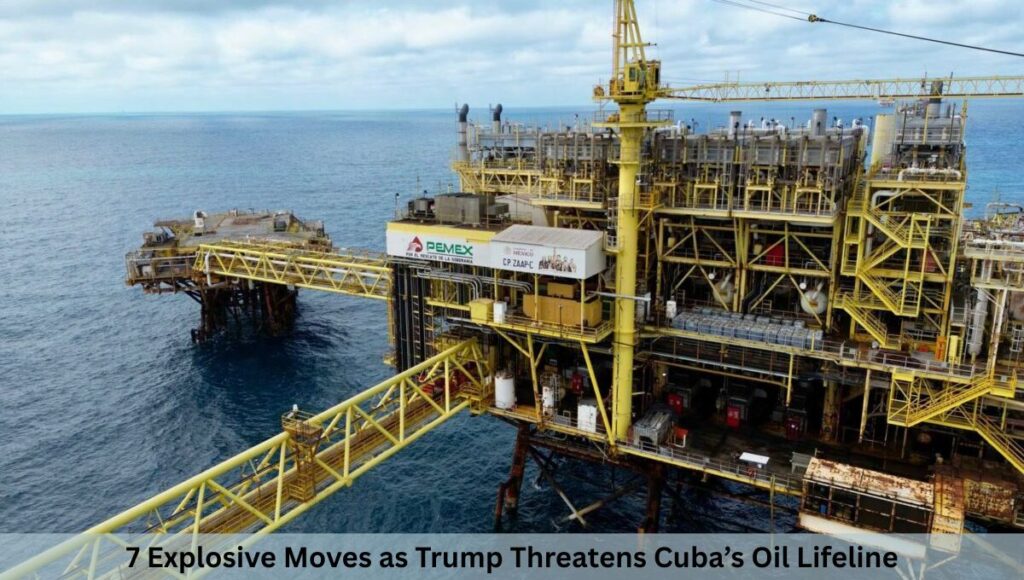
7 Explosive Moves as Trump Threatens Cuba’s Oil Lifeline
Trump Declares National Emergency on Cuba
On Thursday, President Trump signed an executive order under the International Emergency Economic Powers Act (IEEPA), declaring Cuba an “unusual and extraordinary threat” to US national security.
What the Executive Order Does
The order authorises:
- Punitive tariffs on imports from any country supplying oil or refined fuel to Cuba
- Secondary sanctions targeting shipping, insurance, and logistics chains
- Expanded financial restrictions tied to Cuba’s energy sector
The White House justified the move by alleging:
- Cuban cooperation with Russia
- Links to Hezbollah and Hamas
- Hosting foreign intelligence infrastructure
- “Exporting destabilising communist ideology”
Critics argue these claims recycle long-standing Cold War narratives to justify economic coercion.
Díaz-Canel: ‘This Is Economic Warfare’
Responding swiftly, Díaz-Canel described Trump’s decision as “mendacious, illegal, and aggressive”, accusing Washington of weaponising trade and energy supplies.
Key Accusations from Havana
- The US is claiming the right to decide which countries Cuba may trade with
- The policy amounts to a fuel blockade
- It risks collective punishment of civilians
- It violates international trade norms
Cuba’s foreign minister Bruno Rodríguez went further, declaring an “international emergency” and urging global condemnation of what he called economic blackmail.
A Nation Already on the Brink
The timing of Trump’s decision could hardly be worse for Cuba.
Cuba’s Current Energy Crisis
- Daily blackouts lasting 10–12 hours
- Fuel shortages crippling transport and food distribution
- Hospitals struggling to run generators
- Gas canisters scarce and unaffordable
Residents across Havana report living conditions deteriorating rapidly.
“My food is going bad. There’s no electricity. You can’t sleep,” said Yenia León, a Havana resident.
For older Cubans who endured the devastating “Special Period” of the 1990s, the current crisis feels even worse.
“The only thing missing is for bombs to start falling,” said Lázaro Alfonso, an 89-year-old retiree.
The Venezuela Shock: A Turning Point
Cuba’s vulnerability deepened dramatically after the US military operation that captured Venezuelan President Nicolás Maduro earlier this month.
Why Venezuela Matters
- Venezuela supplied around one-third of Cuba’s oil
- Shipments collapsed following US intervention
- Washington now claims effective control over Venezuelan oil exports
The sudden cutoff left Cuba scrambling to secure alternative fuel sources — just as Trump moved to choke those very routes.
Mexico Caught in the Crossfire
Mexico has emerged as one of the most exposed countries under Trump’s tariff threat.
Mexico’s Role
- Supplied 44% of Cuba’s oil imports in 2025
- Shipments account for about 1% of Mexico’s total production
- Delivered crude and refined products after Venezuela’s decline
Mexican President Claudia Sheinbaum warned bluntly that US tariffs could trigger a “far-reaching humanitarian crisis” in Cuba.
“Hospitals, food supplies, transportation — all would be affected,” she said.
While Sheinbaum stopped short of confirming whether Mexico would halt shipments, she emphasised solidarity with the Cuban people and ordered diplomatic engagement with Washington.
Russia, Venezuela, and Regional Pushback
Venezuela’s Response
Venezuela condemned the US move as:
- A violation of international law
- An attack on free trade between sovereign states
- A punitive act against third countries
Russia’s Position
Moscow has signalled diplomatic support for Havana, warning that further escalation could destabilise energy markets and regional security.
Trump’s Mixed Signals: Pressure and ‘Deals’
Despite the hardline stance, Trump has also hinted at negotiations.
“They have no money. They have no oil… I think they’ll want to make a deal,” Trump told reporters aboard Air Force One.
He suggested Cuba could be “free again” — without clarifying what concessions Washington expects.
In a separate social media post, Trump even floated the idea of Secretary of State Marco Rubio becoming president of Cuba, writing:
“Sounds good to me!”
The comment inflamed tensions further, reinforcing Havana’s view that regime change remains Washington’s ultimate goal.
Marco Rubio and the Hardline Approach
Secretary of State Marco Rubio, a Cuban American with deep roots in Miami’s exile community, is widely seen as the intellectual architect behind the renewed pressure campaign.
Rubio’s Influence
- Longtime advocate of regime change in Havana
- Vocal supporter of tightening sanctions
- Frames Cuba as a security threat rather than a humanitarian case
Cuban officials directly accused Rubio of pushing a “fascist, criminal, and genocidal” agenda against the island.
Human Rights Experts Sound the Alarm
The United Nations has repeatedly warned that US sanctions are causing severe humanitarian harm in Cuba.
UN Findings
- Shortages of food, medicine, water, and electricity
- Collapse of industrial and transport infrastructure
- Mass emigration of doctors, engineers, and teachers
- Violations of rights to health, food, and development
UN rapporteur Alena Douhan described the US embargo as the longest-running unilateral sanctions regime in modern history.
Is This a De Facto Oil Blockade?
Analysts say Trump’s tariff threat effectively functions as an oil blockade without declaring one outright.
Why This Matters
- Shipping companies may refuse Cuba-bound cargo
- Insurers may withdraw coverage
- Banks may halt payments
- Even neutral countries may disengage out of fear
An energy expert at the University of Texas warned Cuba could face total fuel exhaustion within weeks if deliveries do not resume.
Global Implications Beyond Cuba
The crisis is being closely watched far beyond the Caribbean.
Why the World Is Paying Attention
- Precedent for secondary sanctions
- Weaponisation of energy supply chains
- Pressure on middle powers like Mexico
- Risks to humanitarian law norms
For many Global South nations, Trump’s move reinforces fears that economic sovereignty can be overridden by US policy choices.
A Familiar Pattern, a New Severity
The US embargo on Cuba dates back to 1962, but analysts say the current phase marks a qualitative escalation.
Unlike previous sanctions, this approach:
- Directly targets third-party countries
- Focuses on energy lifelines
- Is paired with overt regime-change rhetoric
Cuban officials argue this is not about democracy — but submission.
What Happens Next?
Several scenarios are now in play:
Possible Outcomes
- Mexico and others reduce oil shipments to avoid US retaliation
- Humanitarian crisis deepens in Cuba
- Back-channel talks open between Washington and Havana
- Further regional backlash against US coercion
For now, Cuba is preparing for the worst.
‘Homeland or Death’ — A Defiant Close
As night falls across Havana, neighbourhoods go dark under rolling blackouts. Families ration fuel, food, and hope. And yet, Cuba’s leadership remains publicly defiant.
For Díaz-Canel, Trump’s tariffs are not just an economic threat — they are a test of sovereignty.
“They want to decide our future for us,” he said. “But Cuba will resist.” Whether resistance alone can keep the lights on — or prevent a humanitarian catastrophe — remains an open and urgent question.
Also Read: Trump Issues Tylenol Warning: Autism Causes, Cuba Claim, and the Vaccine Debate
Also Read: Trump says U.S. may ‘work a deal’ on Cuba after oil tariff threat
Related Posts:
- 9 Explosive Signals as Trump Targets Cuba’s Oil…

- 11 Punitive Shockwaves from Trump’s Cuba Oil Tariff Threat

- Can the EU and NATO Impose Tariffs on India and…

- 11 Explosive Revelations From Ted Cruz’s Leaked…
- Trump's 3 Blunt Warnings to China and Russia Over…
- 5 Powerful Highlights as Trump Lands Second Nobel…
