In a significant development Russia and Ukraine Agree on Major POW Swap, But Ceasefire Talks Stall in Turkey. During the ongoing Russia-Ukraine war, both countries agreed on a major prisoner of war (POW) exchange during a brief round of peace talks held in Istanbul on Wednesday. Russia and Ukraine will each release at least 1,200 POWs, marking one of the largest exchanges since the start of the full-scale invasion in February 2022.
The announcement came as part of a broader diplomatic push aimed at ending the devastating war, now entering its fourth year. While the POW swap signals progress on the humanitarian front, the talks failed to yield any breakthroughs on key issues such as a ceasefire or a direct meeting between President Volodymyr Zelensky and President Vladimir Putin.
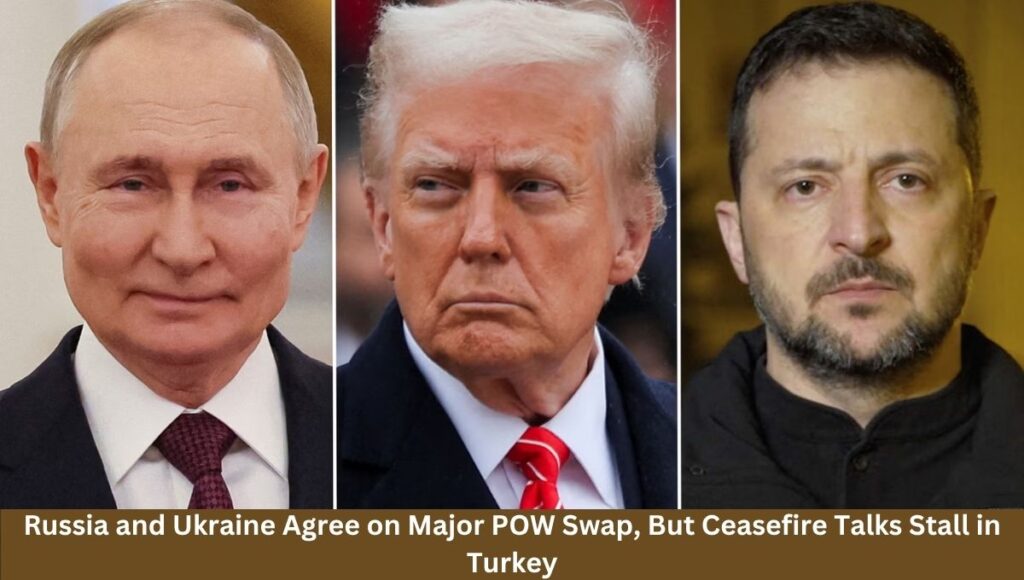
Russia and Ukraine Agree on Major POW Swap, But Ceasefire Talks Stall in Turkey
A Glimmer of Progress in Stalled Peace Process
Ukraine’s chief negotiator Rustem Umerov confirmed the agreement and emphasized the importance of ongoing humanitarian efforts.
“We continue to insist on the release of civilians, including children,” he said. Ukrainian officials report that more than 19,000 children have been forcibly deported to Russia since the conflict began.
Russia’s lead delegate, Vladimir Medinsky, echoed the commitment to further exchanges. “The parties agreed to exchange at least 1,200 prisoners of war each.
We also offered to return the bodies of 3,000 Ukrainian soldiers,” Medinsky said at a press briefing after the talks.
The Turkish-hosted meeting, although brief lasting just 40 minutes resulted in the latest of several prisoner swaps that have taken place over the past few months.
President Zelensky noted in a statement on Telegram that over 1,000 Ukrainians have returned from Russian captivity thanks to the agreements reached in Istanbul.
Diverging Views on Ceasefire and Diplomatic Path Forward
Despite the successful POW deal, the two sides remain deeply divided over the terms of a ceasefire and the conditions for a potential summit between their leaders.
Umerov reiterated Ukraine’s demand for a “full and unconditional ceasefire,” arguing that only a complete halt to hostilities can pave the way for meaningful negotiations.
In contrast, Russia continues to push for short-term ceasefires lasting 24 to 48 hours primarily to facilitate the retrieval of dead and wounded soldiers from the battlefield.
Medinsky stated that these brief truces would allow medical teams and military commanders to recover bodies and treat the injured.
However, Ukraine views this approach as inadequate. “We need a sustained ceasefire to stop the bloodshed and begin serious diplomatic efforts,” said a source within the Ukrainian delegation.
A Summit Between Putin and Zelensky? Not So Fast
Umerov also proposed that a direct meeting between Zelensky and Putin take place by the end of August.
He suggested the participation of U.S. President Donald Trump and Turkish President Recep Tayyip Erdoğan in such a summit to help mediate and ensure accountability.
But Russia was quick to dismiss the idea at least for now.
“A meeting between the presidents should be to sign an agreement, not to start negotiations from scratch,” Medinsky told reporters, signaling Moscow’s unwillingness to engage at the leadership level without concrete terms already agreed upon.
Trump’s 50-Day Ultimatum and Western Pressure on Moscow
The Istanbul meeting occurred just over a week after U.S. President Donald Trump issued a sharp ultimatum to Moscow.
He warned that unless Russia agrees to a peace deal within 50 days, it would face new “very severe” sanctions, including tariffs and restrictions on oil exports.
Trump, who has taken a more assertive tone in recent weeks, also brokered a deal with European allies to expedite weapons shipments to Ukraine through indirect supply routes.
These moves mark a stark shift from his earlier, more cautious stance on the conflict.
“My conversations with Putin are very pleasant, and then the missiles go off at night,” Trump told reporters last week, expressing his growing frustration with the Russian president’s unwillingness to compromise.
Mounting Costs of War: Over 1 Million Russian Casualties
Even as diplomatic efforts continue, the war’s human cost keeps climbing. Recent estimates from the UK Ministry of Defence and the Center for Strategic and International Studies suggest that Russia has suffered over 1 million casualties since the invasion began.
Despite these staggering losses, the Kremlin shows no signs of relenting. Instead, it has intensified drone and missile attacks on Ukrainian infrastructure.
A recent Russian assault on the Sumy region cut power to more than 220,000 people and claimed new ground as Moscow’s forces captured the village of Varachyne.
Ukrainian Sovereignty and Russian Territorial Demands
At the heart of the deadlock remains the issue of territorial sovereignty.
Russia demands that Ukraine withdraw from four regions Luhansk, Donetsk, Zaporizhzhia, and Kherson that Moscow claims to have annexed in 2022.
Ukraine has repeatedly rejected these demands, declaring it will not negotiate over its own land.
This impasse underscores the vast gulf between the two countries’ negotiating positions, which Kremlin spokesperson Dmitry Peskov described as “diametrically opposed.”
He warned reporters not to expect “miraculous breakthroughs” from the Istanbul talks.
Children and Civilians: A Humanitarian Crisis Unfolding
Another key point of contention is the status of civilians and children caught in the conflict. Ukraine accuses Russia of abducting at least 19,000 children and forcibly relocating them.
Russia denies this, claiming it has offered protection to children separated from their families during the war.
Medinsky stated that Russia is working through a list of 339 Ukrainian children and said some have already been returned.
“If their legal parents, close relatives, or representatives are found, these children will immediately return home,” he claimed.
Future of Peace Talks: Will the August Deadline Matter?
With the August deadline proposed by Ukraine and reinforced by Trump looming, all eyes are on whether Russia will respond with substantive proposals or continue its current strategy of attrition and delay.
Oleksandr Bevz, a Ukrainian delegate, explained that the August deadline was chosen to align with Trump’s 50-day ultimatum.
However, Kremlin insiders reportedly told Reuters that Putin is unlikely to yield under pressure and may even expand Russia’s territorial demands if the West fails to meet his expectations.
Conclusion: Progress on POWs, But War Grinds On
The Istanbul peace talks yielded one notable success the large-scale prisoner of war exchange. But the broader issues fueling the conflict remain unresolved. With Russia unwilling to engage in a full ceasefire or a leaders’ summit, and Ukraine insisting on preserving its territorial integrity, the road to peace remains fraught with obstacles.
The next few weeks could be crucial. Whether Trump’s deadline will force a shift in the Kremlin’s calculus or merely harden positions remains to be seen. For now, the humanitarian progress is welcome, but it falls far short of the peace so desperately needed by both nations.
Also Read: Russia and Ukraine Complete Emotional Prisoner Exchange Amid Escalating Conflict
Also Read: Ukraine proposes Zelenskyy, Putin, Trump and Erdogan meet this summer
Related Posts:
- Ukraine and Russia Agree to Exchange 6,000 Fallen…
- Russia and Ukraine Complete Emotional Prisoner…

- Ukraine and Russia Conduct Largest Prisoner Swap of…

- Trump’s 20-Point Gaza Peace Plan Gains Urgent Global…

- In 8 Moves, EU Targets China-Linked Refineries and…

- Ukraine and Russia End Peace Talks in Istanbul Amid…