Critics call it capitulation, as Canada Eases Retaliatory Tariffs, Matches USMCA Exemptions in Trade Reset with Trump. Prime Minister Mark Carney has announced that Canada will drop billions of dollars in retaliatory tariffs against the United States, aligning Canadian policy with tariff exemptions offered under the United States-Mexico-Canada Agreement (USMCA).
The move, effective September 1, marks a significant shift in Ottawa’s trade strategy as it navigates an increasingly protectionist Washington under President Donald Trump.
Carney emphasized that the decision was not appeasement, but rather a pragmatic adjustment to preserve Canada’s unique access to the US market, which remains the destination for more than 75% of Canadian exports. “Canada currently has the best trade deal with the United States. And while it’s different from what we had before, it’s still better than that of any other country,” Carney told reporters in Ottawa.
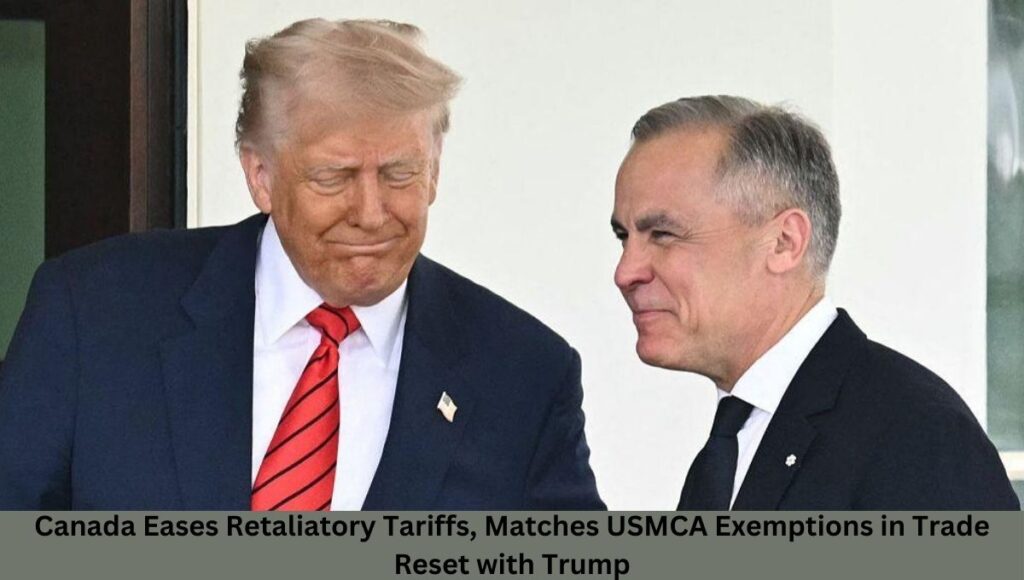
Canada Eases Retaliatory Tariffs, Matches USMCA Exemptions in Trade Reset with Trump
Background: How We Got Here
The latest move represents the third major shift in Canada’s trade strategy since Trump’s return to the White House earlier this year.
- In March, Canada imposed 25% retaliatory tariffs on a C$30 billion basket of US goods ranging from orange juice and alcohol to motorcycles and cosmetics.
- These tariffs mirrored measures once applied under former Prime Minister Justin Trudeau, who had retaliated against Trump’s steel and aluminum duties in 2018.
- However, the Trump administration exempted goods covered by USMCA, meaning that Canada’s countermeasures were often symbolic rather than economically significant.
By late August, Carney faced mounting pressure from business leaders and economists who warned that Canada’s retaliatory tariffs risked undermining preparations for the 2026 USMCA review.
The Announcement: Matching the US
Standing at a press conference in Ottawa, Carney declared that Canada would suspend retaliatory tariffs on all goods that fall under USMCA’s tariff exemption framework.
“In this context, and consistent with Canada’s commitment to USMCA, I am announcing today that the Canadian government will now match the United States by removing all of Canada’s tariffs on US goods specifically covered under USMCA,” Carney said.
This effectively re-establishes tariff-free trade for 85% of goods moving across the border.
However, Canada will maintain its tariffs on key strategic sectors:
- Autos
- Steel
- Aluminum
These industries, Carney stressed, remain under “intensive negotiation” with Washington.
Trump’s Reaction: “Nice Move”
President Trump, speaking from the Oval Office, welcomed Carney’s announcement with rare praise for a foreign leader.
“We are working on something. We want to be very good to Canada. I like Carney a lot. I think he’s a very good person,” Trump said.
Trump also suggested that Canada’s shift could help reset stalled trade negotiations, adding:
“I am fighting for the United States, and Canada and Mexico have taken a lot of our business over the years. But we’re working on something that will be very good.”
Critics Call It Capitulation
Carney’s announcement sparked mixed reactions in Canada.
Union Pushback
Lana Payne, president of Unifor, Canada’s largest private-sector union, blasted the move:
“Trump’s attacks on auto, steel, aluminum, and forestry sectors are hurting Canadian workers in real time. Walking back counter-tariffs isn’t an olive branch. It only enables more US aggression.”
Conservative Opposition
Conservative leader Pierre Poilievre accused Carney of “folding under pressure.”
“It is yet another capitulation and climb down by Mark Carney. His campaign elbows have mysteriously gone missing,” Poilievre said, referencing Carney’s hockey-inspired slogan of taking an ‘elbows up’ approach to Trump.
Carney’s Defense: Pragmatism Over Posturing
Carney rejected suggestions that Canada was backing down. Instead, he framed the decision as a strategic reset aimed at maximizing Canada’s advantage in the upcoming USMCA review.
“The president and I had a long conversation. There is a review of the free trade agreement in the spring. We’re starting our preparations,” Carney said.
He also underscored that Canada’s tariff exposure remains lower than that of other US trading partners.
- Average US tariff on Canadian goods: 5.6%
- Average US tariff globally: 16%
This, Carney said, shows that Canada still has “the best deal of anyone in the world right now.”
Economic Impact: Steel, Aluminum, and Autos Still at Risk
While most goods regain tariff-free status, Canada’s strategic sectors continue to face uncertainty.
- Steel and Aluminum:
- US tariffs remain at 50% under Trump’s Section 232 tariffs.
- Canada has kept its 25% retaliatory tariffs in place.
- Autos:
- Both sides have tariffs in place.
- The Ontario auto industry has already reported 38,000 job losses in three months linked to tariff disruptions.
Economists warn that prolonged tariffs in these sectors could have long-term impacts on Canada’s manufacturing heartland.
The Political Balancing Act
Carney, who came to office in April’s general election, campaigned on a promise to take a tough stance against Trump’s tariffs.
His hockey-inspired “elbows up” slogan became shorthand for a more aggressive negotiating style.
But since taking office, Carney has charted a more moderate course:
- In June, he abandoned plans for a digital services tax after Trump threatened to suspend trade talks.
- In July, he dropped talk of further sanctions, focusing instead on securing USMCA’s carve-outs.
Business leaders see this as pragmatic. Goldy Hyder, president of the Business Council of Canada, said:
“While there is more work to be done to resolve tariffs in strategic sectors, Canada’s priority must be the successful review and renewal of the USMCA.”
Looking Ahead: The 2026 USMCA Review
The USMCA known in Canada as CUSMA officially comes up for review in July 2026, but preparations are already underway.
Carney confirmed that Canada will begin internal consultations this fall, focusing on:
- Steel, aluminum, and autos
- Forestry and lumber
- Digital trade and technology
The outcome of these talks will shape North America’s trade landscape for the next decade.
Conclusion: A Calculated Reset
Canada’s decision to drop most retaliatory tariffs represents a calculated reset in its trade relationship with the United States. By aligning with USMCA exemptions, Carney has ensured that the vast majority of Canadian exports remain tariff-free, preserving an advantage over other countries.
Also Read: Canada to lift retaliatory tariffs on US consumer goods to ease trade tensions
Also Read: India at the G7 Summit: Why Canada’s Invite to PM Modi Signals a Global Reset
Related Posts:
- 9 Explosive Stakes Behind Trump’s 100% Tariff Threat…
- 7 Explosive Reasons Trump’s 100% Tariff Threat Shook…

- 5 Key Takeaways from Trump–Carney Meet: Trade,…
- Trump Slaps 35% Tariff on Canadian Imports Starting August 1

- 7 Historic Shifts Powering Canada–China’s New…
- 50% Shockwave: Trump Slaps Massive New Tariffs on…