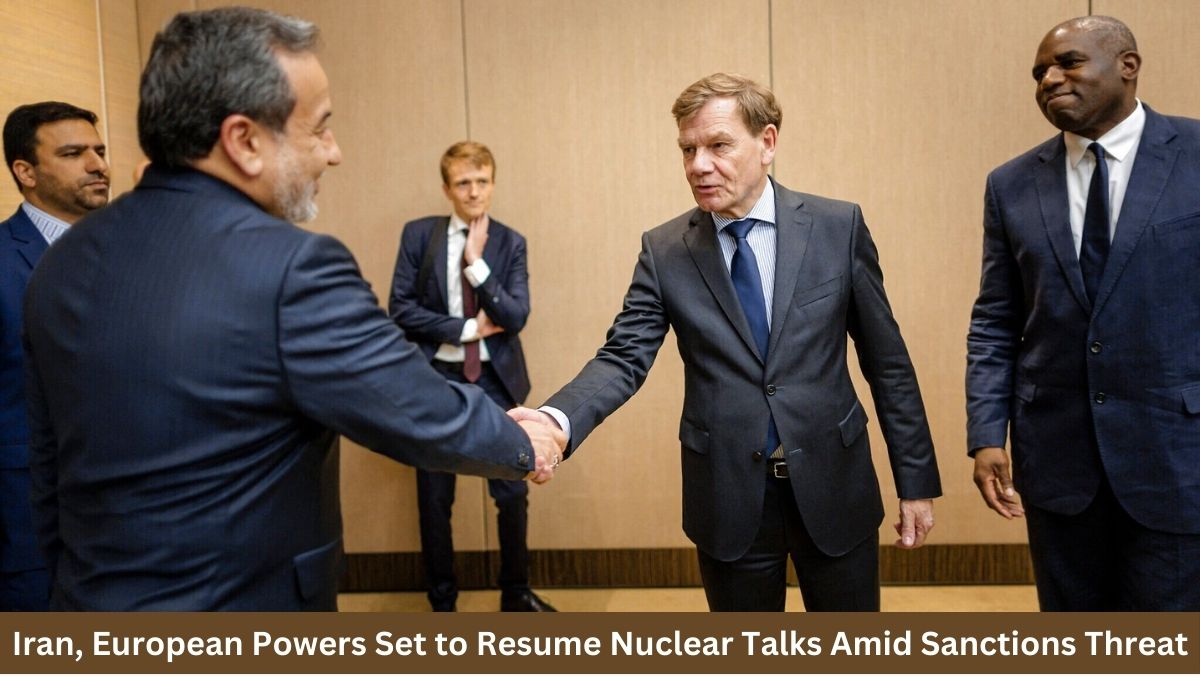
Next week, Iran, European Powers Set to Resume Nuclear Talks Amid Sanctions Threat. Iran and three major European powers France, Germany, and the United Kingdom have agreed to resume nuclear talks next week in a bid to salvage diplomacy and avoid the reimposition of sweeping United Nations sanctions. The decision comes at a tense moment, with both sides trading accusations over uranium enrichment, sanctions threats, and the future of Iran’s cooperation with the International Atomic Energy Agency (IAEA).
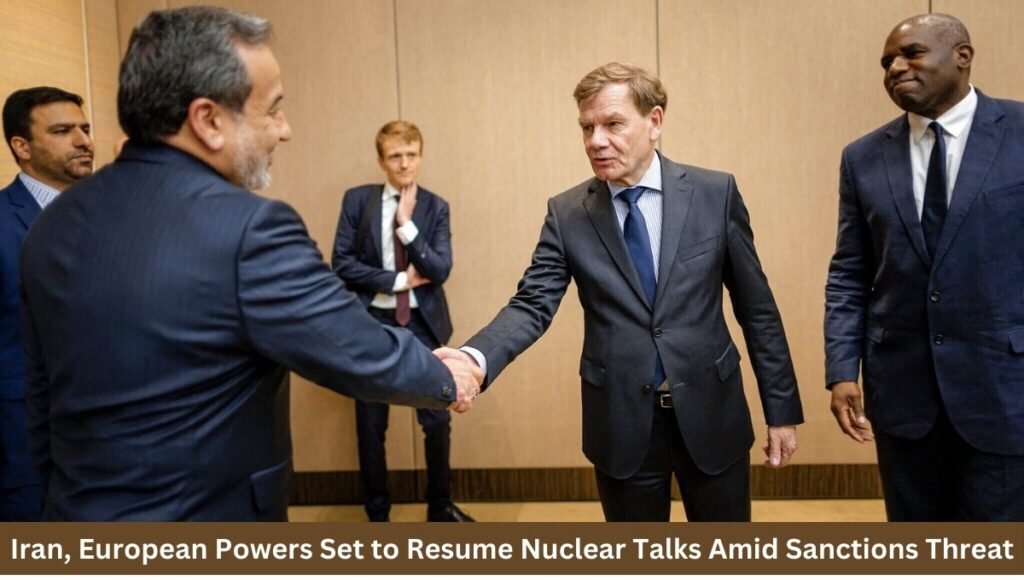
Iran, European Powers Set to Resume Nuclear Talks Amid Sanctions Threat
Looming Deadline for Sanctions
The talks were confirmed after Iranian Foreign Minister Abbas Araghchi spoke with his French, British, and German counterparts on Friday.
According to Iranian state media, the ministers agreed that deputy-level diplomats would meet on Tuesday to discuss the nuclear programme and sanctions relief.
The urgency stems from a looming August 31 deadline, set by the European powers, to decide whether to trigger the “snapback” mechanism a provision in the 2015 Iran nuclear deal that allows for the automatic restoration of UN sanctions if Iran is found in noncompliance.
German Foreign Minister Johann Wadephul emphasized that Europe was running out of patience.
“Time is very short and Iran needs to engage substantively,” he said, warning that sanctions would be reimposed unless a verifiable and lasting agreement was reached.
Iran Rejects Sanctions Threats
Tehran, however, has pushed back strongly against the European position. Araghchi dismissed the snapback threat, accusing the European trio of lacking the “legal and moral competence” to activate the mechanism.
He warned of serious consequences if Europe attempted to move forward with reimposing sanctions.
Iran maintains that its nuclear programme is strictly peaceful, insisting that uranium enrichment is meant for civilian energy production and medical purposes.
Iranian officials argue that the West’s accusations are politically motivated and ignore repeated findings by the IAEA that Iran remains far from developing a nuclear weapon.
Also Read: Iran Defiant on Nuclear Enrichment Despite US-Israel Strikes; Araghchi Urges Negotiated Solution
The IAEA’s Role and Restricted Access
The IAEA has long played a central role in monitoring Iran’s nuclear programme under the 2015 nuclear deal, formally known as the Joint Comprehensive Plan of Action (JCPOA).
However, since the 12-day conflict in June, during which the US and Israel attacked Iranian nuclear facilities, Iran has cut off IAEA inspectors from accessing its installations.
IAEA chief Rafael Grossi has repeatedly stressed that inspections are essential for transparency, but Tehran has accused the agency of “double standards” and failing to condemn what it called “criminal attacks” on its nuclear facilities.
President Masoud Pezeshkian went further in July, signing a law that suspended Iran’s cooperation with the IAEA.
He warned the agency that if it hoped to restore relations with Tehran, it must abandon its bias.
Iranian officials even threatened to arrest Grossi if he visits the country, highlighting the deep mistrust now defining their relationship.
Disputed Enrichment Levels
One of Europe’s main concerns is Iran’s uranium enrichment activities. Before the June conflict, Iran had been enriching uranium up to 60% purity, which is just short of the 90% weapons-grade threshold.
While Tehran insists that enrichment at such levels is necessary for advanced civilian applications, the fact remains that no other non-nuclear weapons state is enriching at such levels.
The European trio, backed by the United States, argue that Iran’s activities could enable it to shorten the so-called “breakout time” the period needed to produce enough fissile material for a bomb.
Iran denies any such intention, pointing out that US intelligence agencies, including testimony from National Intelligence Director Tulsi Gabbard, have found no evidence of Iran moving toward weaponization.
Diplomatic Deadlock Since June
Diplomatic efforts have stalled since June, when nuclear talks between Iran and the United States collapsed following the bombing of Iranian nuclear sites.
The attacks prompted Tehran to withdraw from negotiations and suspend cooperation with the IAEA, dealing a serious blow to the fragile diplomatic framework of the JCPOA.
The last round of talks between Iran and the European powers took place in Geneva on June 20, while the conflict was still ongoing.
At the time, diplomats reported little progress, and mistrust between the parties only deepened after the attacks.
Vienna Talks with the IAEA
Amid the renewed push for diplomacy, Iran’s envoy to the IAEA confirmed that an Iranian delegation had traveled to Vienna to meet with agency officials on Friday.
According to the official IRNA news agency, the discussions focused on how to define future cooperation within the limits of a law passed by Iran’s parliament that restricts the country’s compliance with IAEA monitoring.
While no details were provided, the Vienna meeting indicates that Tehran is still willing to keep a line of communication open with the UN watchdog even if the scope of cooperation remains limited.
Snapback Power Nears Expiration
Complicating matters further is the fact that the snapback power under the JCPOA is set to expire in October.
After that, any attempt to reimpose sanctions would require approval from the UN Security Council, where China and Russia both sympathetic to Iran could exercise their veto power.
This looming expiration is one reason the European powers are pushing hard to finalize a deal before the deadline.
If they lose the snapback option, their leverage over Tehran could diminish significantly.
Iran’s Position
For its part, Iran has made clear that its priorities in the talks include:
- Lifting of existing sanctions it views as “unlawful”
- International recognition of its right to enrich uranium for civilian purposes
- Accountability for what it calls “criminal attacks” on its nuclear facilities
- A demand for the IAEA to act impartially and fairly
Tehran argues that Europe and the US cannot expect Iran to return to full compliance with the JCPOA while simultaneously tolerating Israeli strikes and Western sanctions.
What Comes Next?
The upcoming talks between Iran and the European trio will test whether diplomacy still has a chance or whether the situation is sliding toward another period of confrontation.
If no breakthrough is achieved before the end of August, Europe could formally trigger the snapback mechanism, reinstating UN sanctions that were lifted under the 2015 deal.
Such a move would almost certainly provoke a strong response from Tehran, potentially escalating tensions further in the Middle East.
For now, both sides appear locked in a dangerous cycle: Europe threatening sanctions to force Iran back to the negotiating table, and Iran dismissing the threats while doubling down on its right to nuclear technology.
Conclusion
As Iran and European powers prepare to meet again next week, the stakes could not be higher. The nuclear talks are not just about uranium enrichment levels or sanctions relief; they are about the future of diplomacy in a region already destabilized by wars, mistrust, and great-power rivalries.
Whether the talks produce progress or collapse into confrontation will depend on both sides’ willingness to compromise. But with deadlines looming and mistrust running deep, the window for a peaceful resolution is rapidly closing.
Also Read: Iran meets European diplomats for renewed nuclear talks
Related Posts:
- UN Security Council Blocks China-Russia Resolution…
- 7 Powerful Facts About Ayatollah Ali Khamenei’s…
- 3 Explosive Conditions Iran Sets to End War with US…
- Iran Defiant on Nuclear Enrichment Despite US-Israel…
- 9 Explosive Claims as Trump Says US Winning Iran War

- 7 Explosive Impacts of Trump’s 25% Iran Tariff on…