In strained Russia-US ties, Putin Sees ‘Light at the End of the Tunnel’ in Trump Era as Relations Face Test Over Ukraine War. Russian President Vladimir Putin on Friday expressed optimism about reviving Moscow’s ties with Washington, hailing US President Donald Trump’s leadership as a “light at the end of the tunnel” despite the ongoing Ukraine war.
His remarks came during a visit to Sarov, the birthplace of the Soviet atomic program, where he acknowledged that Russia-US relations had hit their lowest point in years. “As for our relations with the United States, they are at an extremely low level. I have said this many times. However, there is a light at the end of the tunnel now that President (Donald) Trump has come to power,” Putin said in televised remarks while meeting nuclear industry workers.
This optimism contrasted sharply with Trump’s own frustration over stalled progress in Ukraine, where the US leader set a two-week deadline for Moscow to show willingness for peace talks or face what he called a “very important decision” involving massive sanctions or tariffs.
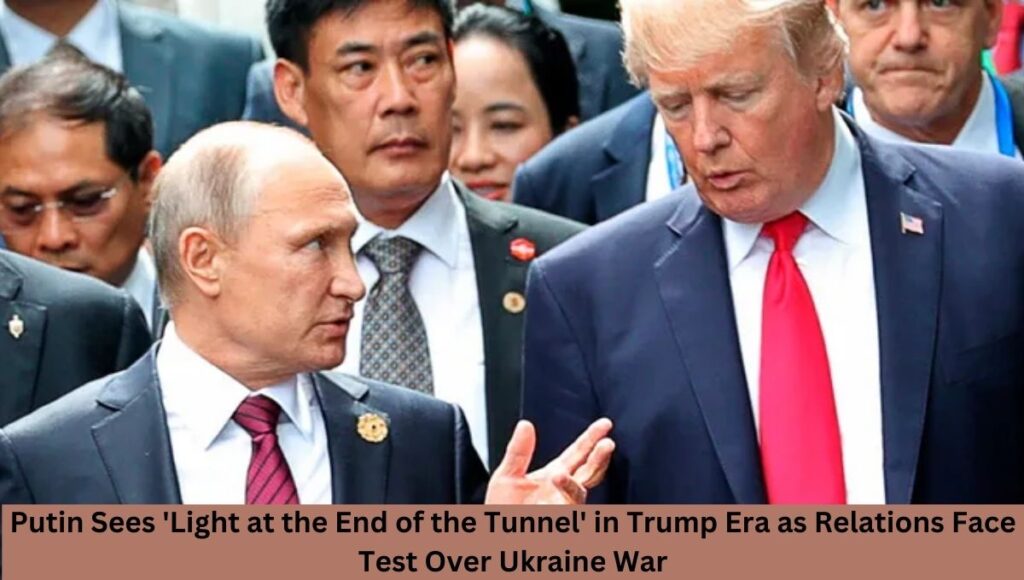
Putin Sees ‘Light at the End of the Tunnel’ in Trump Era as Relations Face Test Over Ukraine War
Russia-US Relations at a Crossroads
Relations between Moscow and Washington have sharply deteriorated in recent years over multiple issues, including:
- The ongoing Ukraine conflict, now in its third year.
- NATO’s eastward expansion, which Russia sees as a direct security threat.
- Economic sanctions imposed by the West against Russia.
Putin argued that Russia, unlike Western Europe, could not afford to lose its sovereignty:
“There are countries that can easily exist without sovereignty. Today, the entire Western Europe has, in fact, no sovereignty. There are also many other countries that are okay about it. However, it’s not for Russia: if Russia loses sovereignty, it will cease to exist in this present form.”
This strong assertion underscored the Kremlin’s position that Western pressure would not force Russia into concessions that threaten its national identity or territorial claims.
Trump’s Two-Week Deadline on Ukraine Peace Talks
On the same day as Putin’s remarks, Trump gave Moscow a clear ultimatum. Speaking from the White House, the US president said he would wait two weeks before making a final decision on how to proceed regarding Russia’s role in the Ukraine war.
“I think I’ll know. I think I’ll know the attitude of Russia, and, frankly, of Ukraine. It takes two,” Trump said. “Then I’m going to make a decision as to what we do, and it’s going to be a very important decision. That’s whether or not it’s massive sanctions or massive tariffs or both. Or do we do nothing and say it’s your fight.”
Trump stressed that his decision hinged on whether Russian President Vladimir Putin and Ukrainian President Volodymyr Zelenskyy would agree to meet face-to-face.
He said he was arranging such a meeting following discussions with Zelenskyy and European leaders in Washington, as well as a direct phone call with Putin.
Putin and Trump’s Alaska Summit
Putin’s hopeful comments came just days after he met Trump in Alaska, their first major summit since Trump entered the White House. Both leaders described the meeting as “meaningful and frank.”
Putin said:
“With the arrival of President Trump, I think that a light at the end of the tunnel has finally loomed. And now we had a very good, meaningful and frank meeting in Alaska. The next steps now depend on the leadership of the United States, but I am confident that the leadership qualities of the current president, President Trump, are a good guarantee that relations will be restored.”
During the summit, the two leaders reportedly discussed not only Ukraine but also economic opportunities in the Arctic and Alaska.
Putin hinted at potential joint projects, noting the region’s “huge, huge” mineral reserves and pointing to Russian energy giant Novatek’s existing operations there.
Putin-Zelensky Meeting in Doubt
Despite Trump’s push for a direct Putin-Zelensky meeting, Russia’s foreign minister Sergey Lavrov cast doubt on the likelihood of such a summit. Speaking on NBC’s Meet the Press, Lavrov said:
“Putin is ready to meet with Zelenskyy when the agenda would be ready for a summit. And this agenda is not ready at all. So no meeting is planned for now.”
Lavrov criticized Ukraine for refusing to show flexibility on key issues raised by Trump, including NATO membership, territorial disputes, and language laws affecting Russian speakers in Ukraine.
He accused Zelenskyy of blocking talks by rejecting these conditions.
Meanwhile, Zelenskyy accused Moscow of deliberately avoiding peace talks and urged Western allies to impose tougher sanctions on Russia.
Russia’s Demands and Ukraine’s Resistance
According to reports, Russia has remained firm on its key demands:
- Ukraine must renounce its ambition to join NATO and remain neutral.
- Kyiv must cede the entire eastern Donbas region to Russia.
- Western troops must stay out of Ukrainian territory.
While Putin signaled some flexibility, such as freezing the current front line and returning small portions of occupied land, Zelenskyy flatly rejected any deal that involved gifting territory to Russia.
“The Kremlin is doing everything it can to prevent a meeting between me and Putin. They want Donbas. They want NATO off the table. But we cannot accept these terms,” Zelenskyy said.
Trump’s Frustration With Russia’s Actions
Trump’s optimism about a breakthrough dimmed after reports of a Russian strike on an American-operated factory in Ukraine, which caused a fire and injured several employees.
Speaking at the White House, he said:
“I’m not happy about it, and I’m not happy about anything having to do with that war.”
The incident added to the pressure on Trump as he tried to balance his promises of ending the war quickly with the realities of Russia’s hardline stance.
Economic Opportunities and Arctic Cooperation
Despite the tensions, both Moscow and Washington see economic opportunities if relations normalize.
Putin specifically mentioned cooperation in the Arctic and Alaska, pointing to untapped mineral and energy reserves.
“We are discussing, by the way, with American partners the possibility of working together in this area. And not only in our Arctic zone, but also in Alaska.
And at the same time, the technologies that we possess, today no one but us possesses. And this is of interest to our partners, including those from the States,” Putin said.
Such projects could provide an economic incentive for both sides to ease tensions, although geopolitical disputes continue to overshadow potential cooperation.
Also Read: Russia’s Putin eyes Arctic cooperation despite geopolitical tensions
Trump’s Balancing Act
For Trump, the challenge remains managing expectations. He has repeatedly claimed he could end the Ukraine war “within 24 hours,” but the reality has proven far more complicated.
His two-week deadline reflects both his impatience and his desire to demonstrate decisive leadership.
At the same time, Trump has sought to maintain a personal rapport with Putin. At a FIFA-related event, he even brandished a photograph of himself with the Russian leader from their Alaska summit.
“Putin sent the picture and I’m going to sign this for him,” Trump said. “He was very respectful of me and my country, and not so respectful of others.”
This personal diplomacy has raised eyebrows among US allies, many of whom worry Trump may prioritize his relationship with Putin over Ukraine’s sovereignty.
Conclusion: A Fragile Hope for Diplomacy
Putin’s optimism and Trump’s deadlines highlight the fragile state of Russia-US relations at a time when the Ukraine war grinds on with no clear end in sight. While both leaders see potential for cooperation, fundamental disagreements over Ukraine’s future, NATO, and sovereignty issues remain unresolved. As Trump weighs sanctions and Putin hails new opportunities, the coming weeks will test whether the two leaders can bridge their differences or whether their optimism will give way to renewed confrontation.