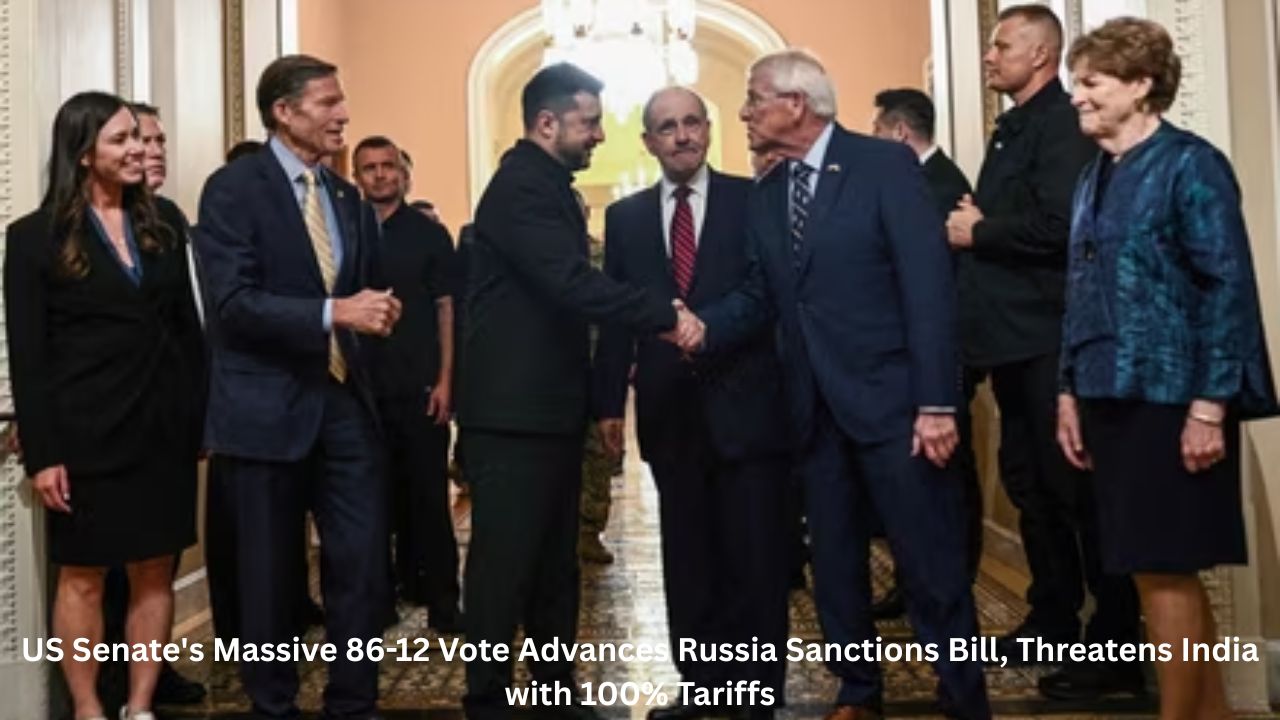
US Senate’s Massive 86-12 Vote Advances Russia Sanctions Bill, Threatens India With 100% Tariffs over Russian oil purchases. The United States Senate delivered one of its most significant bipartisan votes in years on Tuesday, advancing a sweeping sanctions package aimed at choking off Russia’s war financing — and putting India, China, and several other nations on notice that punishing new tariffs could be just weeks away.
Thank you for reading this post, don't forget to subscribe!In an overwhelming 86-12 vote, senators from both parties agreed to fast-track the “Lindsey O. Graham Sanctioning Russia and Iran Act of 2026,” a bill that would authorize President Donald Trump to slap tariffs of up to 100 percent on countries that continue buying large volumes of Russian oil and gas.
The vote came on an emotionally charged day in Washington:
hours after Ukrainian President Volodymyr Zelensky met Trump at the White House, and just as lawmakers gathered to bid farewell to the bill’s namesake, Senator Lindsey Graham, at his Washington funeral.
For India, already navigating a delicate balancing act between its energy needs and its relationship with Washington, the bill’s tariff provisions land as an unwelcome reminder that its Russian oil purchases remain firmly in the crosshairs of US policy.
US Senate’s Massive 86-12 Vote Advances Russia Sanctions Bill, Threatens India with 100% Tariffs
Quick Facts: The Russia Sanctions Bill
- What happened: The US Senate voted 86-12 to advance a Russia and Iran sanctions bill
- Bill name: Lindsey O. Graham Sanctioning Russia and Iran Act of 2026
- Key provision: Authorizes tariffs of up to 100% on major buyers of Russian oil and gas
- Countries at risk: India and China, along with Slovakia, Hungary, and Azerbaijan
- Vote breakdown: 86 in favor, 12 opposed (10 Democrats, one independent, one Republican)
- Context: The vote coincided with the Washington funeral of Senator Lindsey Graham
- Next step: The House has already left for summer recess and is unlikely to act before September
What the Senate Actually Voted On
It’s important to be precise about what Tuesday’s vote did and didn’t do. Senators voted to begin formal consideration of the bill — a procedural step, not a final passage.
That means further debate, possible amendments, and an eventual up-or-down vote are still ahead in the Senate, before the legislation would even reach the House of Representatives.
Even so, the scale of bipartisan support — 86 votes in favor, against just 12 dissenters — signals unusually strong momentum for one of the toughest Russia sanctions packages Congress has considered since the war in Ukraine began.
The bill would impose new sanctions on Russian government officials, oligarchs, and financial institutions, while also incorporating the bipartisan Shadow Fleet Sanctions Act, which targets the network of tankers Moscow uses to quietly ship oil around existing Western restrictions.
A Bill Named After Lindsey Graham — Passed on the Day of His Funeral
The timing of the vote carried unmistakable symbolism. Senator Lindsey Graham, the South Carolina Republican who spent more than a year building bipartisan support for the legislation, died suddenly earlier this month.
Tuesday’s procedural vote took place on the very day Washington gathered to honor him, with the bill now formally bearing his name.
Zelensky, who was in Washington and attended the funeral, called the timing “symbolic,” describing the vote as an honor to witness and framing it as the first real step toward implementing Graham’s unfinished work.
A bipartisan group of senators echoed that sentiment, saying there was no better way to honor Graham’s legacy than pushing the agreement he helped build across the finish line.
Trump, who had held back support for earlier, harsher versions of the bill for months, gave his blessing to a revised version shortly before Graham’s death — reportedly on the condition that new Iran-related sanctions be folded in as well.
Zelensky’s Washington Blitz: Meetings With Trump, 60 Senators, and Lockheed Martin
Tuesday’s vote unfolded against the backdrop of a packed Washington itinerary for Zelensky, who used the visit to press for continued American support as the war with Russia grinds into its fifth year.
The Ukrainian leader met Trump at the White House, describing the meeting as productive on a range of issues.
He also addressed a rare gathering of more than 60 US senators from both parties, focusing much of the discussion on strengthening Ukraine’s anti-ballistic missile defenses.
Separately, Zelensky met with executives from defense giant Lockheed Martin — the manufacturer behind ATACMS missiles, HIMARS rocket systems, F-16 fighter jets, and Patriot air-defense interceptors — to discuss expanding joint production and technology-sharing arrangements between the two countries.
Zelensky later wrote online that his teams were already working on concrete steps toward co-producing air-defense systems with the US, calling continued American backing essential to protecting Ukrainian lives.
How the Sanctions Bill Targets Russia’s War Machine
Sanctions on Oligarchs, Banks, and the “Shadow Fleet”
At its core, the legislation is designed to squeeze the financial pipelines that keep Russia’s war effort funded.
It authorizes penalties against senior Russian officials, wealthy oligarchs connected to President Vladimir Putin, and major financial institutions tied to the Kremlin.
The inclusion of the Shadow Fleet Sanctions Act specifically targets the aging, often unregistered tanker fleet that Russia has relied on to keep exporting oil despite existing Western price caps and restrictions.
Supporters argue that cutting off this energy revenue is one of the few remaining tools capable of meaningfully constraining Putin’s ability to sustain the war, especially as diplomatic efforts toward a ceasefire remain stalled.
Iran Provisions Added at Trump’s Request
In a notable late addition, the bill also extends existing US sanctions authority aimed at restricting Iran’s energy and weapons sectors.
The provision was reportedly added directly at Trump’s request, reflecting Washington’s parallel focus on Tehran amid ongoing tension between the US and Iran.
Lawmakers say the goal is to continue limiting Iran’s ability to fund its nuclear program and support militant proxy groups across the Middle East.
The 100% Tariff Threat: Why India and China Are in the Crosshairs
Perhaps the most consequential — and controversial — part of the bill is the tariff authority it would hand to the president.
If enacted, the legislation would let the US Trade Representative impose tariffs of up to 100 percent on the top five importers of Russian oil and gas.
That figure marks a significant scale-back from an earlier, far more aggressive proposal that floated tariffs as high as 500 percent on the same group of countries.
While the exact list of the “top five” purchasers is still being clarified, most reporting points to India and China as the two largest targets, alongside Slovakia, Hungary, and Azerbaijan.
Notably, the bill reportedly carves out an exception for countries whose Russian gas purchases fall below 15 percent of Russia’s total gas exports, a threshold intended to spare some smaller buyers from the harshest penalties.
India’s Russian Oil Dilemma
For India, the stakes are considerable. The country is currently the second-largest buyer of Russian crude oil in the world, trailing only China, and together the two nations account for roughly 70 percent of Russia’s total energy exports.
India’s reliance on discounted Russian oil has only grown in recent months amid volatility in global energy markets, putting New Delhi squarely in Washington’s sights even as the two countries continue to deepen strategic ties in other areas.
This isn’t India’s first brush with US tariff pressure over its Russian oil purchases — Washington had already raised tariffs on Indian goods and sanctioned major Russian oil companies earlier in this dispute.
If this new bill becomes law, India could face a far steeper penalty than anything imposed so far, forcing New Delhi to weigh energy affordability against access to the American market.
Not Everyone Is On Board: Criticism From Both Sides
Despite the lopsided vote count, the bill isn’t without detractors. Ten Democrats, independent Senator Bernie Sanders of Vermont, and Republican Senator Rand Paul of Kentucky all voted against advancing the measure — a mix of lawmakers united less by ideology than by shared discomfort with specific provisions.
Some Democratic critics argue that handing the president sweeping tariff authority effectively legitimizes power that the Supreme Court had previously pushed back against, and warn that broad tariffs could ultimately raise costs for American consumers or strain relationships with European allies who also import some Russian energy.
Other lawmakers have raised concerns that the sanctions themselves, while politically popular, may prove weaker in practice than their tough headlines suggest.
What Happens Next
Tuesday’s vote was only the opening move. The bill still needs to clear additional Senate debate and a final floor vote before it can move to the House of Representatives — and the House, notably, has already left Washington for its summer recess.
That means any realistic chance of the legislation reaching Trump’s desk is unlikely before September at the earliest, leaving India, China, and other affected nations with a window to prepare their responses, or lobby against the bill’s harshest provisions, before it potentially becomes law.
In the meantime, the political message from Washington was clear: with 86 senators willing to move the bill forward on the same day they laid Lindsey Graham to rest, pressure on Russia — and on the countries still buying its oil — is only intensifying.
Conclusion
Tuesday’s Senate vote captured a rare moment of bipartisan unity in a deeply divided Congress, fused with genuine political emotion as lawmakers honored a colleague who didn’t live to see his signature legislation cross this milestone.
But beneath the symbolism lies a policy shift with real global consequences:
a tariff threat of up to 100 percent that could reshape energy trade for India, China, and other major economies almost overnight.
With the bill now facing further votes and a House that won’t reconvene until autumn, the coming weeks will determine whether this moment of Senate unity translates into lasting pressure on Moscow — or simply becomes another flashpoint in the wider trade tensions between Washington and the world’s largest oil-importing nations.
Also Read: 7 Powerful Shifts as India Slashes Russian Oil Buys Ahead of U.S. Sanctions
Also Read: Senate advances Graham bill to put harsher sanctions on Russia, Iran