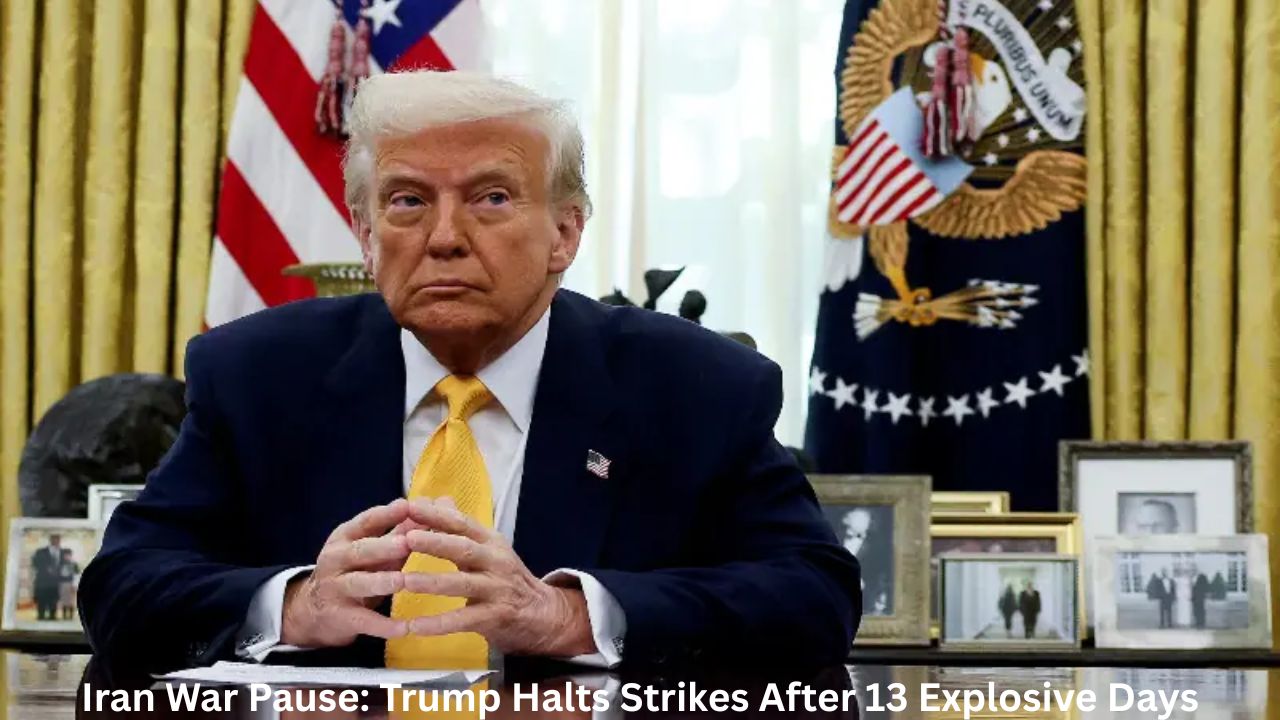
Iran War Pause: Trump Halts Strikes After 13 Explosive Days as Omani mediators push to reopen the Strait of Hormuz. For the first time in nearly two weeks, the skies over Iran stayed quiet. President Donald Trump ordered the US military to stand down from launching new strikes on Friday, breaking a 13-day streak of daily bombing runs that had pushed the Middle East to the brink of a far larger war.
But even as Washington and Tehran edged toward the negotiating table, the conflict’s shockwaves kept spreading — this time into the Red Sea, where Iran-backed Houthi rebels unleashed a fresh wave of attacks on Saudi Arabia’s critical oil infrastructure.
The result is a region caught between two conflicting signals:
a tentative opening for diplomacy in one corner, and an intensifying proxy battle in another.
Global oil markets, already rattled by weeks of turmoil, are watching closely to see which trend wins out.
Iran War Pause: Trump Halts Strikes After 13 Explosive Days
Trump Breaks the 13-Day Strike Streak — Why Now?
For nearly two weeks, the pattern had become almost routine. Every afternoon, the US military submitted a strike plan for Iran, and every afternoon, Trump approved it, with attacks carried out within hours.
That changed on Friday, when Trump reviewed a similar plan but chose not to give the green light, instead directing the military to hold off entirely.
A Directive From the Oval Office
According to people familiar with the decision, Trump’s order reflected two things:
a genuine desire to create breathing room for diplomacy, and a recognition that the current tempo of strikes had largely run its course in terms of battlefield impact.
The US military is reportedly still drawing up plans for a potential shift to full-scale combat operations, but as of Friday, Trump had not authorized that step.
Speaking to reporters at the White House, the president made clear he still sees escalation as an option, but described negotiation as the smarter path forward, adding that Iran appeared to be growing more serious in talks “as the days go by.”
Diplomacy Gets a Chance: Oman’s Tehran Mission
The timing of Trump’s pause wasn’t accidental. Just hours before the announcement, a delegation from Oman arrived in Tehran for talks aimed at brokering a new arrangement to reopen the Strait of Hormuz, the narrow waterway that has become the flashpoint of the entire conflict.
Regional sources close to the negotiations suggested real progress had been made, with some optimism that an Oman-Iran agreement could be finalized over the weekend.
Any such deal would still need Trump’s sign-off before it could take effect — meaning the ball, for now, sits in Washington’s court as much as Tehran’s.
Adding to the sense of a fragile lull, Iran’s Health Ministry spokesperson posted on social media Saturday that the country had experienced what he called a peaceful night, with no reported attacks — a notable departure after 13 consecutive nights of US strikes.
The Houthis Strike Back: Saudi Aramco Sites Under Fire
While the US-Iran track showed early signs of cooling, the conflict’s other front heated up considerably.
Houthi rebels in Yemen, who are backed by Tehran, escalated their campaign against Saudi Arabia this week, targeting tankers in the Red Sea and firing directly at Saudi oil infrastructure.
Sirens Over Yanbu and Jizan
Air raid sirens sounded repeatedly early Saturday across Saudi Arabia’s Yanbu and Jizan provinces — both home to major oil facilities along the Red Sea coast.
Saudi Civil Defense confirmed the alerts were triggered by incoming missile and drone fire from Yemen, though it said the danger had since passed.
Footage circulating from Jizan showed thick black smoke rising from an Aramco refinery struck during the barrage.
A Patriot missile battery operated by Greek military personnel — stationed in Saudi Arabia since 2021 to help defend the kingdom’s energy infrastructure — intercepted at least one drone in the Yanbu area during the exchange.
Neighboring Bahrain also issued missile alerts, though no casualties were reported there.
Saudi Arabia Responds With Hodeida Strike
The escalation didn’t stop with Houthi attacks.
After Yemeni rebels targeted two Saudi oil tankers in the Red Sea earlier in the week, the Saudi-led coalition retaliated with a strike on the Houthi-controlled port city of Hodeida.
It’s a sharp reversal from the relative calm that had held in Yemen since a UN-brokered truce in 2022 — a truce that has now clearly frayed under the pressure of the wider Iran war.
Strait of Hormuz: The Chokepoint at the Center of It All
No single stretch of water matters more to this conflict than the Strait of Hormuz, the passage through which roughly one-fifth of the world’s oil supply normally flows.
Iran’s blockade of the strait — and the US Navy’s parallel blockade of Iranian ports — has choked shipping traffic to a fraction of its usual volume.
Tracking firm Kpler recorded just six confirmed crossings through the strait on Thursday, a 60% drop from the day before.
Iran’s Revolutionary Guards said Saturday they had turned back four vessels attempting an “unsafe” transit through the strait over the previous 24 hours, firing warning shots that prompted the ships to change course.
On the US side, the Navy disabled a merchant vessel in the Gulf of Oman on Friday after it allegedly tried to breach Washington’s blockade, firing into the ship’s engine room to stop it in its tracks.
The Human and Economic Toll of the Iran War
The scale of the conflict’s cost has become staggering.
Iran’s Health Ministry has reported more than 3,400 people killed inside the country since the fighting began, while officials say 18 US service members and 24 Israeli civilians have also died.
The parallel conflict between Israel and Iran-backed Hezbollah in Lebanon has proven even deadlier, with more than 4,000 people reported killed there — a figure that doesn’t distinguish between civilians and combatants — alongside 38 Israeli troops.
Israel, for its part, says it has killed more than 2,500 Hezbollah fighters.
None of these figures have been independently verified, and both sides have strong incentives to shape the narrative around casualties.
The economic toll has been just as dramatic.
Brent crude briefly spiked above $100 a barrel this week before easing slightly, and analysts at Barclays have warned that a sustained three-month disruption to Hormuz traffic could push prices as high as $150 a barrel — a level that would ripple through economies far beyond the Middle East, driving up costs for everything from gasoline to airline tickets to everyday consumer goods worldwide.
Diplomatic Chess: What Iran and the US Are Saying
Publicly, both sides are sending mixed signals.
Trump has repeatedly framed the choice for Tehran in blunt terms:
cut a deal, or face a dramatically higher level of strikes.
He’s claimed that US and allied attacks have already crippled much of Iran’s navy, air force, and radar systems, though those specific claims haven’t been independently confirmed.
Iran’s Foreign Minister, Abbas Araghchi, has pushed back forcefully, insisting Tehran won’t bow to pressure and placing blame on Washington for unraveling the ceasefire that briefly held earlier this month.
Araghchi has also sought to distance Iran from the Yemen escalation specifically, arguing the Houthi-Saudi conflict has roots that predate the current crisis and calling instead for dialogue.
Meanwhile, Iran has found some diplomatic cover from Russia, with Russian Foreign Minister Sergey Lavrov offering to help build a new regional security framework and publicly criticizing the US and Israeli military campaign.
Global Markets React: Oil Prices Swing
Financial markets have been on a rollercoaster as investors try to price in the odds of further escalation versus a genuine de-escalation.
Stocks logged losses for the week as the widening conflict compounded existing worries about tariffs and volatility in AI-related tech stocks.
Energy markets in particular remain hypersensitive to every headline out of the Gulf — a single report of a ship being turned back or a refinery being hit is enough to send crude prices swinging in either direction.
What Happens Next?
Whether Friday’s pause marks a genuine turning point or just a brief lull remains an open question.
Trump himself has acknowledged that the US military can resume strikes on short notice if talks break down.
Much now hinges on whether the Oman-brokered framework for reopening the Strait of Hormuz can actually be finalized — and whether Iran can rein in, or at least distance itself from, the Houthi attacks that continue to threaten Saudi Arabia’s oil infrastructure even as the higher-level diplomatic track shows signs of progress.
Conclusion
Thirteen days of near-nightly strikes have given way, for now, to a cautious and fragile calm between Washington and Tehran — but the broader Iran war is far from over.
With Houthi rockets still finding their way to Saudi Aramco facilities, the Strait of Hormuz still choked to a fraction of normal traffic, and casualty figures climbing on multiple fronts across the region, this pause looks less like an ending and more like a pivot point.
Whether it leads toward a lasting diplomatic breakthrough or simply resets the clock before the next escalation will likely become clear in the days ahead, as the world watches the Gulf, the Red Sea, and the oil markets that connect them both.
Also Read: Yemen War 2025: Israeli Strike Kills Houthi Military Chief in ‘Major Blow’
Also Read: Why new Houthi threats in the Red Sea could spell trouble for global oil prices and inflation
Related Posts:
- 11 Explosive Warnings as Trump Vows to ‘Knock the…

- 12 Explosive Claims as Donald Trump Says Iran War…
- 10 Explosive Signals: Trump Rates Iran War “15/10”…
- 10 Explosive Warnings as Donald Trump Calls Iran…
- 10 Explosive Signals Trump Says Iran War Could End…
- 10 Powerful Revelations from the Trump–Putin Call on…