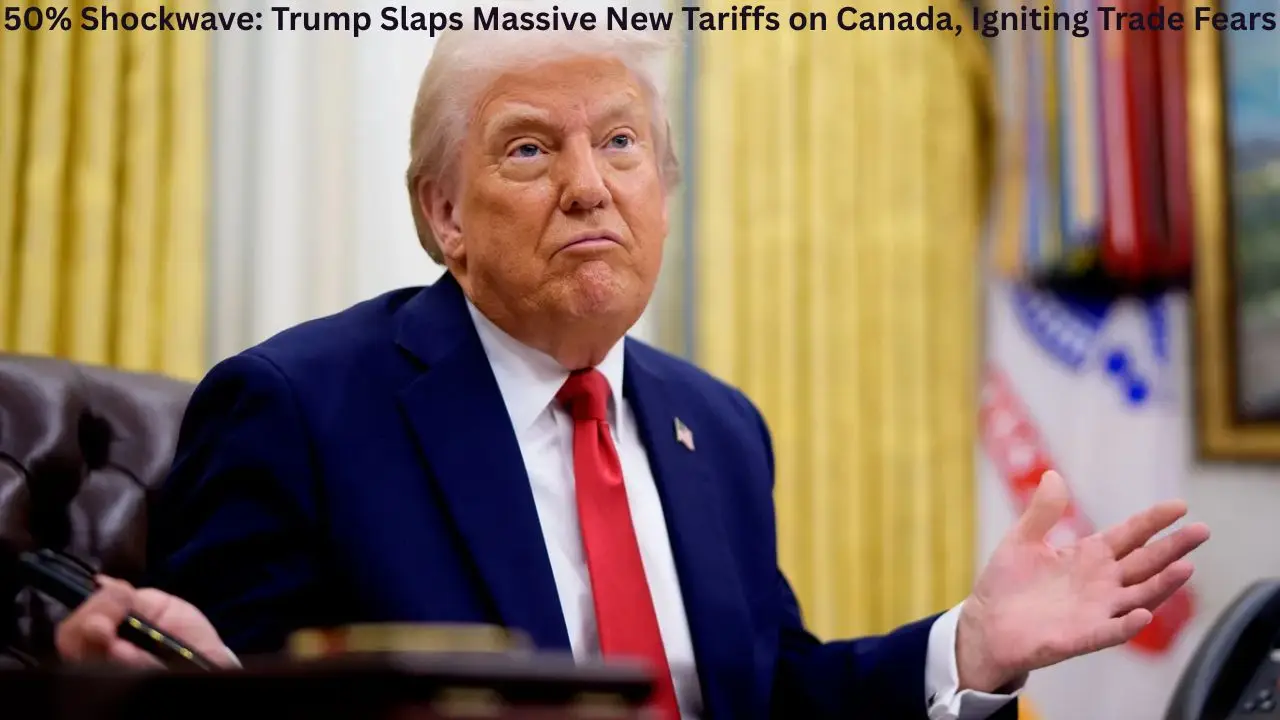
50% Shockwave: Trump Slaps Massive New Tariffs on Canada, Igniting Trade Fears as Carney vows a firm response. Just when the U.S.-Canada trade relationship seemed to be finding a fragile calm, President Donald Trump has thrown it back into turmoil.
On Monday, July 20, 2026, Trump signed proclamations imposing new 50% tariffs on a wide range of Canadian goods, reigniting fears of a fresh trade war between two of the world’s closest economic allies, just as America’s northern neighbor was still absorbing the fallout from previous rounds of tariff battles.
The move marks one of the steepest tariff actions the Trump administration has taken against any single country, and it lands at an especially sensitive moment — barely a day after Trump and Canadian Prime Minister Mark Carney sat down together at the FIFA World Cup final in New Jersey.
Here’s a full breakdown of what was announced, why the administration says it’s necessary, how Canada is responding, and what could come next.
50% Shockwave: Trump Slaps Massive New Tariffs on Canada, Igniting Trade Fears
What Products Are Affected by the New Tariffs?
According to a White House fact sheet, the fresh 50% duties apply to a broad list of Canadian exports, including:
- Wine
- Hockey sticks
- Cement
- Dairy products
- Motor vehicles
- Electrical equipment and machinery
- Furniture
- Ice hockey gear
The tariffs are estimated to cover roughly $20 billion worth of Canadian goods.
Notably, the White House confirmed that several major categories are excluded from the new round, including energy products, potash, critical minerals, fish, and goods already covered under existing sector-specific tariffs, such as autos and metals in certain categories.
The new duties are set to take effect in 30 days, giving both governments a narrow window to negotiate before the measures kick in.
The Legal Tool Behind the Move: An Obscure 1930s Law
Rather than relying on the tariff powers Trump has used throughout his presidency — some of which were struck down by the U.S. Supreme Court earlier this year — the administration is using a rarely invoked legal provision this time:
Section 338 of the Tariff Act of 1930.
Section 338 allows a U.S. president to impose tariffs of up to 50% on countries found to be discriminating against American goods.
According to legal experts, the law has effectively “gone unused for decades,” with no public record of it being applied since 1949, making this an unusually aggressive and largely untested use of presidential trade authority.
Why Is the Administration Doing This Now?
The White House framed the tariffs as a direct response to what it called Canada’s “discriminatory” and retaliatory trade practices.
In a statement, U.S. Trade Representative Jamieson Greer laid out the administration’s case bluntly, accusing Canada of taking U.S. alcohol products off store shelves, giving European dairy producers better market access than American ones, and capping U.S. vehicle exports from companies reshoring production to the United States.
“Canada, unlike other partners and allies, continues to retaliate against the United States for its efforts to rebalance trade and protect U.S. industry in national-security sensitive sectors,” Greer said, adding that the new tariffs aim to “hold Canada accountable for its retaliation and discrimination.”
The administration also pointed out that Canada was one of only two countries — alongside China — that retaliated against Trump’s earlier tariffs last year.
A Crucial Detail: No USMCA Carve-Out This Time
One of the most significant elements of Monday’s announcement is what’s missing from it:
an exemption for goods covered under the United States-Mexico-Canada Agreement (USMCA), also known in Canada as CUSMA.
In previous rounds of tariffs, Trump’s administration had generally carved out protections for products moving under that free trade pact.
This time, there’s no such shield — meaning USMCA-covered goods are directly in the line of fire.
That detail matters enormously, since the USMCA has functioned as the backbone of North American trade for years.
Earlier this month, the Trump administration had already signaled it would not renew the agreement outright, instead triggering a series of annual reviews that cast uncertainty over the treaty’s long-term future.
Canadian Prime Minister Mark Carney was quick to point this out, calling the new tariffs a “direct violation” of the USMCA/CUSMA framework.
Is This Connected to the Wildfire Smoke Dispute?
Just days before the tariff announcement, Trump had publicly threatened to hit Canada with additional tariffs over wildfire smoke drifting across the border, blaming fires burning in Ontario and Manitoba for air quality problems in parts of the U.S. Trump wrote on Truth Social that the costs of the resulting pollution “must of necessity be added to the TARIFFS Canada is currently paying.”
However, senior administration officials were explicit on a briefing call Monday that the newly announced 50% tariffs are not related to the wildfire dispute — though one official noted that Trump “has asked for options on that,” suggesting a separate wildfire-related tariff action could still be on the table down the line.
Adding an unexpected wrinkle to the timeline:
Trump and Carney had actually met in person just a day earlier, at the World Cup final in New Jersey on Sunday.
According to a senior administration official, the two leaders did discuss matters one-on-one, but “it was not a visit to talk about trade and tariffs” — meaning Carney reportedly had no advance warning that sweeping new tariffs were about to land on his desk.
How Is Canada Responding?
Canadian Prime Minister Mark Carney responded to the tariff announcement in a statement posted on X, striking a measured but firm tone.
He described the move as the latest in “a series of unilateral US trade actions” that he said violate the USMCA/CUSMA agreement.
“This trade dispute has raised costs for families, particularly in the U.S.,” Carney said, while reaffirming that “Canada believes in the benefits of free and fair trade,” pointing to more than 20 new economic and security partnerships his government has signed as evidence of that commitment.
Crucially, Carney signaled Canada’s willingness to keep talking rather than immediately escalate.
“We stand ready to intensify those discussions in the coming weeks,” he said, adding that in “all circumstances, Canada will work relentlessly and take any measures necessary to build our strength at home and to support Canadian workers, farmers, businesses, and families.”
Not every Canadian official struck the same restrained tone. Ontario Premier Doug Ford, who has been an outspoken critic of Trump’s tariffs in the past, took a considerably harder line, writing on social media:
“I’ll never stop fighting to protect Ontario. If these tariffs proceed, Canada should respond tariff for tariff, dollar for dollar.”
A Long-Running Trade Battle Reaches a New Peak
Monday’s announcement is far from the first shot fired in this dispute. Trump and Carney’s governments have been locked in an escalating tariff standoff for well over a year.
Canada currently pays a 25% tariff on steel and aluminum products, a 10% tariff on softwood timber and lumber imports, and a separate 12.5% tariff tied to forced-labor concerns that was only implemented last month.
Tensions have also been fueled by Trump’s repeated calls for Canada to become the “51st state” of the United States — remarks that have drawn sharp pushback from Canadian officials and contributed to consumer boycotts of American alcohol products across several Canadian provinces, one of the very grievances the White House cited in justifying its new tariffs.
What Happens Next?
With the tariffs set to take effect in 30 days, both governments now face a narrow window to either de-escalate through negotiation or allow the measures to move forward as planned.
A senior U.S. administration official insisted, “This is not a trade war with Canada,” framing the move instead as an attempt to correct a long-standing trade imbalance.
Still, businesses on both sides of the border have already voiced concern about the risk of broader economic fallout, particularly given how deeply integrated supply chains are between the two countries.
Markets and industry groups will now be watching closely for signs of how Ottawa plans to respond — whether through matching retaliatory tariffs, as Premier Ford has urged, or through the kind of intensified diplomatic talks Carney has proposed.
Conclusion
Trump’s decision to impose fresh 50% tariffs on a broad swath of Canadian goods marks a significant escalation in one of the world’s most consequential trading relationships.
By invoking a decades-dormant legal provision and, for the first time, declining to shield USMCA-covered products, the administration has signaled it’s willing to test the limits of both U.S. trade law and North American economic cooperation.
Canada, for its part, appears to be threading a careful needle — condemning the move as a violation of existing agreements while still leaving the door open for negotiation.
Whether this becomes the opening move of a full-blown trade war or a pressure tactic aimed at extracting concessions before the 30-day deadline will likely become clear in the weeks ahead.
For now, industries on both sides of the border — from Canadian wine producers to American dairy farmers — are left watching closely to see what comes next.
Also Read: 7 Alarming Reasons Mexico’s Shock Tariffs Hammer India and Asia
Also Read: CNBC Daily Open: Trump revives his tariff playbook with Canada
Related Posts:
- 5 Key Takeaways from Trump–Carney Meet: Trade,…
- 9 Explosive Stakes Behind Trump’s 100% Tariff Threat…
- Trump Slaps 35% Tariff on Canadian Imports Starting August 1
- 7 Explosive Reasons Trump’s 100% Tariff Threat Shook…

- U.S. and Canada Navigate Tensions as Carney, Trump…

- What’s Next for Donald Trump After Court Rules His…