7 Powerful Takeaways from the US Supreme Court Birthright Citizenship Ruling rejecting Trump’s proposed limits. In one of the most consequential constitutional decisions on immigration in recent years, the United States Supreme Court has reaffirmed the long-standing principle of birthright citizenship by rejecting an attempt to restrict automatic citizenship for children born on American soil.
The ruling represents a significant setback for former US President Donald Trump’s long-standing campaign to reinterpret the Citizenship Clause of the Fourteenth Amendment. It also provides renewed legal certainty for millions of immigrant families, employers, universities, and international communities that have closely followed the case.
Beyond the immediate political implications, the decision highlights the enduring strength of constitutional protections in the United States. Legal experts describe it as one of the most important immigration rulings of the decade because it reinforces a principle that has shaped American citizenship for more than 150 years.
For families living and working in the United States—including thousands of professionals on employment visas such as H-1B, L-1, and other legal immigration pathways—the judgment offers reassurance that constitutional rights cannot easily be altered through executive action alone. The decision has also attracted worldwide attention because many countries view the United States as a destination for education, employment, innovation, and investment.
Any change to citizenship laws would have affected not only Americans but also countless international families planning their future in the country.

7 Powerful Takeaways from the US Supreme Court Birthright Citizenship Ruling
What Is Birthright Citizenship?
Birthright citizenship refers to the legal principle that nearly every child born within the territory of the United States automatically becomes a US citizen, regardless of the immigration status of their parents.
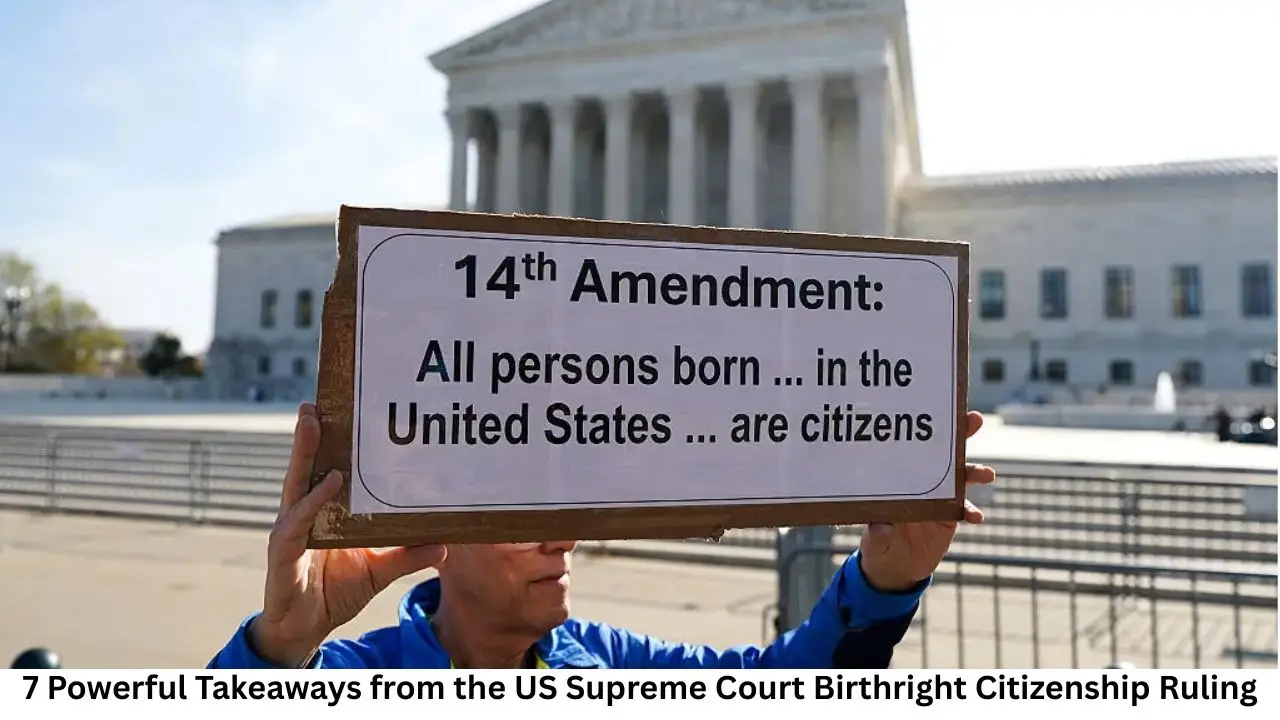
This protection is rooted in the Citizenship Clause of the Fourteenth Amendment to the US Constitution, ratified in 1868 following the American Civil War. The amendment states that all persons born or naturalized in the United States and subject to its jurisdiction are citizens of the United States and of the state in which they reside.
The amendment was originally adopted to guarantee citizenship to formerly enslaved people after the abolition of slavery. Over time, however, it evolved into one of the cornerstones of American constitutional law, extending citizenship to nearly everyone born within US borders.
For more than a century, courts have consistently interpreted the amendment broadly, reinforcing the idea that citizenship by birth is a constitutional guarantee rather than a privilege granted by politicians.
This interpretation has contributed to social stability by ensuring that children born in the country have equal legal standing regardless of their parents’ nationality, race, or immigration status.
Many constitutional scholars argue that this approach prevents the emergence of generations of stateless or legally uncertain children and strengthens the principle of equality before the law.
Why Donald Trump Wanted to Restrict Birthright Citizenship
Donald Trump has long argued that the existing interpretation of birthright citizenship encourages illegal immigration and so-called “birth tourism,” where foreign nationals travel to the United States specifically to give birth so their children automatically receive American citizenship.
Throughout his political career, Trump maintained that the Fourteenth Amendment had been interpreted too broadly and claimed that automatic citizenship should not apply to children whose parents were in the country unlawfully or only temporarily.
His administration sought to redefine the meaning of “subject to the jurisdiction” of the United States, arguing that constitutional protection should apply only to children whose parents had permanent legal status or full legal allegiance to the country.
Supporters of this position argued that restricting birthright citizenship would strengthen border security, reduce incentives for illegal immigration, and modernize immigration policy to reflect contemporary realities.
However, critics countered that such a move would directly conflict with more than a century of constitutional interpretation and Supreme Court precedent. Civil rights organizations, immigration advocates, constitutional scholars, universities, religious groups, and numerous legal experts warned that limiting birthright citizenship through executive action would undermine one of the Constitution’s clearest guarantees.
The legal dispute eventually reached the Supreme Court, where the justices were asked to determine whether the proposed restrictions could stand under the Constitution.
How the Supreme Court Reached Its Decision
The US Supreme Court’s ruling on birthright citizenship is being viewed as one of the most significant constitutional decisions of 2026. After months of legal arguments and nationwide debate, the Court reaffirmed that the Constitution protects the principle of birthright citizenship, rejecting efforts to narrow its scope through executive action.
At the center of the case was the Citizenship Clause of the Fourteenth Amendment, which states that all persons born in the United States and subject to its jurisdiction are citizens of the United States. The Court carefully examined the constitutional text, historical records, and decades of judicial precedent before reaching its decision.
The justices concluded that a president does not have the authority to unilaterally redefine who qualifies for citizenship at birth. While Congress has broad powers to shape immigration policy, the Constitution itself determines the basic qualifications for American citizenship. The Court emphasized that executive orders cannot override constitutional protections that have been consistently recognized for generations.
Legal experts say the ruling reaffirms an important constitutional principle: fundamental rights cannot be changed simply because political priorities shift. Any attempt to alter birthright citizenship would require either a constitutional amendment or a dramatic reinterpretation of the Fourteenth Amendment by the Supreme Court itself—neither of which occurred in this case.
Rather than introducing a new legal standard, the Court chose to uphold the interpretation that has guided American citizenship law for more than 150 years. Constitutional scholars have described the judgment as an example of judicial restraint, with the Court relying on established legal principles instead of creating new constitutional doctrine.
The ruling also highlights the judiciary’s role as a guardian of the Constitution. Even during periods of intense political disagreement over immigration, the Court stressed that constitutional guarantees must remain stable and cannot change with each new administration.
The Constitutional Foundation Behind the Ruling
One of the most important aspects of the decision is its reaffirmation of the Fourteenth Amendment as the cornerstone of American citizenship. Adopted in 1868 after the Civil War, the amendment was originally designed to ensure citizenship for formerly enslaved people and to prevent states from denying equal protection under the law.
Over time, its Citizenship Clause evolved into one of the strongest constitutional guarantees in the United States. The Supreme Court reaffirmed the long-standing understanding that children born on American soil are generally entitled to US citizenship regardless of their parents’ immigration status, except in a few well-established circumstances, such as children born to foreign diplomats or enemy forces occupying US territory.
This interpretation has been supported by more than a century of judicial precedent and consistent government practice. Millions of Americans today derive their citizenship from this constitutional principle, making it one of the most enduring features of the nation’s legal system. Constitutional experts warn that changing this framework would create widespread legal uncertainty.
Questions surrounding citizenship documentation, passport eligibility, voting rights, and access to public services could affect future generations. State governments, schools, hospitals, employers, and federal agencies would all face significant administrative challenges if birthright citizenship were suddenly redefined.
By reaffirming the Citizenship Clause, the Supreme Court has reinforced public confidence in constitutional stability and the rule of law. The decision demonstrates that core constitutional rights remain protected regardless of changing political priorities.
Donald Trump’s Response to the Decision
Former President Donald Trump responded quickly to the Supreme Court’s ruling, expressing disappointment while maintaining that birthright citizenship should remain a subject of political and legislative debate.
For years, Trump has argued that the current interpretation of the Fourteenth Amendment encourages unauthorized immigration and so-called “birth tourism,” in which foreign nationals travel to the United States so their children can automatically receive American citizenship.
Following the Court’s decision, Trump suggested that Congress could explore legislative measures to address broader immigration concerns. However, constitutional scholars point out that while Congress has the authority to enact immigration laws, it cannot pass legislation that conflicts with constitutional protections as interpreted by the Supreme Court.
The ruling is expected to keep birthright citizenship at the forefront of America’s political debate. Supporters of stricter immigration controls continue to advocate reforms, while opponents argue that any effort to weaken birthright citizenship would undermine one of the Constitution’s most enduring guarantees.
Why the Decision Matters for H-1B Professionals and International Families
Beyond its constitutional significance, the Supreme Court’s ruling has immediate real-world implications for millions of families living and working in the United States.
Professionals employed under H-1B, L-1, O-1, and other employment-based visa programs closely followed the case because it had the potential to affect the citizenship status of their future children. International students, researchers, entrepreneurs, and multinational companies also watched the proceedings with considerable interest.
By reaffirming birthright citizenship, the Court has provided legal certainty for families planning long-term careers and lives in the United States. Children born in the country under the existing constitutional framework will continue to receive US citizenship at birth, giving families greater confidence when making decisions about education, employment, and permanent residence.
The decision is also significant for employers in sectors such as technology, healthcare, engineering, finance, and higher education, all of which rely heavily on highly skilled international professionals. Stable constitutional protections help companies recruit global talent by reducing uncertainty surrounding immigration and citizenship policies.
International students pursuing degrees at American universities also stand to benefit from the clarity provided by the ruling. Many eventually transition to professional employment through visa programs before seeking permanent residency. A predictable constitutional framework makes long-term planning considerably easier for these individuals and their families.
Countries with large numbers of citizens working and studying in the United States—including India, China, South Korea, Canada, Mexico, Brazil, Nigeria, and the United Kingdom—have followed the case closely because of its potential impact on thousands of their nationals.
More broadly, the judgment sends a strong message that constitutional protections remain central to the American legal system. While immigration policies may continue to evolve through legislation and administrative action, the Supreme Court has reaffirmed that the nation’s foundational constitutional principles remain firmly intact.
Conclusion
The Supreme Court’s reaffirmation of birthright citizenship is far more than a legal victory—it is a defining constitutional moment that reinforces the balance of powers within the United States government. By rejecting attempts to narrow citizenship through executive action, the Court has upheld a constitutional principle that has shaped American society for more than 150 years.
For immigrant families, H-1B professionals, international students, employers, and millions of people around the world, the ruling provides welcome clarity and stability. Although political debates over immigration are certain to continue, the decision makes clear that fundamental constitutional rights cannot be altered without following the rigorous constitutional process.
As a result, this landmark judgment is likely to remain one of the most influential legal decisions of 2026, shaping discussions on citizenship, immigration, and constitutional law for years to come.
Also Read: 8 Explosive Developments as Trump Plans Long Hormuz Blockade Amid Iran Crisis
Also Read: Why the US Supreme Court struck down Trump’s birthright citizenship order