
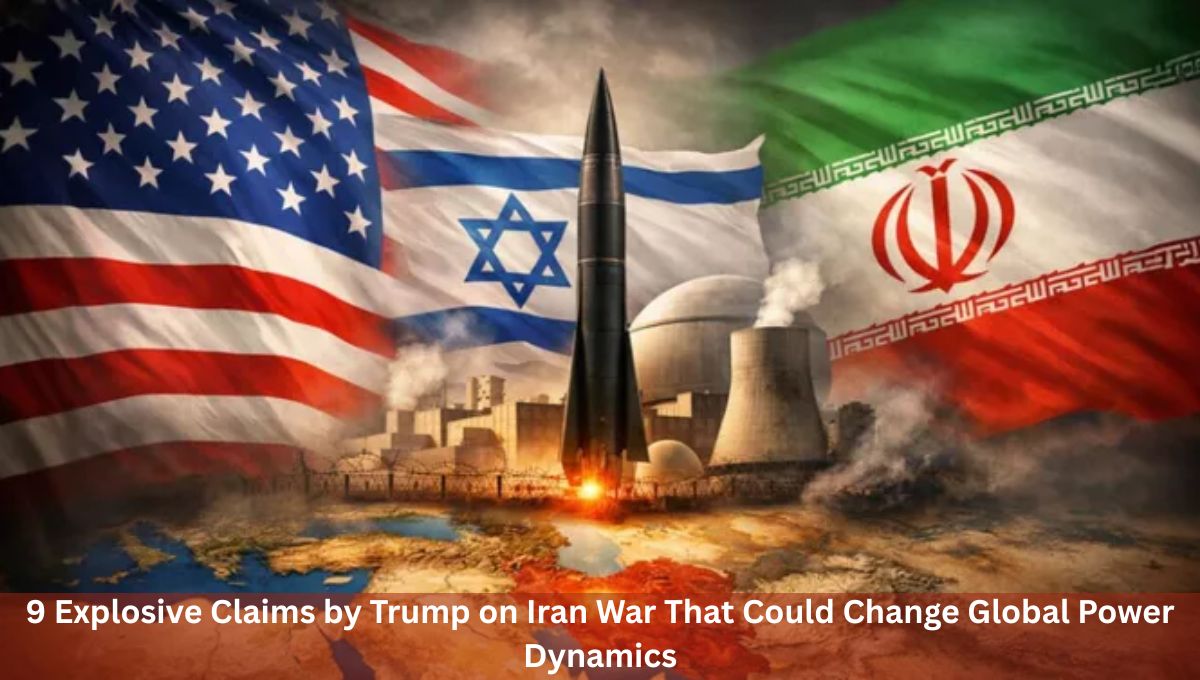
9 Explosive Claims by Trump on Iran War That Could Change Global Power Dynamics and raise geopolitical risks. US President Donald Trump has made a series of bold and controversial claims regarding the ongoing war with Iran, asserting that the United States is on the verge of a swift and decisive victory.
Thank you for reading this post, don't forget to subscribe!Speaking at a high-profile event in Las Vegas, Trump described the conflict as short-lived, controlled, and necessary—framing it as a strategic success rather than a prolonged military entanglement.
Yet, beneath this confident narrative lies a far more complex and volatile reality.
Rising oil prices, geopolitical instability, public skepticism, and fragile ceasefires across the Middle East paint a picture that is anything but settled.
This article breaks down Trump’s key claims, the evolving situation on the ground, and what it all means for global stability.
9 Explosive Claims by Trump on Iran War That Could Change Global Power Dynamics
Trump’s Core Claim: “Victory Very Shortly”
Trump’s central assertion is clear:
the United States is winning—and winning fast.
He emphasized the speed of the campaign compared to previous US wars, stating that the conflict has lasted only a matter of weeks and that victory is imminent.
By calling the war a “little diversion,” Trump signaled confidence in both military capability and strategic direction.
However, such framing has raised concerns among analysts who point out that conflicts involving Iran have historically been complex, prolonged, and unpredictable.
A Devastating Blow to Iran?
One of Trump’s most striking claims was that US forces have effectively dismantled Iran’s naval power.
According to the president:
- 158 Iranian ships have been destroyed
- Iran’s navy has been rendered ineffective
- Military capabilities have been severely weakened
He also referenced the earlier killing of Iranian General Qasem Soleimani, suggesting that it significantly undermined Iran’s regional influence.
While these claims project strength, independent verification remains limited, and military experts caution against taking such figures at face value without corroborating evidence.
The Nuclear “Red Line”
At the heart of the conflict lies Iran’s nuclear program. Trump reiterated that the United States’ primary objective is to ensure that Iran does not acquire nuclear weapons.
He claimed that Tehran has already agreed—“very powerfully”—to this condition.
Key Points in Negotiations:
- US demand: Permanent end to nuclear weapon capability
- Proposal: Up to 20-year suspension of uranium enrichment
- Iran’s stance: Shorter freeze (3–5 years)
- Possible compromise: Partial transfer of enriched uranium
Trump also introduced the controversial term “nuclear dust” to describe Iran’s enriched uranium stockpile, claiming that Iran has agreed to hand it over.
If true, this would represent a major breakthrough—but so far, there has been no independent confirmation.
The Strait of Hormuz: A Global Pressure Point
The Strait of Hormuz has become one of the most critical flashpoints in the conflict. This narrow waterway handles nearly 20% of global oil shipments.
Disruptions here have triggered:
- Sharp increases in oil prices
- Inflation across multiple economies
- Supply chain instability worldwide
Trump suggested that a successful deal with Iran would reopen the strait fully, leading to lower oil prices and economic relief.
For global markets, this is perhaps the most immediate and tangible stake in the conflict’s outcome.
Public Opinion Turns Against the War
Despite Trump’s optimism, public sentiment in the United States appears far less supportive.
Key Poll Findings:
- Majority believe the war is not worth the cost
- 65% blame rising fuel prices on the conflict
- Only 36% approve of Trump’s handling
This disconnect between leadership messaging and public perception could have significant political implications, especially with economic pressures mounting.
A Fragile Regional Ceasefire
Amid the broader conflict, a 10-day ceasefire between Israel and Hezbollah in Lebanon has emerged as a critical development.
The truce:
- Temporarily halts cross-border hostilities
- Creates space for diplomatic engagement
- Raises hopes for a broader regional pause
However, both sides remain on edge. Israel has signaled it will strike if threatened, while Hezbollah has warned of retaliation against any violations.
This fragile balance underscores the interconnected nature of Middle Eastern conflicts.
Pakistan’s Unexpected Diplomatic Role
One of the more surprising elements of the current situation is Pakistan’s role as a mediator between the US and Iran.
Trump praised Pakistan’s leadership and indicated that:
- Talks are being facilitated in Islamabad
- A deal could be signed there
- He may personally visit if an agreement is reached
This marks a notable shift in diplomatic dynamics, positioning Pakistan as a intermediary in one of the world’s most critical negotiations.
Trump’s Potential Visit to Islamabad
Trump’s suggestion that he might travel to Pakistan if a deal is finalized adds a symbolic dimension to the negotiations.
Such a visit would:
- Signal a major diplomatic breakthrough
- Reinforce Pakistan’s role as mediator
- Highlight the global significance of the agreement
It would also represent a rare instance of direct US presidential engagement in South Asian diplomacy tied to Middle Eastern peace efforts.
Economic Stakes: Oil, Inflation, and Markets
The economic impact of the conflict cannot be overstated.
Key Effects:
- Oil price volatility affecting global economies
- Increased transportation and energy costs
- Inflationary pressures in both developed and developing nations
Trump has linked the success of negotiations directly to economic relief, suggesting that oil prices could fall below pre-war levels if a deal is reached.
The Reality Check: Risks and Uncertainties
Despite the optimistic rhetoric, several risks remain:
1. Lack of Verified Agreements
Many of Trump’s claims—particularly regarding uranium transfer—lack independent confirmation.
2. Deep Strategic Divides
The US and Iran remain far apart on key issues, including the duration of nuclear restrictions.
3. Regional Instability
Ongoing tensions involving Israel, Hezbollah, and Lebanon could derail progress.
4. Fragile Ceasefires
Temporary truces are vulnerable to violations and rapid escalation.
The Military vs Diplomatic Balance
Trump has framed the conflict as a combination of military pressure and diplomatic opportunity.
He suggested that:
- Military strikes weakened Iran’s negotiating position
- Economic blockades increased pressure
- Diplomacy is now yielding results
This approach reflects a broader strategy of coercive diplomacy—but its long-term effectiveness remains uncertain.
Global Implications
The outcome of this conflict will have far-reaching consequences:
If Successful:
- Reduced Middle East tensions
- Stabilized global energy markets
- Progress toward nuclear non-proliferation
If It Fails:
- Renewed military escalation
- Further economic disruption
- Increased geopolitical fragmentation
Conclusion
Donald Trump’s assertions of imminent victory in the Iran war present a narrative of confidence and control. However, the reality is far more nuanced.
While diplomatic progress appears possible, significant obstacles remain.
The interplay between military action, nuclear negotiations, regional conflicts, and global economic pressures creates a highly complex environment.
Whether this moment leads to a historic agreement or renewed escalation will depend on the ability of all parties to move beyond rhetoric and achieve tangible outcomes.
Final Takeaway
This is not just a war—it is a decisive moment for global geopolitics.
Trump’s bold claims may shape the narrative, but the true measure of success will lie in whether lasting peace, stability, and economic recovery can actually be delivered.
Also Read: 7 Explosive Warnings as Trump Threatens China Over Iran Arms Deal
Also Read: Iran Mocks Trump’s Big Peace Deal Claims With A Persian Proverb
Related Posts:
- 3 Explosive Conditions Iran Sets to End War with US…
- 9 Explosive Claims as Trump Says US Winning Iran War
- 10 Powerful Revelations from the Trump–Putin Call on…
- 11 Explosive Warnings as Trump Vows to ‘Knock the…

- Trump's 3 Blunt Warnings to China and Russia Over…
- Can the EU and NATO Impose Tariffs on India and…
