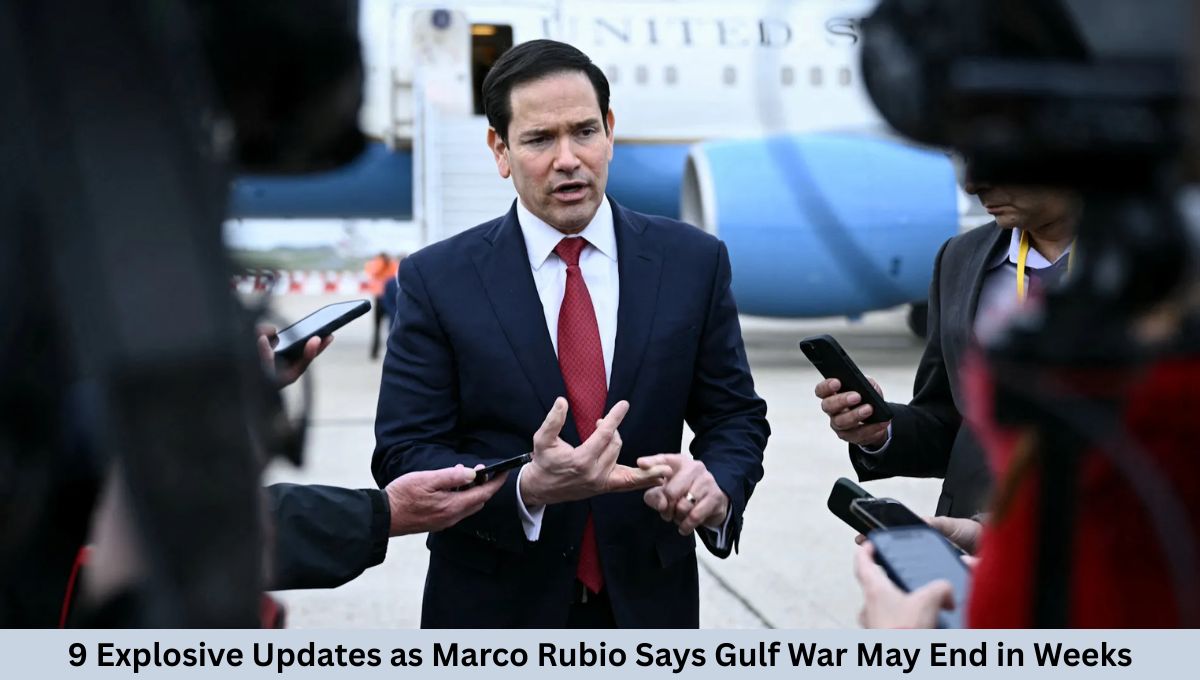
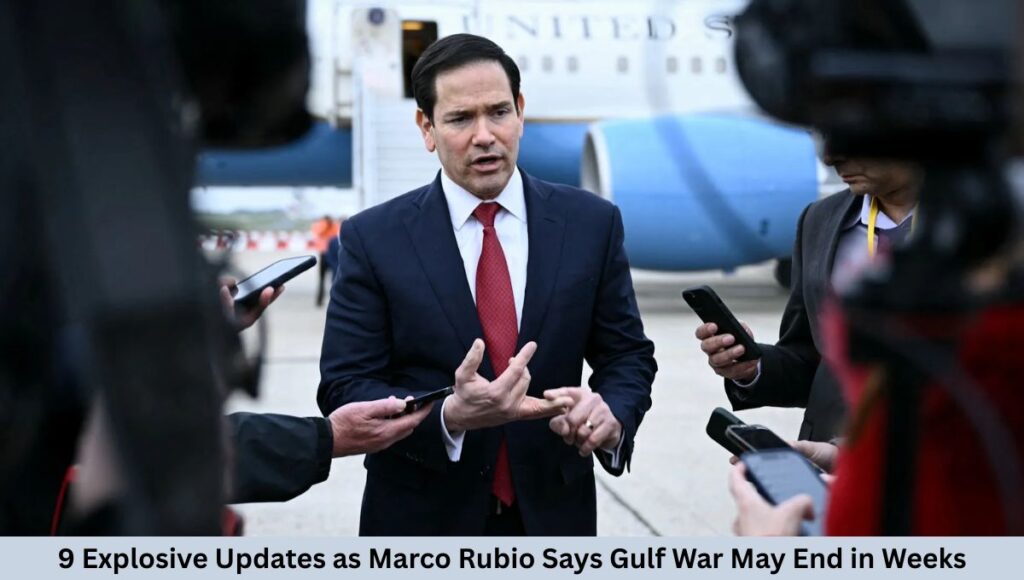
9 Explosive Updates as Marco Rubio Says Gulf War May End in Weeks — Is the war entering a new phase? In a significant development amid escalating tensions in the Middle East, Marco Rubio has stated that the ongoing Gulf war is expected to conclude “within weeks, not months.”
The statement comes at a time when the United States continues to deploy thousands of troops to the region while simultaneously pursuing diplomatic channels to contain the conflict with Iran.
Rubio’s remarks, delivered after high-level discussions with G7 counterparts in France, aim to reassure allies and global markets that the war will not turn into a prolonged ground conflict—even as risks of escalation remain high.
9 Explosive Updates as Marco Rubio Says Gulf War May End in Weeks
Rubio’s Core Message: Quick End, No Ground War
“Weeks, Not Months” Timeline
Rubio offered one of the clearest timelines yet from Washington:
- The war is expected to end within a matter of weeks
- The campaign is progressing “on or ahead of schedule”
- The U.S. believes it can achieve its objectives without deploying ground troops
This assertion directly addresses global concerns about a prolonged war similar to past U.S. engagements in the region.
No Ground Troops: Strategy Explained
Despite troop deployments, Rubio emphasized:
- No large-scale ground invasion is planned
- Operations rely on air power, naval dominance, and strategic strikes
- Ground forces are being positioned for contingency scenarios only
This approach reflects a shift from traditional warfare toward limited engagement with maximum impact.
Troop Deployments: Preparation, Not Escalation
Why the U.S. Is Sending Troops
Thousands of U.S. Marines and airborne troops are being deployed across the Middle East.
Rubio described the move as providing President Donald Trump with:
- “Maximum optionality”
- Flexibility to respond to unexpected developments
- Strategic readiness without committing to escalation
Concerns Over Ground War Risks
Despite official assurances, the deployments have raised concerns:
- Could troop presence trigger a broader war?
- Might contingencies evolve into direct ground engagement?
- Are allies being prepared for a longer conflict than stated?
These questions continue to dominate global geopolitical discourse.
Strait of Hormuz: The Economic Flashpoint
Why This Waterway Matters
The Strait of Hormuz remains at the center of the crisis.
It is one of the most critical chokepoints in global trade, handling:
- Around 20% of the world’s oil supply
- Significant volumes of natural gas
- Essential commodities like fertilizers
Iran’s Alleged “Toll System” Plan
Rubio warned that Iran may attempt to impose a toll system on ships passing through the strait.
According to him:
- Such a move would be illegal under international law
- It would be dangerous for global trade
- It could trigger a coordinated international response
Global Implications
If implemented, the toll system could:
- Disrupt global energy markets
- Increase shipping costs dramatically
- Trigger inflation worldwide
Rubio has urged European and Asian nations to contribute to ensuring free navigation in the region.
Diplomatic Efforts: Talks Continue Behind the Scenes
Signals from Iran
Rubio confirmed that:
- There has been an exchange of messages with Iran
- Tehran has shown some willingness to discuss certain issues
- No formal response has yet been received
This suggests that diplomacy, while fragile, remains active.
U.S. Peace Proposal
The United States has reportedly presented a multi-point plan to Iran that includes:
- Restrictions on nuclear and missile programs
- Reopening the Strait of Hormuz
- De-escalation of military activities
However, Iran has not officially accepted the proposal.
Military Objectives: What the U.S. Wants to Achieve
The U.S. campaign aims to:
- Neutralize Iran’s missile and drone capabilities
- Damage its naval and air power
- Disrupt its nuclear program
According to Rubio, progress toward these objectives is already significant.
Conflict Expansion: A Regional War in Motion
Attacks Across the Middle East
The war has spread beyond direct U.S.-Iran confrontation:
- Missile and drone strikes in Saudi Arabia
- Clashes involving allied militias
- Ongoing tensions in Israel and Lebanon
Casualties and Damage
- Thousands killed across the region
- U.S. troops wounded in missile attacks
- Civilian infrastructure damaged
The humanitarian toll continues to rise alongside military escalation.
Global Economic Impact: Markets Under Pressure
Oil Prices Surge
The conflict has triggered a sharp increase in energy prices:
- Brent crude crossing $110 per barrel
- Fuel prices rising globally
- Inflation concerns returning in major economies
Stock Market Volatility
Global financial markets have reacted negatively:
- Major indices declining
- Investor uncertainty increasing
- Supply chain disruptions affecting industries
G7 Reactions: Allies Seek Clarity
Pressure on the United States
During the G7 meeting:
- Allies demanded clarity on U.S. strategy
- Concerns were raised about escalation risks
- Calls were made for a ceasefire
Key issues discussed included:
- Freedom of navigation in the Strait of Hormuz
- Protection of civilian infrastructure
- Preventing a wider regional war
Russia Factor: Strategic Complications
Rubio dismissed reports that Russia is assisting Iran in targeting U.S. assets.
However, concerns remain about:
- Growing Russia-Iran cooperation
- Broader geopolitical alignments
- Impact on other conflicts like Ukraine
Humanitarian Concerns: Civilian Impact
Rising Civilian Toll
The conflict has severely affected civilians:
- Thousands killed and injured
- Mass displacement in affected regions
- Damage to homes and hospitals
West Bank Violence
Rubio also addressed:
- Rising settler violence in the West Bank
- Attacks on Palestinian communities
- Concerns about regional instability
What Happens After the War?
Post-War Challenges
Even if the war ends within weeks, major challenges remain:
- Securing the Strait of Hormuz
- Preventing future conflicts
- Rebuilding damaged infrastructure
International Cooperation Needed
Rubio emphasized that:
- The U.S. cannot act alone
- Allies must contribute to security efforts
- A global coalition may be required
Three Possible Scenarios Ahead
1. Quick Resolution
War ends within weeks as predicted, with limited long-term impact.
2. Controlled Escalation
Conflict continues at a lower intensity without full-scale war.
3. Wider Regional Conflict
Escalation involving multiple countries and prolonged instability.
Conclusion: A Critical Moment for Global Stability
The statement by Marco Rubio that the Gulf war could end within weeks offers a measure of optimism—but it comes with significant caveats.
While the United States insists it can achieve its objectives without ground troops, ongoing troop deployments, regional tensions, and economic disruptions suggest the situation remains highly volatile.
The fate of the conflict will likely depend on:
- Diplomatic breakthroughs
- Military developments
- International cooperation
For now, the world watches closely as one of the most consequential conflicts in recent history approaches a potentially decisive turning point.
Also Read: 11 Explosive Signals in Marco Rubio’s Munich Speech That Rekindle Fears of a New East India Company
Also Read: US operations in Iran ‘on or ahead of schedule’, says Rubio
Related Posts:
- 3 Explosive Conditions Iran Sets to End War with US…
- 10 Powerful Revelations from the Trump–Putin Call on…
- 10 Explosive Signals: Trump Rates Iran War “15/10”…
- 10 Explosive Signals Trump Says Iran War Could End…
- 7 Explosive Signs Russia Is Quietly Backing Iran in…
- 12 Explosive Claims as Donald Trump Says Iran War…