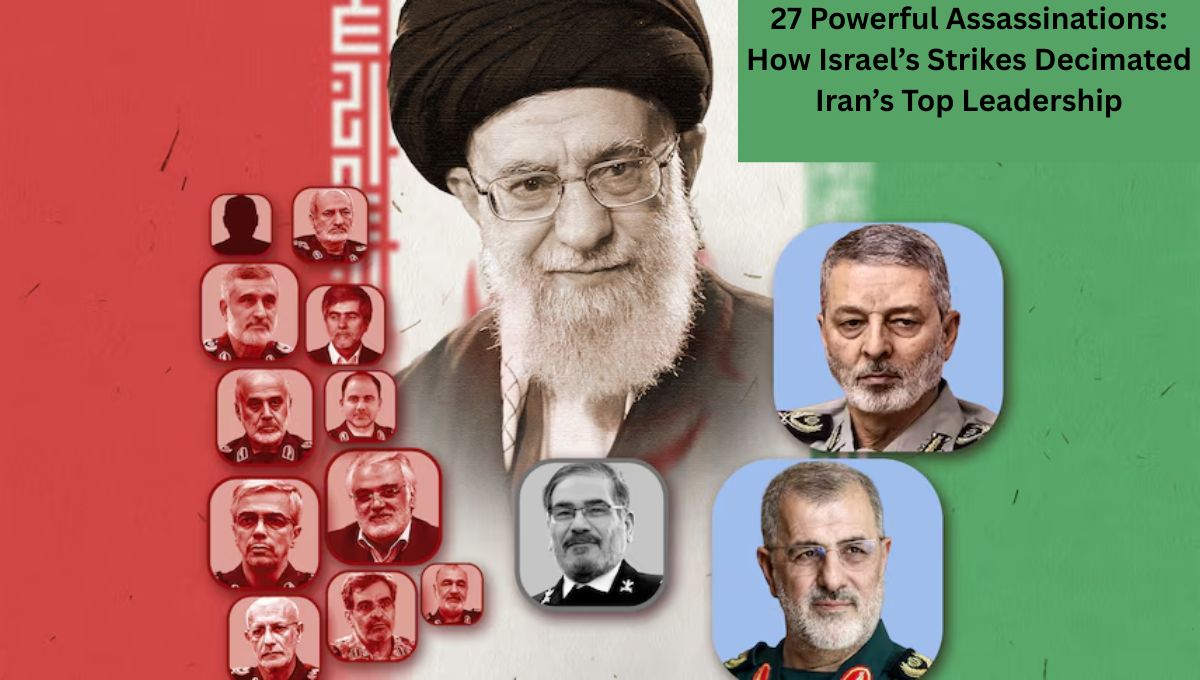
27 Powerful Assassinations: How Israel’s Strikes Decimated Iran’s Top Leadership and reshaped its power structure. The Israel–Iran conflict has entered its most dangerous phase in decades. What began as covert operations, cyber warfare, and proxy confrontations has escalated into direct, high-impact military strikes that have reshaped Iran’s political, military, and nuclear leadership.
Israeli strikes in June 2025 and February 28, 2026, later joined by the United States, resulted in the deaths of Iran’s Supreme Leader, senior Islamic Revolutionary Guard Corps (IRGC) commanders, top generals, and leading nuclear scientists.
The unprecedented scale of these assassinations has sent shockwaves across West Asia, raising fears of a prolonged regional war with global consequences.
This article provides a comprehensive, verified, ready-reference account of the Iranian leaders and scientists killed by Israel, while examining the broader implications for Iran, the Middle East, and global security.
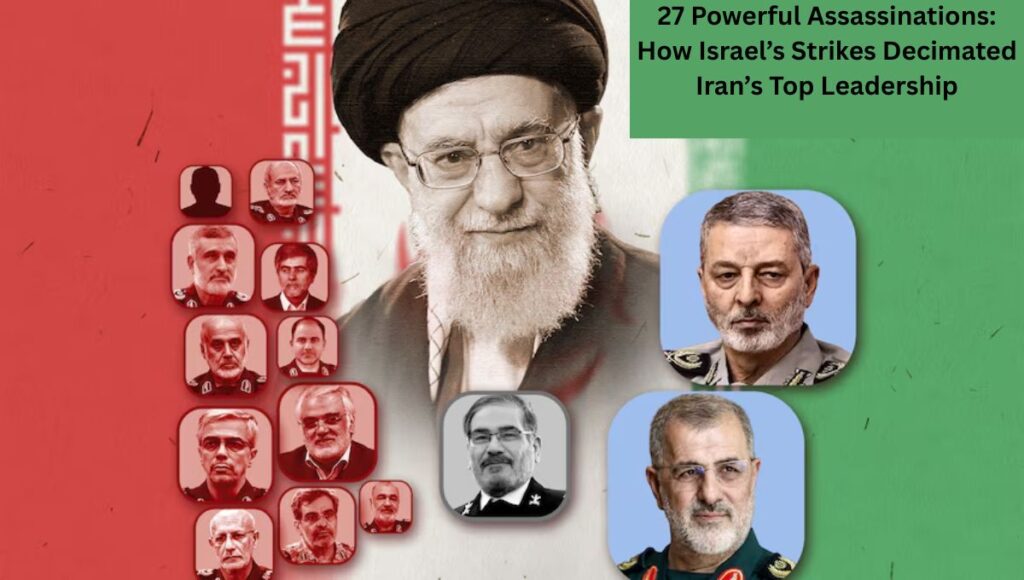
27 Powerful Assassinations: How Israel’s Strikes Decimated Iran’s Top Leadership
Why These Killings Mark a Turning Point
Unlike previous targeted assassinations, these strikes went far beyond tactical disruption.
They aimed at:
- Decapitating Iran’s command-and-control structure
- Weakening the IRGC’s regional operations
- Crippling Iran’s nuclear expertise
- Forcing a leadership and doctrinal crisis in Tehran
For the first time since 1979, Iran lost its Supreme Leader in an act of war, fundamentally altering the balance of power inside the Islamic Republic.
Iran’s Supreme Leader Killed
Ali Khamenei
Iran’s former Supreme Leader, Ayatollah Ali Khamenei, was killed on February 28, 2026, during Israeli airstrikes on central Tehran.
Khamenei had ruled Iran since 1989, making him one of the longest-serving leaders in the Middle East.
As Supreme Leader, he held absolute authority over:
- The armed forces
- The judiciary
- State broadcasting
- Nuclear and foreign policy
The IRGC answered directly to him, making his death a strategic earthquake rather than a symbolic loss.
His killing triggered:
- A 40-day national mourning period
- Emergency activation of constitutional succession mechanisms
- Heightened IRGC dominance over civilian institutions
Senior Political and National Security Figures Killed (2026)
Ali Shamkhani
A longtime power broker and senior adviser to the Supreme Leader, Shamkhani was killed on February 28, 2026. He previously served as Iran’s Defence Minister and played a key role in nuclear negotiations with the United States.
Abdolrahim Mousavi
Iran’s Chief of Staff of the Armed Forces, Mousavi was central to Iran’s missile and drone deterrence strategy. He was killed during the same wave of Israeli airstrikes.
Amir Nazirzadeh
Iran’s Defence Minister and former Air Force commander, killed in February 2026 strikes targeting military leadership hubs.
IRGC Leadership Eliminated
Mohammad Pakpour
Commander-in-Chief of the IRGC at the time of his death. Pakpour had assumed leadership in mid-2025 after earlier Israeli strikes eliminated his predecessor.
Hossein Salami
Killed on June 13, 2025, during Israel’s major operation targeting IRGC headquarters in Tehran. Known for his confrontational rhetoric toward Israel and the United States.
Top Iranian Military Commanders Killed (June 2025)
- Mohammad Bagheri – Chief of Staff of the Armed Forces
- Gholamali Rashid – Head of Khatam al-Anbia Central Command
- Amir Ali Hajizadeh – Oversaw missile and drone programs
- Mehdi Rabbani – Deputy of Operations, Armed Forces
- Mahmoud Bagheri – Senior military strategist
- Davoud Sheikhian – IRGC Aerospace commander
- Mohammad Bagher Taherpour – Senior IRGC commander
- Mansour Safarpour – IRGC Brigadier General
- Masoud Tayyeb – IRGC Aerospace spokesperson
- Khosro Hasani – Deputy head, IRGC Aerospace Force
- Javad Jarsara – IRGC spokesperson
These losses dismantled Iran’s operational military continuity in a single coordinated campaign.
Iranian Nuclear Scientists and Engineers Killed
Israel’s strikes also targeted Iran’s intellectual nuclear infrastructure, eliminating scientists crucial to enrichment, weaponization theory, and detonation research.
Fereidoun Abbasi-Davani
Former head of Iran’s Atomic Energy Organisation; survived earlier assassination attempts before being killed in June 2025.
Mohammad Mehdi Tehranchi
President of Islamic Azad University and a leading theoretical physicist.
Amir Hossein Feqhi
Vice-President of AEOI and head of the Nuclear Science and Technology Research Institute.
Akbar Motalebizadeh
Senior chemical engineer linked to advanced weapons research.
Ahmad Reza Zolfaghari
Nuclear physicist at Shahid Beheshti University, identified by Western intelligence as a rare yield-calculation expert.
Ali Bokouei Katrimi
Specialist in nuclear physics and explosives technologies.
Saeed Borji
Explosives trigger expert from Iran’s SPND organization.
Mansour Asgari
Head of Research and Technology at SPND, focused on detonation sequencing.
Impact on Iran’s Power Structure
With Khamenei gone, Iran entered constitutional survival mode:
- A temporary leadership council assumed authority
- The Assembly of Experts began succession deliberations
- The IRGC emerged as the dominant political force
Analysts suggest future Iranian leadership may be:
- More militarized
- Less restrained by religious doctrine
- More flexible on nuclear deterrence
Regional and Global Implications
The assassinations have:
- Intensified missile exchanges across the Gulf
- Raised oil price volatility
- Alarmed global shipping and aviation sectors
- Deepened divisions between Western powers and Russia-China bloc
For many governments, this conflict now represents the most serious escalation risk since the Iraq War.
Conclusion: A Middle East at a Crossroads
The killing of Iran’s Supreme Leader and senior leadership has shattered decades-old assumptions about red lines in warfare.
Whether this marks the collapse of Iran’s current system—or its radical transformation—remains uncertain.
What is clear is that the Israel–Iran conflict is no longer a shadow war. It is an open confrontation with consequences that extend far beyond West Asia.
Also Read: 17 Explosive Strikes: Israel-US Launch Power Play as Iran, Trump & Khamenei Collide
Also Read: Iran vows revenge after the killing of its top leader and trades strikes with Israel in widening war
Related Posts:
- 3 Explosive Conditions Iran Sets to End War with US…
- 7 Powerful Facts About Ayatollah Ali Khamenei’s…
- 10 Explosive Warnings as Donald Trump Calls Iran…
- 10 Explosive Strikes: Israel Bombs Tehran Oil Depots…

- 9 Explosive Claims as Trump Says US Winning Iran War

- 5 Major Takeaways from the US Supreme Court's…