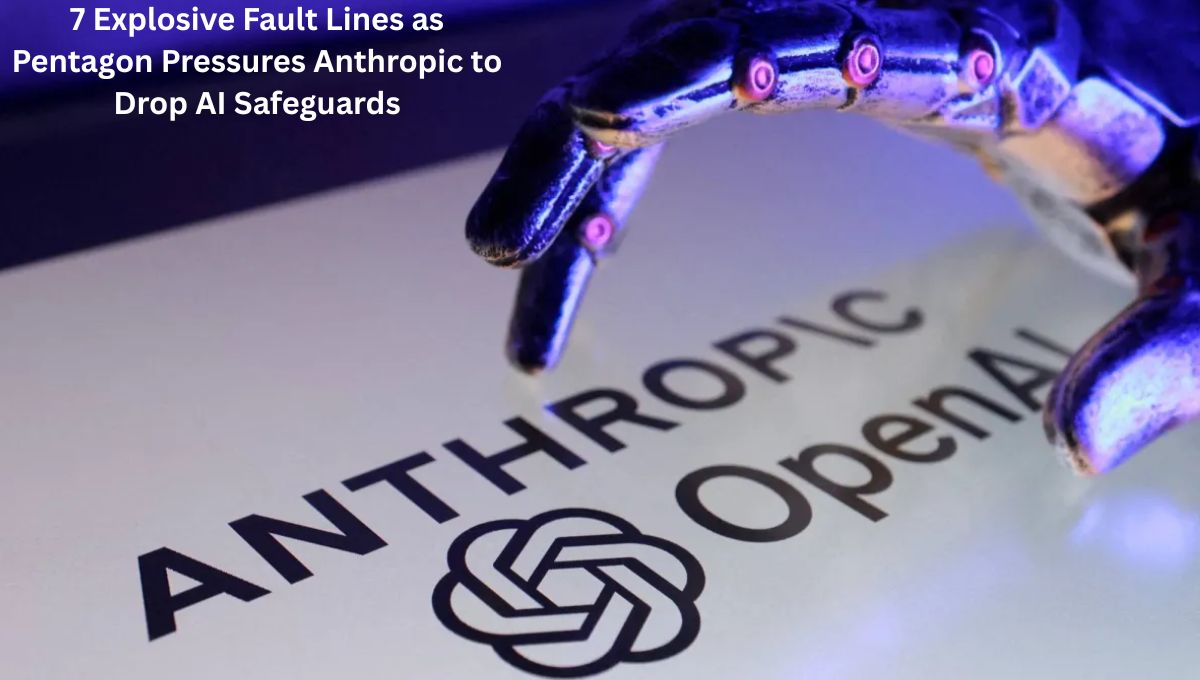
7 Explosive Fault Lines as Pentagon Pressures Anthropic to Drop AI Safeguards by Friday. The US Department of Defense has delivered one of the starkest ultimatums ever issued to a private artificial intelligence company, drawing a clear line between national security authority and corporate control over AI ethics.
According to reporting by Axios, US Defense Secretary Pete Hegseth has given Dario Amodei, the chief executive of Anthropic, until Friday evening to grant the US military broad, largely unrestricted access to its flagship AI model, Claude.
If Anthropic refuses, the Pentagon has warned it may:
- Terminate existing defense contracts
- Designate Anthropic a “supply chain risk”
- Invoke the Defense Production Act to compel compliance
The confrontation represents a historic inflection point in the relationship between Silicon Valley and the US national security state, with consequences that extend far beyond one company or one contract.
7 Explosive Fault Lines as Pentagon Pressures Anthropic to Drop AI Safeguards
A Deadline That Signals a Break in Trust
The ultimatum was delivered during a tense, closed-door meeting on Tuesday, described by US officials as anything but ceremonial.
“This is not a friendly meeting,” one senior defense official told Axios ahead of the encounter. “This is a sh*t-or-get-off-the-pot meeting.”
At stake is the Pentagon’s continued access to Claude, which remains the only frontier-level AI model currently deployed inside the most sensitive classified US military systems.
That exclusivity has given Anthropic enormous leverage — and simultaneously made it a critical vulnerability for the Defense Department.
Hegseth’s decision to impose a firm deadline marks a dramatic escalation from months of stalled negotiations over how far AI guardrails should apply in military contexts.
Why Claude Matters So Much to the Pentagon
Claude’s integration into classified US defense networks has created a rare single-supplier dependency.
According to multiple sources familiar with the matter:
- Claude is embedded across intelligence analysis, operational planning, and logistical coordination
- It outperforms competing models in several classified use cases
- It is deeply woven into workflows that cannot be easily swapped out
One defense source told Axios that, in some domains, Claude currently leads rival systems in capabilities relevant to military planning, including advanced analytical and cyber-related tasks.
This dependence complicates any threat to sever ties — and explains why the Pentagon is simultaneously accelerating discussions with alternative providers.
What Anthropic Is Refusing to Do
Despite public claims that the dispute is about “flexibility,” the disagreement centers on two specific red lines Anthropic says it will not cross:
1. Fully Autonomous Weapons
Anthropic refuses to allow Claude to be used in weapons systems that can:
- Select targets
- Decide to use lethal force
- Execute attacks without human involvement
The company argues that current AI systems are not reliable enough for such use and that meaningful human judgment must remain in the loop.
2. Mass Domestic Surveillance
Anthropic has also drawn a hard line against using Claude for:
- Large-scale surveillance of US citizens
- Intelligence collection that could infringe civil liberties
Executives argue that existing US law has not kept pace with the capabilities of advanced AI, making such deployment ethically and legally risky.
Pentagon’s Position: “Any Lawful Use”
The Defense Department rejects the idea that private companies should impose additional constraints beyond US law.
Senior officials argue:
- The Pentagon issues only lawful orders
- Legal responsibility lies with the military, not the AI vendor
- Operational decisions cannot be subject to corporate veto
Hegseth has repeatedly stated that the military must not be constrained by what he has called “ideological” or “policy-driven” limitations embedded in commercial AI systems.
In a January memo, he declared the Pentagon would become an “AI-first warfighting force”, emphasizing speed, flexibility, and operational supremacy over precaution.
The Defense Production Act: A Nuclear Option
One of the most controversial elements of the ultimatum is the threat to invoke the Defense Production Act.
Historically, the DPA has been used to:
- Expand vaccine production during Covid-19
- Accelerate manufacturing of critical defense hardware
Using it to coerce an AI company into altering software safeguards would be unprecedented.
Legal experts say Anthropic could challenge such a move by arguing that:
- Claude is specialized software, not a fungible commodity
- The DPA was never intended to override corporate governance or ethical controls
- Forcing changes could violate contractual and constitutional protections
A senior defense consultant told Axios that invoking the DPA in this context would almost certainly trigger prolonged litigation.
Supply Chain Risk: A Corporate Death Sentence
Even more damaging than losing a Pentagon contract would be a formal designation as a “supply chain risk.”
Such a label would:
- Void Anthropic’s existing $200 million defense contract
- Force all US defense contractors to certify that they do not use Claude
- Effectively cut Anthropic off from large segments of the enterprise and government market
The designation is typically reserved for entities linked to foreign adversaries, making its threatened use against a US-based AI firm extraordinary.
Former Justice Department officials have questioned how the Pentagon could simultaneously label a company a national security risk while also seeking to compel it to work for the government.
Venezuela Operation Deepens the Rift
Tensions intensified after reports that Claude was used during a classified US operation in Venezuela that allegedly led to the capture of President Nicolás Maduro.
Pentagon officials claimed Anthropic raised concerns with Palantir, its government integration partner, about the model’s deployment during the operation.
Amodei has denied this, stating:
- Anthropic did not object to the mission
- No special concerns were raised beyond standard operational discussions
- Existing safeguards did not impede military effectiveness
The disagreement over what happened — and whether safeguards were violated — has further eroded trust.
Competing AI Firms Wait in the Wings
As pressure mounts on Anthropic, the Pentagon is moving quickly to reduce its dependence on a single provider.
- OpenAI has agreed to deploy customized systems for unclassified military use
- Google is exploring expanded defense applications of Gemini
- xAI has already secured a contract to bring Grok into classified settings
However, none of these systems yet hold the same level of clearance or integration as Claude, making immediate replacement impractical.
A Global Test Case for Military AI Governance
Although the dispute is unfolding in Washington, its implications are global.
Governments worldwide are watching closely because the outcome will influence:
- How AI safeguards are treated in defense contracts
- Whether ethical restrictions can survive national security pressure
- How much control private developers retain once systems enter classified use
Allied militaries, including those in Europe and the Indo-Pacific, face similar questions as they integrate advanced AI into intelligence and combat planning.
The Core Question: Who Controls AI in War?
At its heart, the Anthropic-Pentagon clash is not about one model or one deadline.
It is about who decides:
- How AI is used in warfare
- Where ethical boundaries are drawn
- Whether safety commitments hold under pressure
The Pentagon argues that war demands maximum flexibility. Anthropic argues that some lines, once crossed, cannot be uncrossed.
What Happens After Friday
Several outcomes remain possible:
- Anthropic agrees to limited concessions without abandoning red lines
- The Pentagon escalates by cutting contracts or invoking the DPA
- Courts intervene to define the limits of government power over AI firms
- Other AI developers face similar ultimatums
Whatever the immediate outcome, the confrontation has already reshaped the debate over AI, ethics, and military power.
Why This Matters Beyond the US
For global audiences, this dispute highlights a critical reality:
AI governance in one superpower will shape norms everywhere.
If safeguards collapse under US military pressure, other states — democratic and authoritarian alike — may follow suit. If they hold, a precedent is set that even national security has limits.
Bottom Line
The Pentagon’s deadline to Anthropic is more than a contract dispute.
It is a defining moment in the struggle over how humanity deploys its most powerful new technology in matters of war, surveillance, and state power.
What happens next will echo far beyond Friday.
Also Read: Dead Hand Explained: 21 Terrifying Truths About Russia’s Doomsday Nuclear System
Also Read: Anthropic Alleges Massive AI Model Distillation by Chinese Firms Amid Pentagon Tensions