
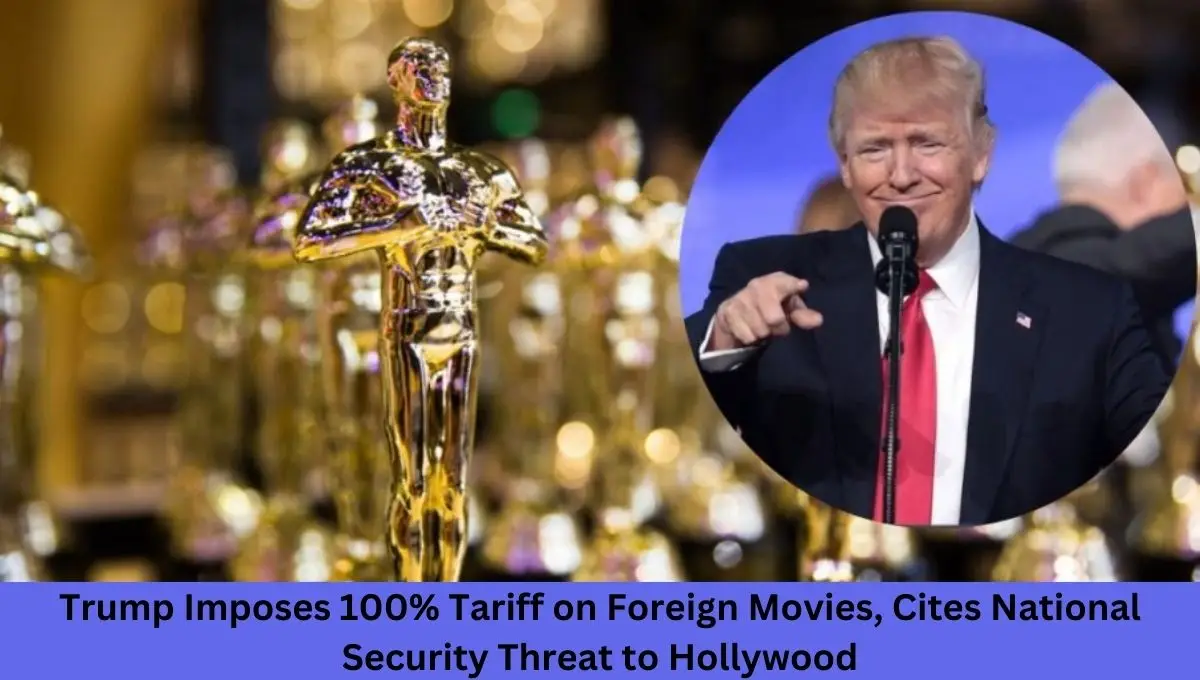
Ripples sent through entertainment industry as Trump Imposes 100% Tariff on Foreign Movies, Cites National Security Threat to Hollywood. In a dramatic move to ‘Protect Hollywood’ U.S. President Donald Trump announced a 100% tariff on all movies produced outside the United States, labeling the growing foreign film production trend as a “national security threat.” The announcement, made via his Truth Social platform, has sparked fierce reactions from industry insiders, trade partners, and global markets.
Trump Imposes 100% Tariff on Foreign Movies, Cites National Security Threat to Hollywood
Hollywood is ‘Dying a Fast Death,’ says Trump
Trump claimed that America’s movie industry is in rapid decline due to the increasing number of U.S. studios and filmmakers choosing to produce content abroad. He pointed fingers at countries like Canada, Australia, and the UK for offering tax breaks and other incentives that lure American film production out of the country.
“The Movie Industry in America is DYING a very fast death. Other Countries are offering all sorts of incentives to draw our filmmakers and studios away from the United States. Hollywood, and many other areas within the USA, are being devastated,” Trump wrote on Sunday.
A National Security Argument
Going beyond the economic rationale, Trump justified the tariff on national security grounds. He claimed that foreign-made films are not just economic competition but also vessels for “messaging and propaganda.” According to Trump, this makes the influx of imported films a matter of security and American cultural integrity.
“This is a concerted effort by other Nations and, therefore, a National Security threat. It is, in addition to everything else, messaging and propaganda,” the President stated.
Departments Mobilized to Enforce the Tariff
Trump confirmed that he has authorized both the Department of Commerce and the U.S. Trade Representative (USTR) to begin implementing the 100% tariff immediately.
Commerce Secretary Howard Lutnick posted on X (formerly Twitter), “We’re on it,” suggesting swift enforcement action was underway.
Tariff Policy Unclear on Details
It remains uncertain how the Trump movie tariff will be applied—whether it will target only foreign production companies or include U.S. studios filming overseas. The lack of clarity has led to confusion within the film industry, which is already grappling with reduced revenues and global competition.
Notably, Trump’s announcement did not mention television series or streaming-exclusive content, sectors that now represent a large portion of global entertainment production and consumption.
China Responds to Trump’s Trade War Escalation
Trump’s decision to impose a 100% tariff on foreign films comes after China announced it would reduce the number of American films it imports, a retaliatory move linked to Trump’s broader tariff war. The U.S. has recently imposed tariffs of up to 145% on Chinese goods, prompting Beijing to strike back with 125% duties on American imports, including cultural products.
“The wrong action of the US government to abuse tariffs on China will inevitably further reduce the domestic audience’s favourability towards American films,” said China’s Film Administration in a statement released in April.
Global Film Markets Brace for Impact
The announcement has sent shockwaves across the global film production industry. Countries like Canada, New Zealand, and the UK, which have seen a rise in production investment, may now face steep barriers to accessing the U.S. box office, the world’s largest entertainment market.
According to film industry research firm ProdPro, U.S. film production spending dropped by 26% in 2024, falling to $14.54 billion. Meanwhile, foreign countries have benefited from increased American studio investment abroad due to cost savings and incentives.
Film Stars Tapped as Ambassadors for Hollywood
Earlier this year, Trump appointed actors Jon Voight, Mel Gibson, and Sylvester Stallone as special envoys to promote business opportunities in Hollywood. The President described them as leaders in the effort to “bring Hollywood BACK—BIGGER, BETTER, AND STRONGER THAN EVER BEFORE!”
“We Want Movies Made in America, Again”
Echoing his signature campaign rhetoric, Trump ended his announcement with a familiar refrain:
“WE WANT MOVIES MADE IN AMERICA, AGAIN!”
Supporters argue that the move will reinvigorate domestic film production and restore jobs, while critics claim it risks stifling creative freedom and escalating trade conflicts.
What’s Next for the Movie Industry?
As the Department of Commerce and USTR begin implementing the tariffs, Hollywood studios and international distributors are bracing for economic fallout. Some experts warn that retaliatory actions from trade partners could lead to higher prices for consumers and fewer international co-productions.
The full impact of this policy remains to be seen, but one thing is clear: the Trump movie tariff has redefined the intersection of entertainment, economics, and national policy.
Also Read: Donald Trump Imposes 100% Tariff on Foreign-Made Movies: Impact on Hollywood & Bollywood
Related Posts:
- Donald Trump Imposes 100% Tariff on Foreign-Made…
- Trump’s 2025 Gaza Peace Plan Signing and Historic…

- 9 Explosive Revelations as Trump Declares His Health…
- Trump to Host 2026 G20 Summit at His Florida Golf…
- What’s Next for Donald Trump After Court Rules His…
- 9 Explosive Revelations Behind Trump’s ‘Trump-Class’…
