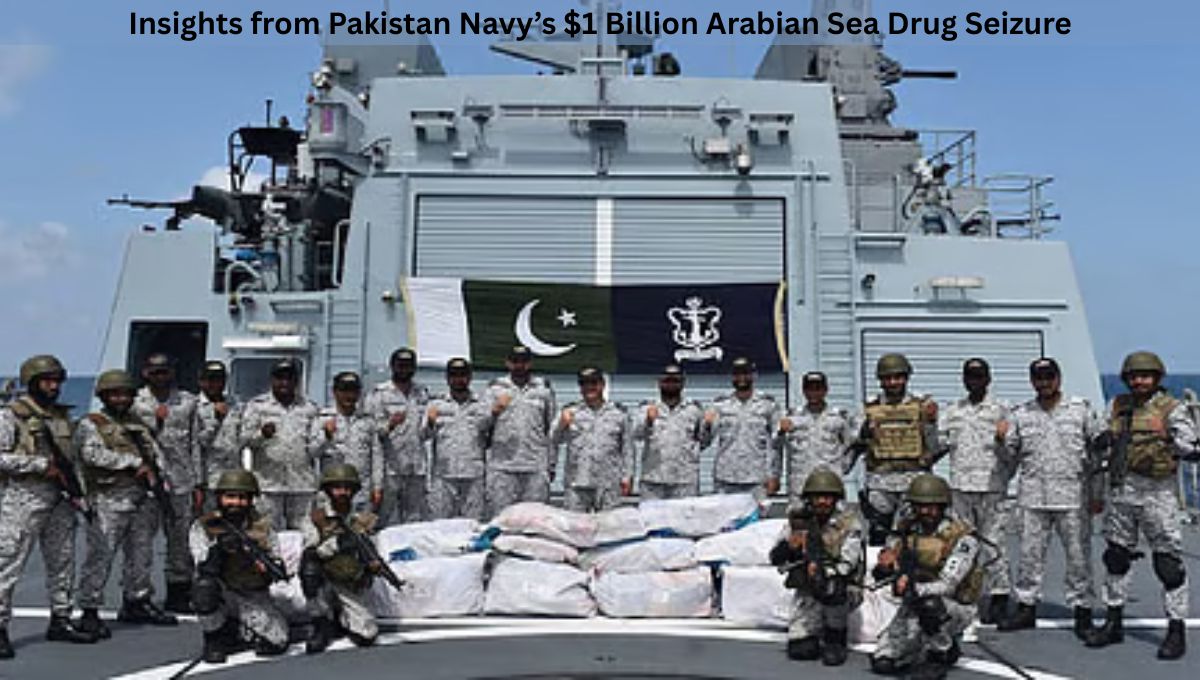
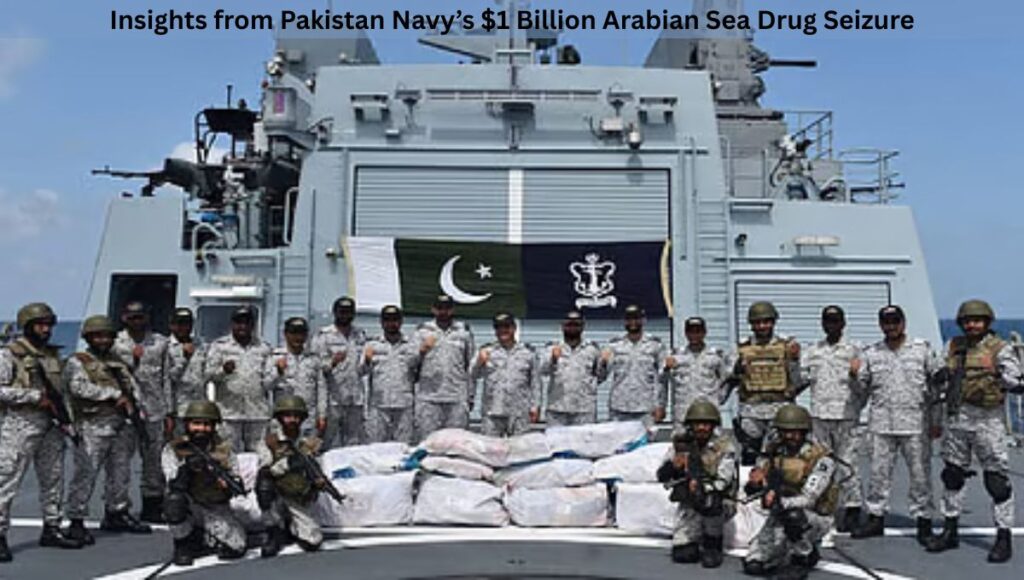
Insights from Pakistan Navy’s $1 Billion Arabian Sea Drug Seizure — One of the largest maritime busts in years. The Pakistan Navy has seized narcotics worth nearly $1 billion in two separate maritime operations in the Arabian Sea, in what officials are calling one of the most successful drug interdictions in recent years.
Operating under the Saudi-led Combined Maritime Forces (CMF), the missions took place within a 48-hour window and involved the interception of two stateless dhows carrying large quantities of crystal methamphetamine and cocaine.
The seizures were made by Pakistan Navy Ship (PNS) Yarmook as part of Focused Operation Al Masmak, a multinational effort aimed at curbing illicit trafficking across international waters. The operations underscore Pakistan’s expanding role in regional maritime security and the growing coordination between Gulf and South Asian naval forces.
A Major International Operation
According to a statement issued by the Combined Maritime Forces, Pakistani naval personnel boarded two dhows that were not transmitting on the Automatic Identification System (AIS) and bore no national markings — a common tactic used by smugglers.
On October 18, the first dhow was intercepted, and more than two tonnes of crystal methamphetamine (ICE) were discovered on board. The narcotics, with an estimated street value of $822 million, were seized after thorough inspection and testing.
Less than two days later, a second dhow was intercepted. This vessel carried 350 kilograms of ICE, valued at $140 million, and 50 kilograms of cocaine worth approximately $10 million. The crew was detained, and both vessels were declared “stateless” after verification.
In total, the narcotics seized were valued at more than $972 million, making it one of the largest maritime anti-narcotics operations in Pakistan’s history.
The operation was led by PNS Yarmook, a modern multi-role combat vessel commissioned in Romania in 2020 and inducted into the Pakistan Navy later that year.
Equipped for anti-ship, anti-air, electronic warfare, and surveillance missions, the ship has previously participated in rescue operations and international maritime patrols.
Naval analysts say the success of the Yarmook in Operation Al Masmak highlights the Pakistan Navy’s growing technological and operational sophistication.
The vessel’s ability to detect, intercept, and board vessels operating without identification in open waters reflects advanced coordination and readiness.
Saudi-Led Combined Task Force 150’s Role
The raids were conducted under the command of Combined Task Force (CTF) 150, one of four task forces under the CMF framework. The CTF 150 operates in the Indian Ocean, the Arabian Sea, and the Gulf of Oman, targeting non-state actors involved in drug trafficking, weapons smuggling, and terrorism financing.
Royal Saudi Naval Forces Commodore Fahad Aljoiad, who commands the task force, described the seizures as “one of the most successful narcotics interdictions for CMF.” He emphasized the value of multinational collaboration in maintaining maritime security across one of the world’s busiest shipping corridors.
“The success of this focused operation highlights the expertise and cooperation of our naval forces within the organization,” Commodore Aljoiad said. “It demonstrates how coordinated maritime efforts can significantly disrupt illicit networks operating across international waters.”
International Praise and Cooperation
The United States Central Command (CENTCOM) lauded the operation on social media, congratulating Pakistan and its partners in the Saudi-led coalition. In a post on X (formerly Twitter), CENTCOM said:
“U.S. Central Command congratulates the Saudi-led Combined Task Force 150 of Combined Maritime Forces for successfully seizing more than $972 million worth of narcotics. Over a 48-hour period, Pakistan Navy Ship Yarmook conducted boarding operations of two dhows in the Arabian Sea.”
CENTCOM’s message underscored the importance of the CMF’s 47-nation network, which monitors over 3.2 million square miles (8.2 million square kilometers) of sea — including the Arabian Gulf, Gulf of Oman, Red Sea, and Indian Ocean. These routes are vital to global commerce and are often exploited by criminal syndicates trafficking narcotics and weapons.
Operation Al Masmak: A Model of Multinational Collaboration
The CMF said the raids were part of Focused Operation Al Masmak, launched on October 16. The initiative integrates naval resources from Pakistan, Saudi Arabia, France, Spain, and the United States to enhance regional maritime security and disrupt smuggling routes.
The CMF operates on a rotating leadership basis, with member nations taking command of task forces periodically. For this phase, Saudi Arabia held command, with Pakistan providing operational assets.
The operation demonstrates how coalition-based maritime security frameworks can effectively tackle transnational threats.
According to a CMF statement, Al Masmak was designed to target high-risk smuggling routes in the Arabian Sea and the northern Indian Ocean, areas frequently used for trafficking narcotics from Afghanistan, Iran, and East Africa to global markets.
Regional Impact: Curtailing Narcotics Networks
The Arabian Sea has become a critical transit route for international drug traffickers. Analysts believe much of the methamphetamine produced in Afghanistan’s southern provinces is trafficked via Iran and Pakistan’s Makran coast before being shipped to markets in Southeast Asia, Africa, and Europe.
Maritime security experts say Pakistan’s operations, in coordination with CMF allies, are central to disrupting these trafficking pipelines. The country’s geographic position — linking the Arabian Sea with the Persian Gulf and the Indian Ocean — makes its navy an essential player in regional counter-smuggling efforts.
Rear Admiral (retired) Hassan Rizvi, a Pakistani maritime analyst, told local media that the recent operation represents “a significant advancement in Pakistan’s maritime enforcement capacity.”
“Such large-scale interdictions not only demonstrate Pakistan Navy’s operational readiness but also its commitment to global maritime governance,” he said.
Global Maritime Security Context
The CMF’s 47-nation coalition includes the United States, United Kingdom, France, Japan, Australia, Canada, and Saudi Arabia, among others. Its primary goal is to maintain a rules-based international order at sea by combating piracy, terrorism, and smuggling.
The Arabian Sea, part of the CMF’s operational zone, is a vital artery for global trade. Every year, millions of tonnes of goods — including oil, food, and raw materials — pass through these waters.
However, the same routes are increasingly used by smugglers exploiting the vastness of the open sea to move illicit cargo.
Recent years have seen several major seizures. In September 2024, PNS Yamama, another Pakistani naval ship, seized $120 million worth of narcotics from a vessel in the Arabian Sea.
Earlier, the French Navy intercepted 10 tonnes of cocaine worth over $600 million off West Africa, while the U.S. Coast Guard confiscated $74 million worth of cocaine in the Atlantic.
These operations collectively reflect a growing international push to enforce maritime laws and prevent the financing of organized crime and insurgent groups through illicit trade.
Testing and Disposal
Following the latest seizures, the narcotics were transported to PNS Yarmook for testing to confirm their chemical composition. After verification, the drugs were destroyed under strict supervision, officials said.
The Pakistan Navy issued a statement commending its personnel for their professionalism and reaffirming its “unwavering commitment to regional maritime security, global peace, and the collective fight against illicit trafficking at sea.”
The CMF noted that all seized narcotics were safely disposed of in accordance with international environmental and legal protocols.
A Broader Message: Commitment to Global Security
Pakistan’s participation in CMF operations reflects its broader diplomatic and security alignment with Gulf and Western partners. By leading significant interdictions in international waters, Islamabad strengthens its standing as a reliable maritime partner and demonstrates its contribution to global counter-narcotics and counter-terrorism efforts.
The CMF credited Pakistan with consistent leadership within its ranks, noting that Pakistan has commanded CTF 150 multiple times since joining the coalition in 2004.
“Pakistan Navy’s continued engagement in CMF operations showcases its professionalism and dedication to maintaining maritime order,” said a CMF spokesperson. “The recent seizures are a testament to what multinational naval cooperation can achieve.”
Future Outlook: Strengthening Maritime Enforcement
Experts suggest that the success of Operation Al Masmak may prompt further joint operations among CMF member states. With increasing drug flows from Southwest Asia, regional navies are under pressure to expand surveillance, intelligence sharing, and rapid-response coordination.
Pakistan is reportedly investing in new patrol vessels, surveillance drones, and maritime domain awareness technologies to enhance its operational reach. Officials have hinted that upcoming naval exercises under CMF will focus on intelligence-driven interdictions and coordinated task force maneuvers.
Conclusion
The Pakistan Navy’s seizure of nearly $1 billion in narcotics during twin Arabian Sea operations stands as a landmark in the global fight against maritime smuggling.
Conducted in close partnership with the Saudi-led Combined Maritime Forces, the operations highlight how multinational cooperation, advanced surveillance, and professional seamanship can yield significant results in the face of transnational crime.
As regional waters become increasingly contested by traffickers and non-state actors, the success of PNS Yarmook in Operation Al Masmak demonstrates that collaborative maritime security remains one of the most effective tools in maintaining peace and stability across the Arabian Sea and beyond.
Also Read: Drug ring taken down in joint sweep across Belgium, the Netherlands and the UK