5 Explosive Twists: Trump Denies Missile Policy Amid Russia-Ukraine Tensions, angering Moscow. U.S. President Donald Trump on Wednesday furiously denied reports that his administration had secretly lifted key restrictions on Ukraine’s use of Western-supplied long-range missiles, calling the story “fake news.”
His denial came just hours after The Wall Street Journal reported that Washington had quietly authorized Kyiv to carry out cross-border strikes inside Russia using British-made Storm Shadow cruise missiles.
The controversy erupted after a Ukrainian strike on a chemical and rocket-fuel plant in Bryansk, Russia, on Tuesday, reportedly causing massive damage. The attack, confirmed by Ukraine’s General Staff, came shortly after a shift in U.S. military policy that transferred approval for such strikes from Defense Secretary Pete Hegseth to General Alexus Grynkewich, the top U.S. commander in Europe and NATO’s Supreme Allied Commander.
“The Wall Street Journal story on the U.S.A.’s approval of Ukraine being allowed to use long-range missiles deep into Russia is FAKE NEWS!” Trump wrote on his Truth Social account.
“The U.S. has nothing to do with those missiles, wherever they may come from, or what Ukraine does with them!”
His post followed a day of speculation in European capitals and the Kremlin over whether Washington had loosened the leash on Kyiv’s use of Western missiles—a move that could sharply escalate the war.
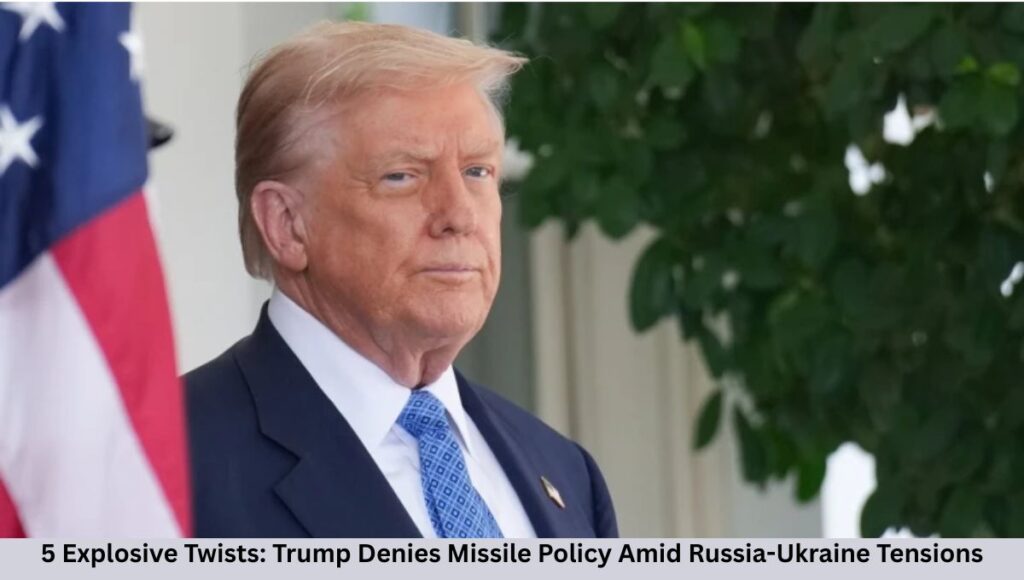
5 Explosive Twists: Trump Denies Missile Policy Amid Russia-Ukraine Tensions
Long-Range Missiles and the Pentagon Power Shift
According to the Wall Street Journal report, General Grynkewich now has the final say on approving operations involving Western long-range weapons that use U.S. targeting data.
That internal policy shift effectively restored the authority of the U.S. European Command, which had been curtailed early in Trump’s second term when the Pentagon centralized decisions under the defense secretary.
Officials told the paper that the change was designed to streamline approvals for urgent battlefield strikes, but it also gives Ukraine broader freedom to target Russian logistics, oil refineries, and military production centers beyond the front lines.
The Storm Shadow—a British-French air-launched cruise missile—has a range of about 180 miles (290 km), allowing Ukraine to hit deep inside Russian territory while keeping its aircraft out of reach of most Russian defenses.
Although supplied by the United Kingdom, the missile relies on American satellite data for targeting, giving Washington indirect control over its use.
Kyiv Seizes the Moment
Ukraine’s Armed Forces said the Bryansk strike was “successful” and targeted a facility producing gunpowder, explosives, and rocket-fuel components used in Russian ammunition. While the attack was celebrated in Kyiv, Moscow condemned it as “another act of Western aggression.”
For President Volodymyr Zelensky, the apparent policy shift marks a breakthrough in his campaign to secure more powerful weapons.
Ukrainian officials have been pressing Washington for months to relax limits on using Western-supplied missiles against Russian targets, arguing that Moscow’s infrastructure is fair game after two years of relentless bombardment of Ukrainian cities.
At a White House meeting last week, Zelensky again urged Trump to approve the purchase of U.S.-made Tomahawk cruise missiles, which can strike targets more than 1,500 miles away.
However, the White House denied the request, fearing it could push Russia into direct confrontation with the United States.
Also Read: Trump denies report of US approval for Ukraine’s strikes inside Russia
Trump’s Push for Peace Talks Falters
The missile controversy unfolded as peace efforts between Trump and Russian President Vladimir Putin collapsed.
A planned summit in Budapest was abruptly canceled after Russian Foreign Minister Sergey Lavrov rejected any immediate ceasefire proposal.
“I didn’t want to have a wasted meeting,” Trump told reporters, explaining why he pulled out of the talks. “We’ll talk when they’re ready to talk peace.”
The failed meeting came just two months after Trump and Putin last met in Alaska, where both leaders discussed a potential framework for ending the war.
Since then, progress has stalled, with Moscow demanding Western sanctions relief and Kyiv insisting on full troop withdrawal from occupied territories.
Washington Turns to Sanctions Pressure
As diplomatic channels faltered, the Trump administration turned to financial warfare. U.S. Treasury Secretary Scott Bessent announced fresh sanctions on Russia’s two largest oil giants—Rosneft and Lukoil—in a move aimed at cutting off Kremlin revenue.
“Now is the time to stop the killing and for an immediate ceasefire,” Bessent said in a press statement.
“Given President Putin’s refusal to end this senseless war, Treasury is sanctioning Russia’s two largest oil companies that fund the Kremlin’s war machine.”
He added that the U.S. “stands ready to take further action if necessary to support President Trump’s effort to end yet another war,” calling on allies to align with the sanctions.
Officials hinted that additional economic measures targeting Russia’s defense supply chains and shipping networks could be announced within days.
European Allies Step Up Pressure
In London and Brussels, leaders voiced strong backing for tougher measures.
British Prime Minister Keir Starmer and European Union officials released a joint statement vowing to “ramp up the pressure on Russia’s economy and defense industry until Putin is ready to make peace.”
The EU is also advancing its 19th sanctions package, targeting Chinese firms accused of helping Russia circumvent existing export controls, and moving ahead with plans to ban all Russian energy imports by 2028.
The coordinated push reflects a shared determination across Western capitals to squeeze Moscow economically while bolstering Ukraine militarily.
Mixed Messages from the White House
Despite Trump’s fiery denial of the missile-approval story, White House officials offered nuanced language that stopped short of fully rejecting the Journal’s report.
One official said:
“This is a war that never would have happened had President Trump been President—something President Putin himself acknowledged—and President Trump is trying to get it stopped. The President also negotiated a historic agreement to allow NATO allies to purchase American-made weapons.”
The statement left room for interpretation—appearing to neither confirm nor deny a behind-the-scenes adjustment in how Washington oversees Ukraine’s long-range strike capability.
Analysts say the ambiguity may be intentional, giving the U.S. strategic flexibility to support Kyiv while maintaining plausible deniability about direct involvement in attacks inside Russia.
Reactions from Moscow
The Kremlin reacted cautiously to Trump’s denial, avoiding direct criticism of Washington but warning of “serious consequences” if Western-made missiles are used against Russian soil.
Russian Defense Ministry spokesperson Igor Konashenkov said Moscow was “closely monitoring U.S. actions” and accused NATO of escalating tensions under the guise of aiding Ukraine.
State media commentators seized on Trump’s Truth Social post as proof that the U.S. was “losing control” of its allies.
However, military analysts in Moscow privately acknowledged that the Storm Shadow strikes had exposed vulnerabilities in Russia’s air defenses.
The Grynkewich Factor
The newly empowered General Alexus Grynkewich has emerged as a pivotal figure in Washington’s evolving approach.
In a recent Senate hearing, he said he believed “Ukraine can win this war” with sustained Western support.
By transferring strike-approval authority to him, the administration effectively placed operational decisions closer to the battlefield—potentially speeding up Kyiv’s response to Russian aggression.
Analysts note that Grynkewich’s dual role as NATO commander underscores the alliance’s growing synchronization of military decisions.
European officials welcomed the move as “a return to trust in field leadership,” contrasting it with the earlier, more centralized control from Washington.
Storm Shadow vs. Tomahawk: What’s at Stake
While the Storm Shadow has proven effective, it pales in comparison to the range and precision of the Tomahawk, which Ukraine has long sought.
Trump briefly floated the idea of supplying Tomahawks earlier this month, telling reporters aboard Air Force One:
“If this war is not going to get settled, I might send them Tomahawks.”
But the proposal was quickly walked back amid warnings from the Pentagon and European allies that Moscow would interpret such a move as direct U.S. participation in the war.
Still, even the limited use of Storm Shadows gives Kyiv new leverage—and poses a fresh challenge for Putin as strikes inch closer to Russia’s industrial heartland.
Analysts Divided on Impact
Security experts are split on whether the apparent shift marks a turning point. Some argue that allowing Ukraine to hit deeper inside Russia could accelerate peace talks by pressuring the Kremlin’s war economy. Others warn it risks drawing NATO into a direct confrontation.
“Even symbolic U.S. approval of cross-border strikes changes the calculus in Moscow,” said Thomas Reed, a senior fellow at the Atlantic Council. “Russia will see it as escalation, regardless of what the White House says publicly.”
Trump’s Balancing Act
For Trump, the challenge lies in balancing his America First peace narrative with the realities of sustaining Western support for Ukraine.
He has repeatedly argued that the war “never would have happened” under his leadership, even as his administration continues to provide military and economic assistance to Kyiv.
At the same time, he has sought to portray himself as the only leader capable of brokering an end to the conflict, insisting that “both sides want peace, but they need someone strong enough to make it happen.”
The Road Ahead
As the missile debate rages, the war shows no sign of ending soon. Ukraine continues to press its advantage with targeted strikes on Russian infrastructure, while Moscow ramps up drone and missile attacks on Ukrainian cities.
Behind the scenes, U.S. officials are working to maintain Western unity amid growing fatigue with the conflict. For now, Trump’s denial may quiet speculation—but the policy ambiguity surrounding Ukraine’s long-range missile use is likely to persist.
Whether the U.S. quietly green-lighted the strikes or not, the message from Washington and its allies is unmistakable:
Russia’s war machine will face mounting pressure until it stops its invasion.
Also Read: Trump Caught off Guard as India Exposes US-Russia Trade Amid Tariff Tensions
Related Posts:
- 9 Explosive Revelations as Trump Declares His Health…

- Murdoch vs. Trump: A Media Feud with Press Freedom…

- Trump’s 2025 Gaza Peace Plan Signing and Historic…

- Trump sues the Wall Street Journal over Epstein…

- Deadly Explosion at China Chemical Plant in Shandong…

- 7 Key Revelations from Trump’s ‘Perfectly Normal’…