
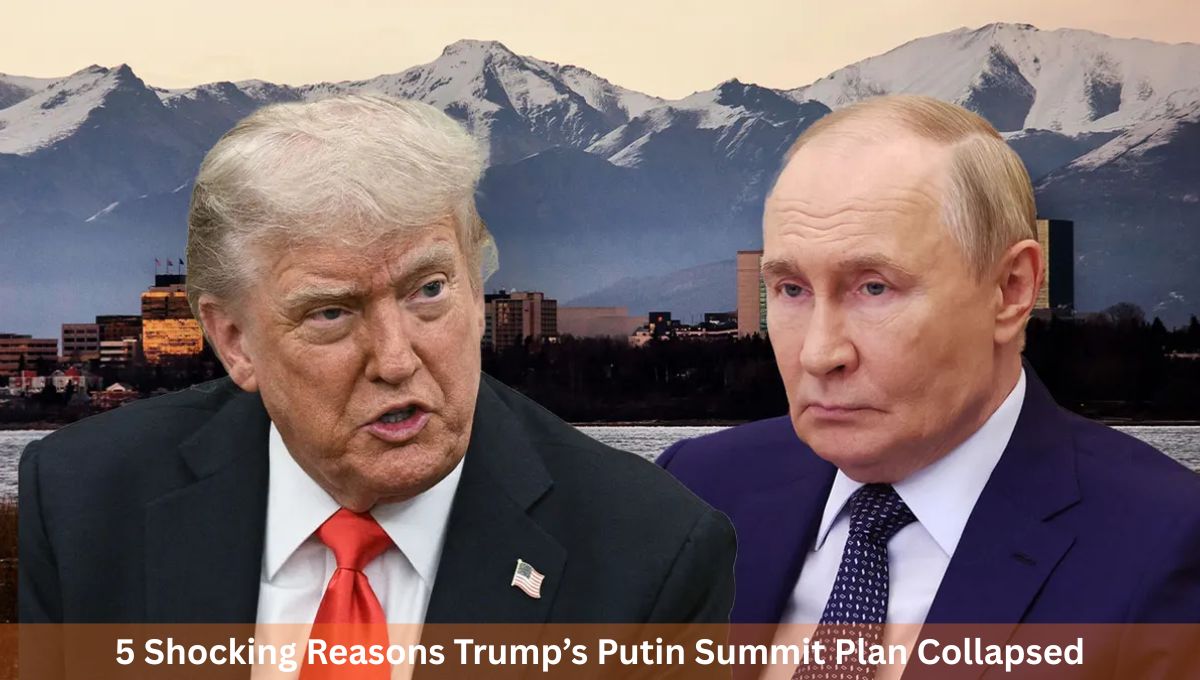
5 Shocking Reasons Trump’s Putin Summit Plan Collapsed amid Ukraine ceasefire dispute. Donald Trump has confirmed that he currently has no plans for a face-to-face summit with Russian President Vladimir Putin. The announcement comes after a previously discussed meeting in Budapest was shelved due to unresolved disagreements over the Ukraine conflict. Trump emphasized he did not want a “wasted meeting” and underscored that a constructive summit requires Moscow’s serious engagement on freezing the current front line.
5 Shocking Reasons Trump’s Putin Summit Plan Collapsed
Trump: “I Don’t Want a Wasted Meeting”
Speaking from the White House, Trump said, “I don’t want to have a wasted meeting. I don’t want to have a waste of time, so I’ll see what happens.”
The US president indicated that discussions with Russia would only proceed if Moscow were willing to consider freezing the battle lines in Ukraine, a proposal supported by Kyiv and European leaders. Trump reiterated his position that the current line of contact should be the baseline for negotiations.
Key Diplomatic Sticking Points
One of the major obstacles in arranging a Trump-Putin summit has been Moscow’s refusal to freeze fighting along the current front line.
Kremlin spokesperson Dmitry Peskov emphasized that Russia’s position remains unchanged, demanding more substantial concessions from Ukraine, including control of certain territories.
Russian Foreign Minister Sergey Lavrov reinforced this stance, arguing that a temporary freeze would not constitute “long-term, sustainable peace.”
He stressed that the “root causes of the conflict” must be addressed, including the recognition of Russian sovereignty over the Donbas and Ukraine’s demilitarization—conditions that Kyiv and its European allies consider non-starters.
European leaders and President Volodymyr Zelensky jointly stated that negotiations should start from the current front line, criticizing Moscow’s lack of seriousness in pursuing peace.
Zelensky added that the key to securing Russian attention might lie in Ukraine’s access to long-range weapons, such as Tomahawk missiles.
Timeline of Recent Events
- August: Trump and Putin met in Alaska for a three-hour summit, yielding no significant agreements.
- October 16: Trump announced a phone call with Putin, stating they would meet in Budapest within two weeks.
- October 19: Preparatory discussions were scheduled between US Secretary of State Marco Rubio and Russian Foreign Minister Sergey Lavrov but later canceled after a “productive” phone call.
The White House confirmed that no in-person meeting would take place in the immediate future. A senior official explained that a face-to-face meeting between Rubio and Lavrov was no longer necessary because the call sufficiently gauged Russia’s position.
Rubio and Lavrov: A Productive Yet Limited Call
On Monday, Rubio spoke with Lavrov by phone to discuss next steps following the Trump-Putin conversation. While the call was described as “productive” by US officials, the differences between Russian and American expectations remained significant.
A European diplomat noted that Lavrov, while loyal to Putin, is not directly involved in major decisions, making any discussions with him somewhat symbolic. The administration viewed the call as informative but insufficient to move forward with a summit.
Trump’s Ceasefire Proposal
Trump has publicly advocated freezing the battle lines in Ukraine as a preliminary measure for peace negotiations. He stated:
“You go by the battle line, wherever it is. Otherwise, it’s too complicated. You’ll never be able to figure it out. You stop at the battle line.”
This approach aligns with the position of European leaders and Ukraine, who have called on Russia to halt aggression while negotiations proceed.
However, Moscow has consistently rejected this proposal, demanding territorial concessions that Kyiv considers unacceptable.
Zelensky’s Perspective
President Zelensky highlighted the importance of long-range capabilities for Ukraine, suggesting that Russia’s willingness to engage in diplomacy correlates with the military support Kyiv receives. Zelensky said:
“As soon as the issue of long-range capabilities became a little further away for us — for Ukraine — Russia almost automatically became less interested in diplomacy.”
The Ukrainian leader stressed that enhanced military capabilities may be crucial in compelling Moscow to negotiate seriously.
Historical Context
Trump’s fluctuating timeline for a potential summit mirrors past challenges in US-Russia diplomacy. During the August Alaska meeting, both leaders touted progress, yet no substantive deal was reached.
Trump’s earlier claims of potentially ending the war quickly reflect his ongoing reliance on personal diplomacy with Putin, which critics argue may oversimplify a complex geopolitical conflict.
White House Position
The Trump administration has maintained that the president remains committed to brokering peace. White House spokesperson Anna Kelly stated:
“President Trump has consistently worked towards finding a peaceful and diplomatic resolution to end this senseless war and to stop the killing. He has courageously engaged parties on all sides and will do everything in his power to achieve peace.”
Despite the stalled summit, the administration continues to monitor diplomatic channels and remains open to future meetings, emphasizing flexibility in approach.
Moscow’s Perspective
The Kremlin has made it clear that no summit date was ever finalized, and serious preparation is required before any meaningful dialogue.
Lavrov stressed that the focus should be on implementing understandings reached in Alaska rather than scheduling another high-profile meeting.
Russian officials argue that the primary causes of the conflict, including Ukraine’s military capabilities and territorial issues, must be resolved before any productive summit can occur.
Trump’s Strategic Considerations
Trump’s decision to postpone the meeting highlights a pragmatic approach: avoiding a high-profile summit without concrete outcomes.
Observers note that a poorly prepared meeting could damage his credibility, especially given the complex nature of the Ukraine conflict.
Experts also suggest that Moscow’s maximalist stance, combined with Zelensky’s refusal to cede territory, has created a diplomatic impasse that cannot be resolved without concessions from both sides.
European Leaders’ Involvement
European leaders have aligned with Trump and Zelensky in advocating that negotiations start from the current battle lines. A joint statement emphasized:
“The current line of contact should be the starting point of negotiations, and pressure on Russia must increase.”
This collective approach reinforces the stance that any future summit must consider both military and political realities on the ground.
Also Read: After Trump–Putin Summit Collapses, US Senators Push New Sanctions Package Against Russia
Potential Future Scenarios
While no immediate summit is planned, discussions could still occur on the sidelines of international meetings, such as the upcoming ASEAN summit in Malaysia. Analysts believe that any future Trump-Putin summit will require careful preparation, addressing Moscow’s demands while ensuring Ukraine’s territorial integrity.
Public and Political Reactions
Trump’s announcement has elicited mixed reactions. Supporters praise his caution, emphasizing the need for a summit that yields tangible results. Critics argue that delaying talks could prolong the conflict and hinder diplomatic progress.
Observers also note the high stakes: a successful summit could enhance Trump’s international profile, whereas a failed meeting could damage his credibility as a negotiator.
Conclusion: A Complex Diplomatic Puzzle
The postponement of the Trump-Putin summit underscores the intricate nature of diplomacy in the Ukraine conflict. Key obstacles include:
- Moscow’s refusal to freeze the current front line.
- Divergent expectations between US and Russian negotiators.
- Zelensky’s insistence on maintaining Ukrainian territory.
- The limits of Lavrov’s authority in representing Putin.
- The risks of a high-profile summit without clear outcomes.
Trump remains committed to facilitating peace, but the path forward will require careful negotiation, strategic patience, and alignment with European allies and Kyiv.
Also Read: Trump-Putin Alaska Summit: High-Stakes Talks on Ukraine and Global Diplomacy
Related Posts:
- Putin’s Shocking Risks Ahead of Trump–Hungary Summit 2025

- 9 Explosive Revelations as Trump Declares His Health…

- Trump–Zelensky Meeting 2025: Stylish Yet Strategic…

- Impacts of the Trump-Putin Call on Ukraine’s 2025 Strategy

- Trump to Host 2026 G20 Summit at His Florida Golf…

- 7 Explosive Revelations Behind Trump’s Move to…
