Typhoon Ragasa Kills 14 in Taiwan, Batters Southern China and Hong Kong Before Weakening, still triggers heavy flooding across Asia. Typhoon Ragasa, one of the most powerful storms of the 2025 Pacific typhoon season, has wreaked havoc across Asia, killing at least 14 in Taiwan, displacing nearly 2 million people in China, and battering Hong Kong and Macao with destructive winds and floods. The storm has since weakened into a tropical depression but continues to bring torrential rain and landslide risks across the region.
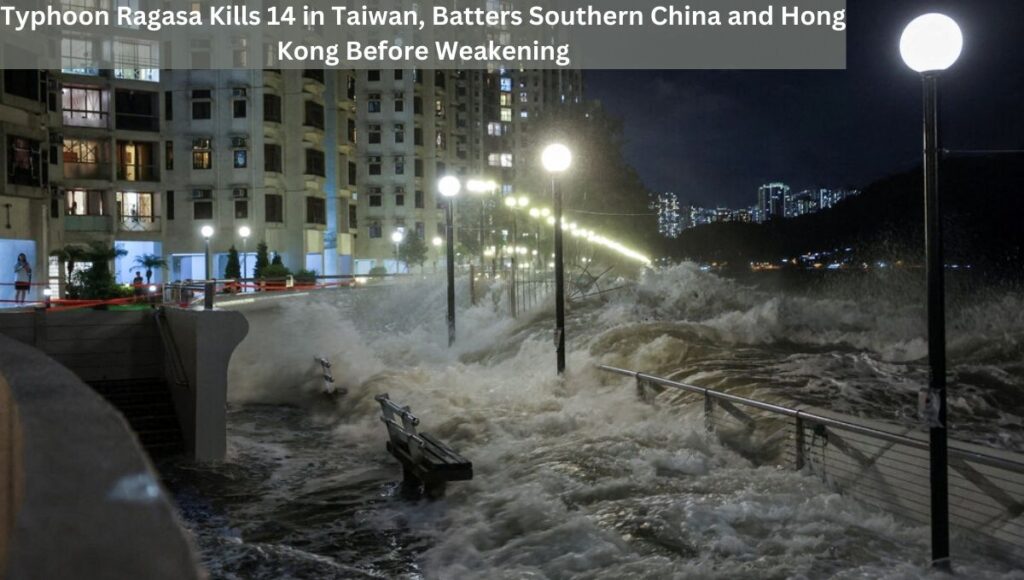
Typhoon Ragasa Kills 14 in Taiwan, Batters Southern China and Hong Kong Before Weakening
Taiwan: Deadly Flooding After Natural Dam Collapse
In Taiwan, Ragasa left devastation in its wake, particularly in Hualien County, where a natural dam collapsed and unleashed 68 million tons of water on Guangfu township.
- At least 14 people were confirmed dead and 31 remain missing, though authorities later revised numbers due to initial double-counting.
- Videos from Guangfu showed torrents of water sweeping cars away and residents sheltering on upper floors as homes flooded.
- A large bridge in Hualien was destroyed by the raging waters.
The natural dam had formed in July after a landslide, creating a fragile barrier that officials had long warned might fail. Authorities had monitored the site but determined it was not feasible to remove the dam safely. The collapse, triggered by Ragasa’s heavy rainfall, proved catastrophic.
Hong Kong and Macao Battered
As Ragasa advanced toward southern China, it passed through Hong Kong and Macao, bringing life to a standstill in two of the world’s most densely populated cities.
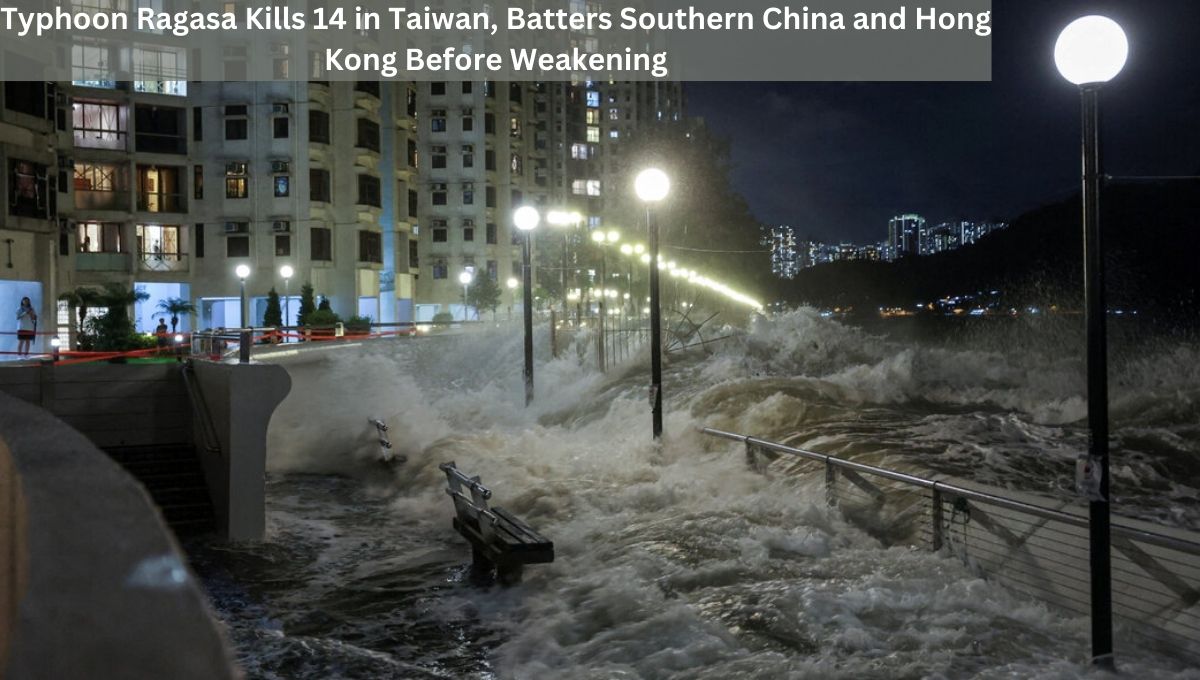
- In Hong Kong, scaffolding was ripped from buildings, trees were toppled, and storm surges smashed into coastal areas.
- Viral videos showed massive waves breaking through the glass doors of the Fullerton Ocean Park Hotel, flooding its lobby and sweeping people off their feet. Luckily, no injuries were reported.
- In Macao, waist-deep water flooded streets, leaving cars stranded and residents wading to safety.
Despite being well-prepared with advanced storm defenses, the scale of Ragasa’s winds — clocked at over 181 km/h (112 mph) in Shenzhen — exposed vulnerabilities in the region’s infrastructure.
Southern China: Nearly 2 Million Evacuated
China took no chances as Ragasa barreled toward Guangdong province, home to megacities such as Shenzhen and Guangzhou.
- By Tuesday night, 1.89 million people had been evacuated across Guangdong.
- Schools, factories, and transport services were shut down in at least a dozen cities.
- Train services in southern China were suspended, and airports faced widespread disruption.
The storm made landfall on Hailing Island, Yangjiang city, Guangdong province around 5 p.m. Wednesday with the strength of a Category 3 hurricane.
Massive waves crashed into coastal parks, while videos showed residents being evacuated from seaside high-rises to government shelters and school gyms.
China Mobilizes Relief Funds
China’s central government quickly released emergency funds to aid recovery:
- The Ministry of Finance and Ministry of Emergency Management allocated 150 million yuan ($21 million) to Guangdong, Hainan, and Fujian provinces for evacuations, hazard removal, and emergency repairs.
- The National Development and Reform Commission (NDRC) released 200 million yuan ($28 million) for infrastructure restoration, including repairs to roads, bridges, schools, and hospitals.
This rapid response highlights the seriousness with which Beijing views Ragasa, as it battered some of China’s most economically vital provinces.
Ragasa Weakens Over China and Vietnam
After landfall, Ragasa weakened faster than expected as it crossed into Guangxi province. By Thursday morning, it had been downgraded to a tropical depression, with winds at 61 km/h (38 mph).
- The weakened storm crossed into Mong Cai, northern Vietnam, but forecasters expect it to dissipate completely by Friday.
- Heavy rainfall remains a major concern, with 80–180 mm of rain forecast in northern Vietnam, Thanh Hoa, and Nghe An provinces, with some areas expected to receive more than 300 mm.
- Flash floods, landslides, and urban flooding remain likely across northern Vietnam and southern China.
The Philippines: Ragasa’s First Strike
Before Taiwan and China, Ragasa first hit the Philippines as a Category 5 typhoon, the most powerful storm level.
- At least seven fishermen were killed after their boat capsized off Luzon island.
- Northern provinces were battered by heavy rains, strong winds, and coastal flooding.
- Cleanup efforts are underway, but communities remain on alert as another storm, Opong, is forming in Philippine waters.
A Stormier Typhoon Season
Ragasa is the 18th named storm of the 2025 Pacific typhoon season — and unusually, it is the ninth storm to strike Hong Kong this year, nearly double the city’s typical annual average of six.
Scientists warn that climate change is making typhoons more frequent and intense.
- Warmer seas provide more energy to fuel storms.
- Increased atmospheric moisture leads to heavier rainfall and flooding risks.
- Stronger winds and higher sea levels demand updated building codes and stronger coastal defenses.
Professor Johnny Chan of the Asia-Pacific Typhoon Collaborative Research Centre emphasized that “most building codes were designed based on past data, but the past data would not be accurate anymore for the future.”
Climate Change and Asia’s Vulnerability
Asia’s densely populated coastlines make it especially vulnerable to typhoons like Ragasa. Cities such as Hong Kong, Shenzhen, and Guangzhou are well-prepared with drainage systems and flood defenses, yet even they struggle under the force of stronger, climate-fueled storms.
In Taiwan, the combination of mountainous terrain and fragile landslide-created dams creates added risks, while the Philippines faces repeated strikes each year.
Climate scientists warn that stronger evacuation systems, upgraded infrastructure, and global emissions cuts are needed to prepare for the storms of the future.
International Impact and Warnings
Beyond the immediate destruction, Ragasa serves as a warning of Asia’s rising storm risks:
- Hong Kong’s $3.8 billion drainage system has saved lives, but experts warn it must be expanded.
- Macao, the world’s most densely populated city, faces growing threats of storm surges.
- Vietnam, still recovering from previous storms, is bracing for widespread flooding.
- The Philippines, where Ragasa first struck, is already monitoring Typhoon Opong, the next looming storm.
With typhoon season stretching until December, millions across the region remain at risk.
Also Read: Air India Cancels Flights as Super Typhoon Ragasa Batters Asia
Conclusion: A Deadly Reminder
Typhoon Ragasa’s path of destruction — from the Philippines to Taiwan, Hong Kong, Macao, southern China, and Vietnam — shows how one storm can disrupt lives across multiple nations.
- 14 lives lost in Taiwan.
- Nearly 2 million displaced in China.
- Cities like Hong Kong and Macao paralyzed by floods.
Though Ragasa has weakened, its legacy underscores Asia’s vulnerability to increasingly powerful storms in a warming world. Governments across the region are now racing to rebuild, prepare for after-effects like flooding, and brace for more storms in the months ahead.
Also Read: Super Typhoon Ragasa leaves devastation across China, Taiwan, Philippines