
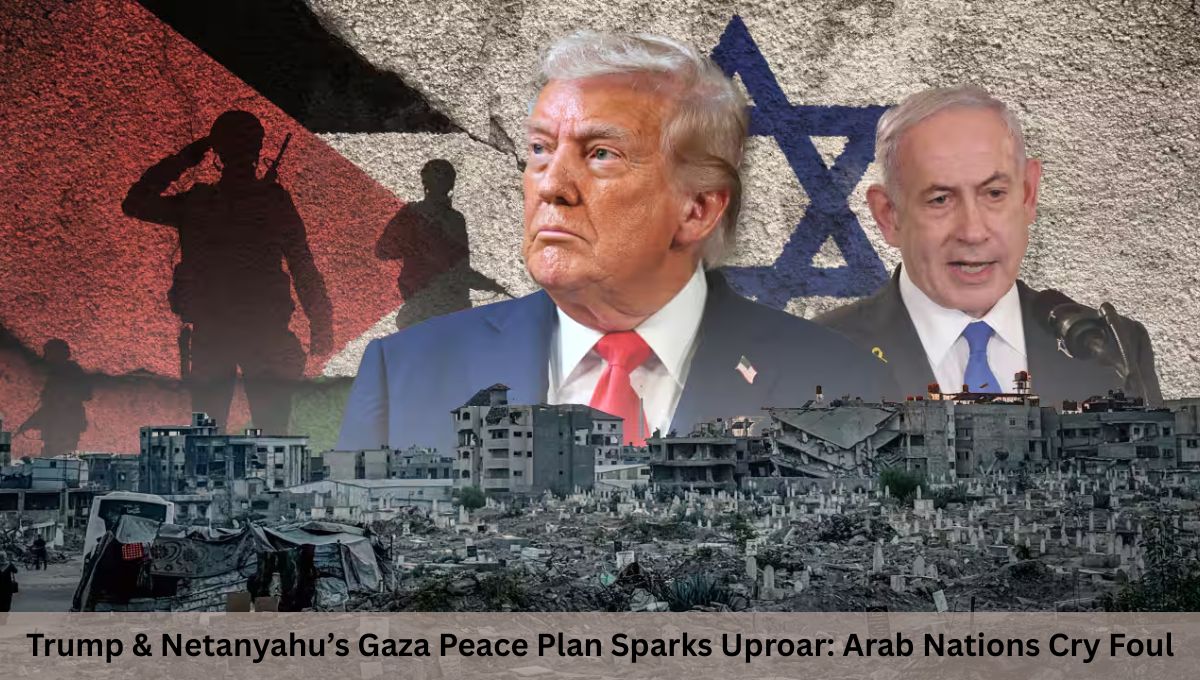
Trump & Netanyahu’s Gaza Peace Plan Sparks Uproar: Arab Nations Cry Foul over reports of last-minute changes by Netanyahu. When United States President Donald Trump unveiled his 20-point Gaza peace plan, flanked by Israeli Prime Minister Benjamin Netanyahu, it was hailed as a potential breakthrough.
For the first time in nearly two years of Israel’s war on Gaza following the October 7, 2023 Hamas attacks, a roadmap seemed to emerge that promised hostages released, Palestinian prisoners freed, aid flowing into Gaza, and the groundwork for reconstruction.
But within hours, cracks began to show. Eight Muslim-majority countries — Egypt, Jordan, Qatar, Saudi Arabia, the United Arab Emirates, Turkey, Indonesia, and Pakistan — had endorsed the plan in a rare joint statement. Yet, Hamas, the Palestinian group at the heart of the conflict, received a different version of the deal — allegedly altered at Netanyahu’s request.
The revelation has thrown the peace plan into turmoil. With Trump giving Hamas “three to four days” to respond or face “a sad end”, Muslim nations now fear they were tricked. Qatar, Egypt, and Turkey — key mediators — are demanding clarifications as mistrust grows.
Trump & Netanyahu’s Gaza Peace Plan Sparks Uproar: Arab Nations Cry Foul
What Was in Trump’s 20-Point Gaza Peace Plan?
Trump’s proposal, drafted over eight months, is formally titled the “Comprehensive Plan to End the Gaza Conflict.” Its broad points included:
- Ceasefire & Hostage Release: All Israeli hostages to be freed within 72 hours, with Israel releasing nearly 2,000 Palestinian prisoners.
- Hamas Disarmament & Amnesty: Hamas members would receive amnesty if they pledged peaceful coexistence and, crucially, decommissioned weapons.
- Israeli Withdrawal: The Israel Defense Forces (IDF) would withdraw in stages, replaced by an International Stabilization Force (ISF) from Arab and Muslim countries.
- Governance of Gaza: Gaza to be run temporarily by a technocratic Palestinian committee under the supervision of a “Board of Peace” chaired by Trump.
- Reconstruction: Humanitarian aid, infrastructure repair, and large-scale reconstruction projects under international oversight.
- No Forced Displacement: Palestinians would not be expelled from Gaza, rejecting extremist Israeli calls for annexation.
At face value, the plan seemed balanced enough to secure Arab backing. But Netanyahu reportedly intervened at the last minute, changing critical clauses on IDF withdrawal and Hamas disarmament.
Netanyahu’s “11th-Hour Changes”: Two Sticking Points
According to reports from Axios, The Times of Israel, and the Associated Press, Netanyahu successfully lobbied Trump’s team to alter the text of the peace plan before it was presented to Hamas.
1. IDF Withdrawal
- Original Clause: Israeli forces would withdraw to battle lines as of the US envoy’s proposal to prepare for hostage release.
- Changed Clause: IDF would withdraw only to an “agreed-upon line”, leaving scope for Israeli troops to remain in large parts of Gaza indefinitely.
This effectively allows Israel to ringfence Gaza even after Hamas disarms.
2. Hamas Disarmament
- Original Clause: Amnesty for Hamas members committing to peaceful coexistence.
- Changed Clause: Amnesty only if members also decommission weapons.
This subtle but crucial shift hardens Israel’s hand while narrowing Hamas’s options.
Arab & Muslim Countries Feel Betrayed
For leaders who had publicly endorsed Trump’s peace plan, the revelation of altered terms was humiliating.
- Saudi Arabia, Egypt, Jordan, and Turkey were reportedly furious, with diplomats saying they felt “tricked” by Netanyahu and Trump.
- Qatar, the chief mediator with Hamas, demanded further discussions before pressing the group to accept.
- The White House, however, released the plan in full despite objections, forcing Arab leaders into a corner.
Critics across the Arab world lashed out. Social media users accused leaders of being “traitors to the Ummah” for endorsing a plan that appeared to trade Palestinian sovereignty for geopolitical favors.
Entrepreneur Eli David summarized the sentiment bluntly on X:
“They hoped for the hundredth time Trump would turn against Netanyahu. They were disappointed for the hundredth time to discover Trump and Netanyahu are aligned on everything.”
Hamas: Split Over the Peace Plan
Inside Hamas, debates rage over how to respond.
- Some leaders see the plan as a rare chance for a ceasefire, guaranteed by Trump.
- Others reject clauses on disarmament and forced removal of cadres as unacceptable.
- Several factions demand international guarantees for a full Israeli withdrawal and protection against assassinations.
AFP quoted a Palestinian source saying:
“There are two views: one supports unconditional approval for a ceasefire. The other rejects disarmament and fears legitimizing occupation while criminalizing resistance.”
Qatar, Egypt & Turkey Push Hamas to Accept
Despite their frustrations, Qatar, Egypt, and Turkey are urging Hamas to accept Trump’s ultimatum.
On September 29, Qatari Prime Minister Mohammed bin Abdulrahman Al Thani and Egyptian intelligence chief Hassan Rashad met Hamas leaders in Doha, presenting the plan. The next day, Turkish intelligence chief Ebrahim Kalin joined the talks.
Al Thani told Al Jazeera that while the deal had “implementation challenges,” it met the core goals of stopping killing, displacement, and securing Gaza’s future.
But Hamas has not yet issued an official response, wary of internal divisions and Arab discontent.
Netanyahu’s Balancing Act: Facing Hardliners at Home
While Netanyahu celebrated the plan alongside Trump, back home he faced pushback from his hard-right coalition partners.
- Itamar Ben Gvir, Israel’s far-right National Security Minister, called the deal “dangerous” and “full of holes.”
- Bezalel Smotrich, Finance Minister, labeled it a “diplomatic failure”.
- Netanyahu reassured his cabinet that any move toward Palestinian statehood was only “ambiguous wording” and that Israel and the US alone would dictate terms.
Netanyahu reportedly told ministers:
“This will end either peacefully or by force — or by both. It is tighter than you think.”
Modi’s Multilingual Endorsement Raises Eyebrows
In a striking move, Indian Prime Minister Narendra Modi praised Trump’s plan in seven languages — English, Arabic, Hebrew, Spanish, French, Mandarin, and Russian.
This overt support contrasted sharply with Modi’s earlier dismissal of Trump’s claim to have mediated between India and Pakistan. Analysts see Modi’s gesture as an attempt to signal alignment with Washington on West Asia, while balancing India’s strategic interests in the Middle East.
Pope Leo XIV Weighs In
Even the Vatican entered the debate. Pope Leo XIV, the first American pope, urged Hamas to accept the plan, calling it a “realistic proposal” while stressing concern over humanitarian aid flotillas headed to Gaza.
Also Read: Trump Warns Hamas: Accept Gaza Peace Plan in 3-4 Days or Face Severe Consequences
The Humanitarian Reality in Gaza
As negotiations continue, Gaza’s suffering deepens.
- Over 66,000 Palestinians killed and 168,000 injured since October 7, 2023, according to Gaza’s Health Ministry.
- 453 deaths from malnutrition due to Israeli restrictions on aid.
- The International Committee of the Red Cross (ICRC) recently suspended operations in Gaza City, citing impossible conditions.
Also Read: The grim reality of Gaza’s hunger crisis appears to be shifting U.S. public opinion
Trump’s Ultimatum: A Businessman’s Plan or a Diplomat’s Deal?
Trump’s peace plan bears his trademark business imprint — bold promises, ambitious infrastructure projects, and a prominent role for himself as chair of the Board of Peace.
But analysts warn its lack of detail could doom it. The plan offers no guarantees for Palestinians, only for Israel. As Palestinian lawyer Diana Buttu noted:
“Not a single guarantee for Palestinians. Every guarantee is for Israel.”
For Trump, the plan could secure a Nobel Peace Prize nomination and burnish his legacy. But without Hamas’s buy-in — and with mistrust among Arab nations — it risks becoming another stillborn Middle East initiative.
Conclusion: Did Trump & Netanyahu Trick Muslim Nations?
At its core, the controversy boils down to trust.
- Arab and Muslim countries believe they endorsed one plan, only for Netanyahu to secure “11th-hour changes” that favored Israel.
- Hamas is caught between pressure from mediators and internal resistance.
- Netanyahu is balancing US coordination with appeasing far-right partners.
- Trump has set a ticking clock, threatening Hamas with “a sad end” if they refuse.
Whether or not it succeeds, the Trump-Netanyahu Gaza peace plan reveals the enduring fault lines of Middle East diplomacy: mistrust, shifting terms, and the recurring sense among Arab nations that they are being sidelined.
As of October 1, Hamas has yet to respond. But one thing is certain: what began as a potential breakthrough now risks collapsing into yet another chapter of disappointment.
Related Posts:
- Gaza Peace Deal First Phase Achieved: Trump’s Israel…

- Trump’s 20-Point Gaza Peace Plan Gains Urgent Global…

- Trump Orders Israel to Halt Gaza Bombing After Hamas Move
- Trump’s Breakthrough Gaza Ceasefire Deal 2025: Key Insights

- Israel–Hamas Ceasefire Under Strain: 4 More Hostage…

- Trump’s 2025 Middle East Peace Trip: Inside Mission…
