
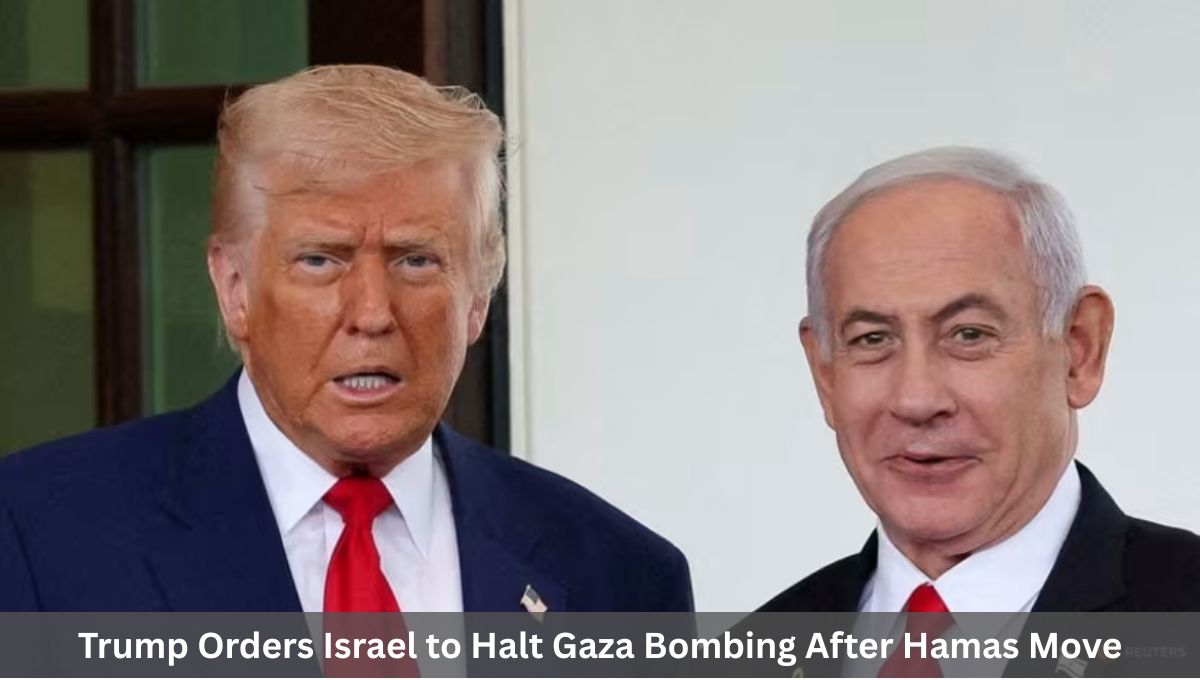
Trump Orders Israel to Halt Gaza Bombing After Hamas Move to release remaining hostages from 2023 attack. In a dramatic twist that could shape the trajectory of the Israel–Gaza conflict, U.S. President Donald Trump ordered Israel to immediately stop bombing the Gaza Strip after Hamas announced it would release the last of its hostages taken during the October 7, 2023 attack.
Trump welcomed Hamas’ partial acceptance of his 20-point Gaza peace plan, which envisions an end to the nearly two-year war, return of hostages, disarmament of Hamas, and eventual reconstruction of Gaza. Yet, while Hamas’ statement marks a significant breakthrough, it also leaves several key gaps, particularly regarding disarmament, foreign oversight, and the future governance of Gaza.
Trump hailed the moment as a “big day” but warned Hamas that if it fails to finalize the deal by Sunday evening, “all HELL, like no one has ever seen before, will break out.” This article explores Trump’s reaction, Hamas’ position, Israel’s response, and the broader international reception to this latest push for Middle East peace.
Trump Orders Israel to Halt Gaza Bombing After Hamas Move
Trump’s Reaction: “Too Dangerous to Continue Bombing”
Trump took to his social media platform Truth Social shortly after Hamas’ announcement:
“Based on the Statement just issued by Hamas, I believe they are ready for a lasting PEACE. Israel must immediately stop the bombing of Gaza, so that we can get the Hostages out safely and quickly! Right now, it’s far too dangerous to do that. We are already in discussions on details to be worked out.”
The U.S. president framed Hamas’ acceptance as a turning point and called on Israel to halt its airstrikes to ensure the safe extraction of hostages. He stressed that this was not merely about Gaza but about the “long-sought PEACE in the Middle East.”
Later, in a video message, Trump described the day as “big”, thanking mediating nations and urging all parties to seize the opportunity. However, he tempered optimism with caution:
“We’ll see how it all turns out. We have to get the final word down and concrete.”
What Did Hamas Say?
Hamas confirmed its readiness to release all Israeli hostages — both living and deceased — according to the exchange formula outlined in Trump’s proposal. The group emphasized:
- It is open to handing over Gaza’s governance to an independent Palestinian technocratic authority, based on national consensus.
- Other aspects of Trump’s plan, especially those concerning Palestinian rights and Gaza’s long-term future, require broader consultations with Palestinian factions.
- Its statement notably omitted any mention of disarming, which remains Israel’s central demand.
Senior Hamas officials also said that some elements, like locating the remains of captives, could take days or weeks, casting doubt on the feasibility of Trump’s proposed 72-hour timeline.
Hamas added that the future of Gaza must be decided on the basis of international law and a “unanimous Palestinian stance.”
Also Read: Trump & Netanyahu’s Gaza Peace Plan Sparks Uproar: Arab Nations Cry Foul
Israel’s Initial Response
Israeli Prime Minister Benjamin Netanyahu’s office cautiously welcomed Hamas’ move, announcing Israel’s readiness to implement the “first stage” of Trump’s plan — the release of hostages.
However, Netanyahu reaffirmed that Israel remains committed to its own principles for ending the war, which include Hamas’ total disarmament and ensuring the group can never again launch attacks.
The Israel Defense Forces (IDF) confirmed it had been ordered to prepare for the implementation of the plan’s first stage and to pause certain offensive operations. Reports indicated the IDF may switch to defensive operations in Gaza, though it has not announced a complete halt to the offensive.
Trump’s Peace Plan: The Key Points
Trump unveiled his 20-point Gaza peace proposal earlier this week alongside Netanyahu. The plan includes:
- Release of all 48 hostages (around 20 believed alive, others deceased) within 72 hours.
- Disarmament of Hamas and relinquishing of power.
- Israeli withdrawal from much of Gaza after security conditions are met.
- Release of Palestinian prisoners — including 250 serving life sentences and 1,700 detained since the war began.
- Massive humanitarian aid flows and reconstruction efforts.
- Establishment of an International Stabilization Force (ISF) led by Arab partners.
- Governance of Gaza by an independent technocratic Palestinian body until a reformed Palestinian Authority can take over.
- Oversight by an international body Trump has dubbed the “Board of Peace,” with former British Prime Minister Tony Blair named as co-chair.
- Long-term vision of a credible pathway to Palestinian self-determination and statehood.
Crucially, the plan shelves relocation plans for Gaza’s population, a proposal that had drawn widespread criticism.
Also Read: Trump’s 20-point Gaza peace plan in full
International Reactions: Broad Support but Caution
The latest developments drew quick responses from key mediators and world leaders:
- Egypt and Qatar welcomed Hamas’ announcement and vowed to continue facilitating discussions.
- UN Secretary-General António Guterres urged all parties to seize the opportunity to end the war.
- French President Emmanuel Macron tweeted: “The release of all hostages and a ceasefire in Gaza are within reach!”
- The Israeli Hostage Families Forum praised Trump’s demand to halt the fighting as “essential to prevent irreversible harm to hostages.”
However, skepticism remains about Hamas’ sincerity and Israel’s willingness to halt military pressure without guarantees of disarmament.
Trump’s Warning: A “Last Chance” Ultimatum
Just hours before Hamas issued its statement, Trump warned that failure to accept his plan by Sunday evening would trigger unprecedented consequences:
“If this LAST CHANCE agreement is not reached, all HELL, like no one has ever seen before, will break out against Hamas. THERE WILL BE PEACE IN THE MIDDLE EAST ONE WAY OR THE OTHER.”
This ultimatum underscores Trump’s dual approach — carrot and stick — as he seeks to secure a breakthrough ahead of the second anniversary of the October 7 attack.
Hamas’ Omissions: The Missing Pieces
While Hamas’ partial acceptance is significant, glaring omissions remain:
- No mention of disarmament or handing over weapons.
- No acceptance of foreign administration of Gaza, despite Trump’s plan requiring international oversight.
- Hamas insisted on having a role in future Palestinian governance, contrary to Trump’s demand that it play no role “directly or indirectly.”
- No commitment to the “Board of Peace” structure proposed by Trump.
These gaps raise concerns that Hamas’ response could be a tactical move to buy time rather than a genuine acceptance.
Humanitarian Crisis in Gaza
The humanitarian situation in Gaza remains catastrophic:
- Over 66,000 Palestinians have been killed, according to Gaza’s Health Ministry.
- 90% of the population displaced, many multiple times.
- Gaza City has slipped into famine, with hundreds of thousands trapped.
- The UN humanitarian office describes scenes of families living in hospital parking lots without basic necessities.
Trump’s plan envisions humanitarian corridors, food and medical aid deliveries, and reconstruction. But without a sustainable ceasefire, relief efforts remain stalled.
Second Anniversary of the 2023 Attack
The developments come days before the second anniversary of Hamas’ October 7, 2023 attack, which killed 1,200 Israelis and saw 251 abducted.
Since then, Israel’s retaliatory offensive has devastated Gaza. While earlier ceasefire attempts secured the release of some hostages, dozens remain in Hamas’ custody.
Trump appears determined to secure their release before the anniversary, framing it as both a moral imperative and a political milestone.
Analysis: A Fragile Step Toward Peace
Hamas’ acceptance of key elements of Trump’s proposal is undeniably significant. It opens the door for serious negotiations after months of stalemate.
Yet the omissions — especially regarding disarmament — leave Israel skeptical. Netanyahu’s government faces pressure from both hawks demanding Hamas’ defeat and hostage families demanding immediate action.
Trump’s gamble hinges on whether he can bridge these gaps quickly. His insistence that Israel stop bombing could strain U.S.–Israel relations, especially with Netanyahu reluctant to pause operations.
Ultimately, the fate of the proposal rests on whether Hamas is genuinely willing to disarm and whether Israel can compromise on its red lines.
Conclusion: A Moment of Possibility, But Not Certainty
Donald Trump’s order for Israel to halt bombing Gaza after Hamas’ announcement has created a rare moment of possibility in a brutal, protracted war.
The coming days — and Trump’s Sunday deadline — will determine whether this becomes a historic breakthrough or yet another missed opportunity in the long history of failed Middle East peace efforts.
For now, families of hostages dare to hope, mediators scramble to close the gaps, and the world watches to see if Trump can deliver where so many before him have failed.
Related Posts:
- Gaza Peace Deal First Phase Achieved: Trump’s Israel…

- Trump’s Breakthrough Gaza Ceasefire Deal 2025: Key Insights

- Trump’s 2025 Gaza Peace Plan Signing and Historic…

- Trump’s 20-Point Gaza Peace Plan Gains Urgent Global…

- 11 Explosive Warnings as Trump Vows to ‘Knock the…

- Israel Awards Highest Honor to Trump in 2025 for…
