

7 Crucial Developments as Thailand–Cambodia Ceasefire Ends Deadly Border War that killed over 100 and displaced more than 500,000. Thailand and Cambodia have signed a ceasefire agreement aimed at halting weeks of intense and deadly fighting along their disputed border, bringing a tentative pause to one of Southeast Asia’s most serious military escalations in years.
Thank you for reading this post, don't forget to subscribe!The agreement follows prolonged clashes that killed more than 100 people, displaced over half a million civilians, and drew growing concern from regional and global powers.
While guns have fallen silent for now, officials and observers have cautioned that the truce remains fragile and its success will depend heavily on adherence in the coming days.
The ceasefire took effect at 12:00 pm local time (05:00 GMT) on Saturday, according to a joint statement signed by the defence ministers of both countries.
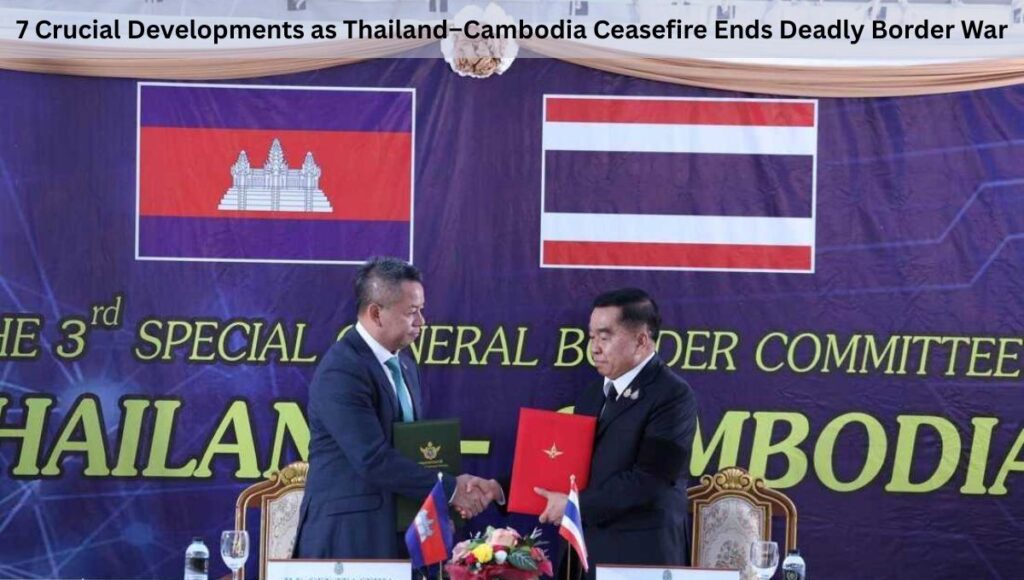
7 Crucial Developments as Thailand–Cambodia Ceasefire Ends Deadly Border War
Ceasefire Agreement: What Thailand and Cambodia Have Committed To
In a jointly signed statement, Thai Defence Minister Natthaphon Narkphanit and Cambodian Defence Minister Tea Seiha confirmed that both sides had agreed to an immediate and comprehensive ceasefire.
Key Provisions of the Ceasefire
- Immediate cessation of hostilities following the signing
- No movement or reinforcement of existing troop deployments
- Suspension of all types of weapons, including air, artillery, and rocket fire
- Prohibition of attacks on civilians, civilian infrastructure, and military targets
- Commitment to avoid provocative actions and misinformation
The agreement applies to all conflict zones along the Thailand–Cambodia border, signaling an intent to fully de-escalate after nearly three weeks of sustained violence.
Fighting That Pushed the Region to the Brink
The latest conflict represents the worst fighting between Thailand and Cambodia in years, involving fighter jets, heavy artillery, rocket barrages, and ground assaults.
Human Cost of the Conflict
- At least 101 people killed, including soldiers and civilians
- More than 500,000 civilians displaced on both sides of the border
- Entire villages evacuated amid fears of bombardment
- Damage to homes, schools, temples, and public infrastructure
Border districts in Thailand and Cambodia saw mass evacuations, with residents sheltering in bunkers and emergency camps as clashes intensified in December.
“Guns Have Fallen Silent,” But Tensions Remain
Despite the ceasefire, journalists on the ground reported that intense fighting continued until the final moments before the truce took effect.
Al Jazeera correspondent Assed Baig, reporting from the Cambodian border city of Poipet, described the situation as tense and uncertain.
“Right up until the ceasefire was implemented, there was some really intense firing going on. That gives you an idea of how fragile this actually is,” Baig said.
He added that many displaced civilians remain hesitant to return home, waiting to see whether the ceasefire holds over the critical first 72 hours.
ASEAN to Monitor the Ceasefire
A key element of the agreement is the involvement of the Association of Southeast Asian Nations (ASEAN), which will deploy observers to monitor compliance.
ASEAN’s Role
- Observe troop behavior and ceasefire compliance
- Facilitate communication between both militaries
- Help prevent misunderstandings or accidental escalation
- Support humanitarian access and civilian returns
The inclusion of ASEAN underscores regional concern about the conflict and reflects growing pressure on both Bangkok and Phnom Penh to stabilize the situation.
Return of Captured Soldiers
Thailand has agreed to return 18 Cambodian soldiers captured during earlier clashes, but only after the ceasefire has been fully maintained for 72 hours.
This provision is seen as a confidence-building measure, though both sides have stressed that violations during this period could derail further steps toward normalization.
Allegations of Ceasefire Violations
Even as the ceasefire was announced, tensions persisted. Cambodia accused Thailand of conducting airstrikes using F-16 fighter jets shortly after peace talks concluded.
According to Cambodia’s Defence Ministry, bombs were dropped on Serei Saophoan in Banteay Meanchey province, while Thailand defended its actions as necessary to protect border provinces from cross-border attacks.
Both sides have blamed each other for violations, describing military actions as self-defense, a pattern that has repeatedly undermined past ceasefires.
Why the Thailand–Cambodia Border Is So Disputed
The conflict is rooted in a century-old territorial dispute stemming from colonial-era border demarcations.
Key Sources of Tension
- Undemarcated sections of the 817-kilometre land border
- Competing interpretations of French colonial maps
- Strategic high ground along the Dangrek mountain range
- Ancient Khmer temples near the frontier
The most famous flashpoint is the Preah Vihear temple, which the International Court of Justice ruled belongs to Cambodia in 1962. However, surrounding land was never clearly defined, leaving room for recurring clashes.
Why Fighting Reignited in 2025
The current escalation follows the collapse of a previous ceasefire brokered in July with international involvement.
Timeline of the Latest Escalation
- May: Border confrontation kills a Cambodian soldier
- July: Heavy fighting displaces hundreds of thousands before a truce
- December: Ceasefire collapses amid renewed clashes
- Late December: Airstrikes, artillery fire, and rocket attacks intensify
Each breakdown has deepened mistrust and hardened military positions on both sides.
Role of International Powers
The conflict has drawn attention from major global players.
United States
- US President Donald Trump claimed to have spoken to both leaders
- Secretary of State Marco Rubio offered mediation
- Washington urged full implementation of ceasefire commitments
Malaysia and ASEAN
- Malaysian Prime Minister Anwar Ibrahim, as ASEAN chair, pushed diplomatic talks
- Kuala Lumpur hosted emergency meetings of regional foreign ministers
Russia and China
- Both called for restraint and a diplomatic solution
- Emphasized regional stability and civilian protection
Despite diplomatic pressure, fighting continued until the current ceasefire was finalized.
Civilians Caught in the Middle
The humanitarian impact has been severe.
Displacement and Fear
- Entire districts evacuated under military orders
- Residents warned to stay in bunkers ahead of ceasefire timing
- Schools, temples, and farms abandoned
- Families separated amid chaotic evacuations
Local officials warned civilians not to return prematurely, fearing renewed shelling or air attacks.
Border Districts on High Alert Before the Truce
In the hours before the ceasefire took effect, Thai border districts issued urgent warnings urging residents to remain in shelters.
Authorities feared last-minute offensives aimed at reclaiming territory before the ceasefire deadline — a pattern seen in previous conflicts.
Wildlife Rescue Amid the Fighting
Amid the destruction, an unusual story emerged from the conflict zone.
Thai media reported the rescue of five malnourished wild animals, including lions and bears, from a casino allegedly used as a Cambodian military position.
The animals were relocated to wildlife centers in Thailand and named “Christmas” and “Merry” upon arrival. The episode highlighted the broader environmental and humanitarian toll of the fighting.
What Happens Next? The Critical 72 Hours
Officials and analysts agree that the first 72 hours after the ceasefire are crucial.
Key Risks Ahead
- Accidental skirmishes or miscommunication
- Allegations of airspace or artillery violations
- Political pressure from nationalist factions
- Delays in humanitarian access
Both militaries have pledged direct communication between defence ministers and chiefs of armed forces to address incidents swiftly.
Border Demarcation Remains Unresolved
Notably, the ceasefire does not address border demarcation, leaving the core dispute unresolved.
Existing bilateral mechanisms will continue negotiations, but decades of failed efforts suggest a long road ahead.
Can the Ceasefire Hold?
While the ceasefire marks a significant diplomatic step, history offers reasons for caution. Previous truces have collapsed under accusations, retaliatory strikes, and political pressures.
As one Thai military official put it:
“War and clashes don’t make the two countries or the two people happy.”
For now, calm has returned to much of the border — but whether peace follows depends on restraint, transparency, and sustained diplomacy.
Conclusion: A Fragile Pause, Not a Final Peace
The Thailand–Cambodia ceasefire has halted the bloodshed, offering hope to hundreds of thousands displaced by weeks of fighting. Yet the agreement remains fragile, overshadowed by unresolved territorial disputes, mutual distrust, and the legacy of past breakdowns.
As ASEAN monitors the truce and civilians wait anxiously to return home, the coming days will determine whether this ceasefire becomes a foundation for lasting peace — or merely another pause before conflict resumes.
Also Read: 7 Explosive Developments as Cambodia Accuses Thailand of Defying Ceasefire
Also Read: Explained | Thailand–Cambodia Ceasefire: What Sparked Dispute Between The Two Nations?
Related Posts:
- 7 Heartbreaking Facts About Venezuela's Earthquake Disaster

- 5 Major Takeaways from the US Supreme Court's…

- Afghanistan–Pakistan War 2025: Inside the 48-Hour Ceasefire

- 7 Powerful Facts About Ayatollah Ali Khamenei’s…

- 3 Explosive Conditions Iran Sets to End War with US…

- Trump’s 20-Point Gaza Peace Plan Gains Urgent Global…
