In a critical diplomatic moment, Putin Warns of Escalation After Ukraine Drone Strike as Trump Seeks Diplomatic Breakthrough. Russian President Vladimir Putin and U.S. President Donald Trump held an 85-minute phone call addressing a string of escalating global conflicts from Ukraine’s audacious drone attacks deep inside Russian territory, to the volatile India-Pakistan standoff, and rising nuclear concerns in Iran.
The high-level conversation comes at a time when geopolitical tensions are boiling across multiple regions, threatening to push several flashpoints into open conflict.
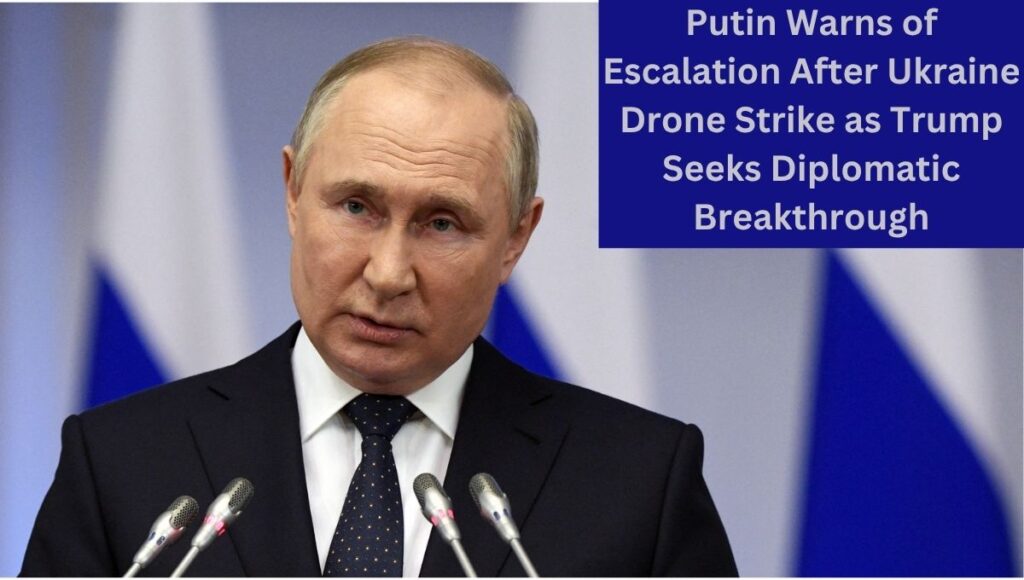
Putin Warns of Escalation After Ukraine Drone Strike as Trump Seeks Diplomatic Breakthrough
Ukraine Drone Strike Shocks Moscow
One of the most dramatic moments discussed during the Trump Putin phone call was Ukraine’s precision drone strike on June 1, targeting Russia’s strategic airbases.
According to Ukrainian military sources, at least 41 Russian aircraft were hit, including long-range nuclear-capable bombers stationed at bases like Belaya, Dyagilevo, and Olenya locations previously thought to be beyond Kyiv’s reach.
New video footage released by Ukraine’s security agency (SBU) revealed surgical strikes against dozens of parked aircraft. The damage marked one of the deepest and most successful Ukrainian operations inside Russian territory since the conflict began over three years ago.
In response, Putin told Trump that Russia “will have to” respond, setting the stage for possible escalation in the ongoing war.
Trump: “Not a Conversation That Will Lead to Immediate Peace”
Despite the gravity of the situation, Trump described the exchange with Putin as “a good conversation, but not one that will lead to immediate peace.”
In a Truth Social post, Trump acknowledged that the recent events particularly Ukraine’s strike on Russian airfields have complicated ceasefire efforts. Yet, he insisted the dialogue between him and Putin was “positive and productive,” with both leaders agreeing to remain in contact.
Trump also claimed credit for facilitating initial rounds of peace talks between Russian and Ukrainian delegations, most recently held in Istanbul. Kremlin aide Yury Ushakov confirmed that peace plan memorandums were exchanged but accused Ukraine of trying to sabotage progress through “terrorist attacks” on civilian infrastructure.
Putin Accuses Kyiv of Terrorism, Rejects Zelenskyy Summit
Following the drone attacks, Putin appeared visibly angry in a video conference with top officials, calling Ukraine’s leadership a “terrorist organization.”
He flatly rejected the idea of direct talks with President Volodymyr Zelenskyy, despite Ukraine’s continued calls for one-on-one negotiations.
Putin questioned the logic of pursuing diplomacy while accusing Ukraine of staging “terrorist acts” in the Kursk and Bryansk regions and targeting civilian infrastructure.
However, Ushakov suggested that Trump “listened intently” to Putin’s briefing and implied that talks could resume through alternative diplomatic channels.
US Officials Caught Off Guard, Warn of Rising Escalation Risk
According to U.S. officials, the Ukrainian drone strike was not coordinated with Washington, and came as a surprise. Trump’s envoy for Ukraine, Keith Kellogg, warned during a Fox News interview that such attacks raise the risk of retaliation and potential escalation into broader conflict, especially since some of the targeted bombers form part of Russia’s nuclear triad.
Despite this, Trump refrained from criticizing Ukraine or urging restraint, prompting concern among Ukrainian lawmakers. Oleksandr Merezhko, a member of Ukraine’s parliament, warned that Trump’s silence might appear as tacit approval of a Russian reprisal.
India-Pakistan Conflict Eased With Trump’s Help, Kremlin Claims
In a surprising addition, the Kremlin disclosed that Trump played a role in de-escalating the India-Pakistan conflict following India’s Operation Sindoor. The operation was a direct response to a deadly terror attack in Pahalgam that claimed 26 civilian lives.
India’s precision strikes on terror camps in Pakistan-occupied Kashmir (PoK) triggered retaliatory fire from Pakistan, raising fears of a larger war. However, both sides agreed to a ceasefire on May 10. Kremlin aide Ushakov credited Trump with helping “stop the armed conflict,” although details remain scarce.
Iran Nuclear Crisis Looms: Trump and Putin Seek Urgent Resolution
Another central issue in the Trump Putin phone call was Iran’s nuclear program. Both leaders reportedly agreed that Iran must not develop nuclear weapons. Trump expressed frustration over Tehran’s “slow-walking” of negotiations and said a definitive answer was urgently needed.
Putin indicated willingness to join upcoming talks, while U.S. Secretary of State Marco Rubio met in Washington with Andriy Yermak, Ukraine’s presidential chief of staff, to discuss the Middle East and Eastern Europe security issues.
However, Iran’s Supreme Leader Ayatollah Ali Khamenei dismissed the latest U.S. proposal, stating it was against Iran’s national interests and reiterated Tehran’s right to continue uranium enrichment.
Pope Leo Calls Putin, Urges Peace
In a notable intervention, Pope Leo also spoke to Putin on Wednesday, urging the Russian leader to support peace and return to meaningful negotiations. The Vatican described the call as emphasizing the “importance of dialogue.”
The Pope’s involvement adds a humanitarian dimension to a largely militarized and politically tense set of global developments.
What’s Next?
As Trump attempts to position himself as a peacemaker, the next few weeks will be pivotal. With Putin warning of potential military retaliation, Iran’s nuclear ambitions intensifying, and fragile India-Pakistan relations still under strain, the global diplomatic landscape remains volatile.
Whether diplomacy prevails or spirals further into conflict depends on the decisions made by world leaders in the days ahead.
Conclusion
The Trump Putin phone call has cast a spotlight on the most urgent global issues of 2025: the Russia Ukraine war, the India Pakistan conflict, and the looming threat of a nuclear Iran. As Washington, Moscow, Kyiv, Tehran, and New Delhi all weigh their next moves, the world holds its breath waiting to see whether leaders will choose escalation or diplomacy.
Also Read: Trump Slams Putin as “Absolutely CRAZY” After Deadliest Russian Drone Strikes on Ukraine
Also Read: Trump Warns Putin Plans to Retaliate ‘Very Strongly’ Against Ukraine
Related Posts:
- Impacts of the Trump-Putin Call on Ukraine’s 2025 Strategy
- Trump’s 2025 Gaza Peace Plan Signing and Historic…

- 7 Crucial Insights Into Trump and Xi’s High-Stakes…
- 5 Powerful Highlights as Trump Lands Second Nobel…

- US President Donald Trump Fuels Third-Term…

- 9 Explosive Revelations as Trump Declares His Health…