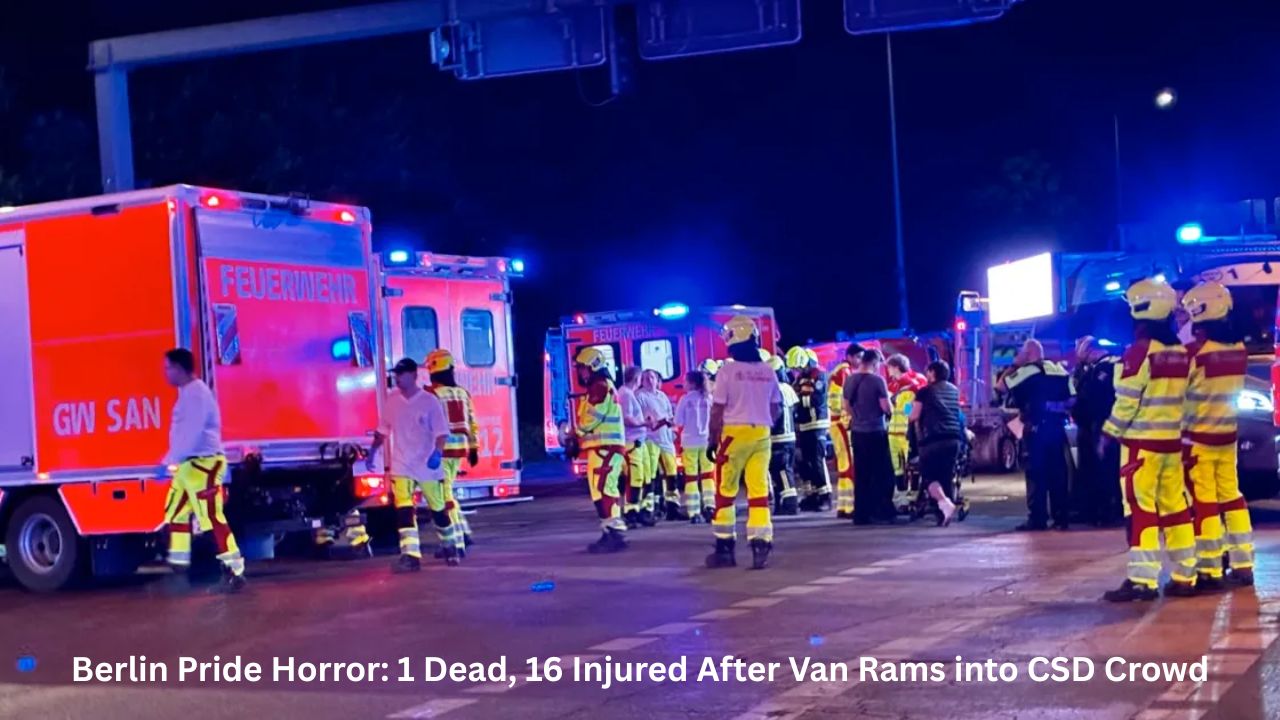
Berlin Pride Horror: 1 Dead, 16 Injured After Van Rams into CSD Crowd; suspect identified, manhunt ongoing. Berlin’s biggest celebration of the year turned into a scene of panic and grief on Saturday night when a van plowed into crowds gathered for the city’s Christopher Street Day Pride festivities, killing one person and injuring at least 16 others.
What began as a joyful march through the German capital, drawing hundreds of thousands of participants, ended abruptly with sirens, stretchers, and a citywide manhunt that is still underway.
The attack has shaken Germany’s LGBTQ+ community and reignited concerns across Europe about vehicle-ramming attacks at large public gatherings.
As of Sunday morning, the person responsible remains unidentified to the public and unaccounted for, with Berlin police confirming they are actively pursuing a named suspect who has not yet been arrested.
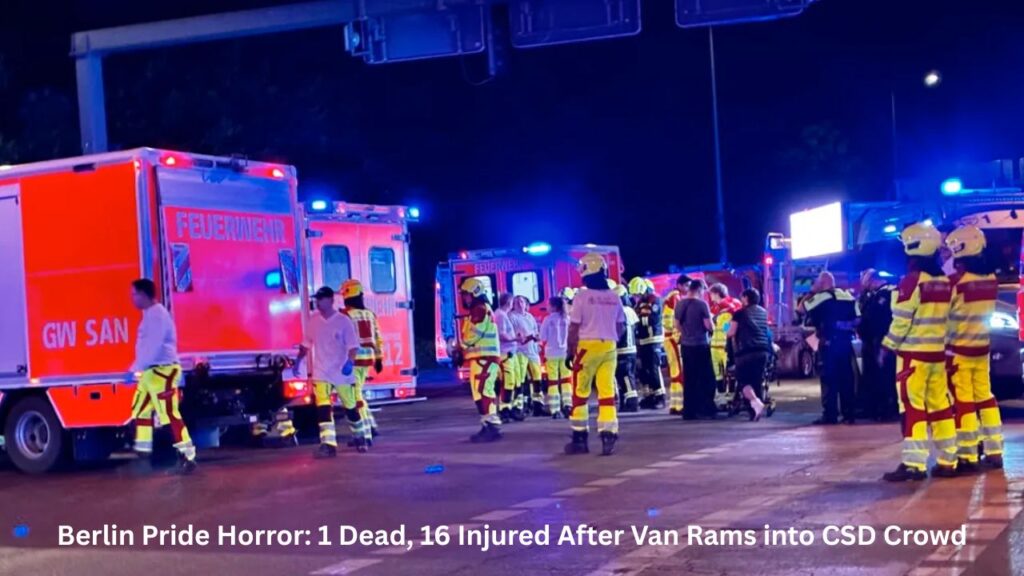
Berlin Pride Horror: 1 Dead, 16 Injured After Van Rams into CSD Crowd
A Celebration Turned Chaotic: Timeline of the Berlin Pride Attack
Christopher Street Day, known locally as CSD, is one of Europe’s largest LGBTQ+ celebrations. First held in West Berlin in 1979, it commemorates the 1969 Stonewall uprising in New York and combines a festive parade with political demonstrations for equality and protection against discrimination.
This year’s event drew hundreds of thousands of people who marched peacefully for hours behind roughly 80 parade floats, dancing through the streets before gathering for a closing rally near the Brandenburg Gate.
The Vehicle Strikes Tiergarten Park
Around 10 p.m. local time on Saturday, that celebration turned to chaos. Police say a white van drove into the city’s central Tiergarten park, an area adjoining the route the Pride parade had passed through earlier in the day.
The vehicle struck multiple pedestrians before crashing into a tree. According to police, the van was empty when officers arrived, meaning the driver had already fled the scene on foot.
A witness cited by German tabloid Bild described seeing a man get out of the vehicle and run away immediately after the crash.
Emergency Response and Evacuation
Organizers pulled the plug on the closing festivities at around 10:15 p.m., cutting short a stage performance that was underway at the time.
Berlin police posted urgent messages online telling everyone at the venue to leave the area immediately.
More than 2,200 police officers had already been deployed across the city that day to help secure the Pride parade and related LGBTQ+ events, and many of them were quickly redirected to the Tiergarten crash site alongside fire department crews and ambulances.
Casualties: One Dead, More Than a Dozen Injured
The human toll of the Berlin Pride attack shifted several times overnight as authorities gathered more information. Early reports on Saturday night put the number of injured at around 14.
That figure climbed as rescue crews continued treating victims at the scene, with some accounts overnight citing as many as 17 people struck by the vehicle.
By Sunday morning, police and the Associated Press confirmed a toll of one person killed and at least 16 others injured, with several described as being in life-threatening condition.
A fire brigade spokesperson said earlier in the night that eight of the injured had suffered serious injuries, three of them critical. The identities of the victims have not been publicly released.
Berlin authorities have set up a dedicated hotline for relatives and friends trying to locate loved ones who attended the event, and they’ve asked anyone with photos or video from the scene to come forward.
Manhunt Underway: What We Know About the Suspect
By Sunday, Berlin police announced a significant development: they had identified a suspected perpetrator, though he remains at large.
Police spokesperson Florian Nath told reporters at the scene that the suspect is known to law enforcement as a member of Islamist circles operating in Berlin, though authorities stopped short of naming him publicly or confirming a motive.
Investigators reportedly searched an apartment in Berlin’s Schöneberg district as part of the operation, but no arrest resulted because no one was found on the property.
Nath said the search for the suspect was continuing “at full speed,” underscoring the urgency officers are placing on tracking down whoever was behind the wheel.
Possible Second Phase: Stab Wound Reports
Adding another layer of uncertainty to the investigation, police say they are also looking into witness accounts describing what appeared to be stab wounds among some of the victims, separate from injuries caused directly by the vehicle.
Investigators have not confirmed how those injuries occurred or whether they are connected to the ramming, and officials have cautioned that it is too early to draw firm conclusions.
The possibility that the attack unfolded in two distinct phases — a vehicle strike followed by a separate assault — remains under active investigation as of Sunday.
Reactions From Berlin and Beyond
Berlin Mayor Kai Wegner condemned the attack in a statement, describing it as a strike against the city’s open and tolerant values, and calling the events of the night deeply disturbing given how peaceful the parade had been just hours earlier.
Germany’s federal Interior Minister, Alexander Dobrindt, also weighed in, pledging federal support to Berlin authorities as they investigate.
For many attendees, the shock was deeply personal. One man who rushed to Tiergarten after hearing what happened described it as one of the darkest moments the city’s queer community has experienced in recent memory.
Messages of solidarity have poured in from LGBTQ+ organizations, city officials, and international observers who follow Pride events around the world, many of whom are now asking what this means for the security of similar gatherings elsewhere.
A City on Edge: Germany’s History With Vehicle-Ramming Attacks
Saturday’s incident is far from an isolated case. Germany has experienced a troubling pattern of vehicle-ramming attacks on crowds in recent years, and the Berlin Pride attack now adds to that grim list.
In May of this year, a driver believed to be experiencing a mental health crisis drove into a pedestrian zone in Leipzig, killing two people.
In 2025, a car attack in Mannheim killed two people, carried out by a man authorities described as psychologically unwell.
Just weeks before that Mannheim attack, an assailant rammed a vehicle into a trade union demonstration in Munich, killing two and injuring more than 40 people, including several children.
And in December 2024, a car-ramming attack on a Christmas market in Magdeburg left multiple people dead, with the suspect later identified as a Saudi-born psychiatrist with a documented history of anti-Islamic rhetoric.
Berlin itself is no stranger to this type of violence either. In 2022, a driver plowed a car into pedestrians near the Kaiser Wilhelm Memorial Church on Kurfürstendamm, killing one person and injuring 17 — a chilling numerical echo of Saturday night’s toll.
This recurring pattern has fueled an ongoing national debate in Germany over public safety at large gatherings, vehicle barriers at pedestrian events, and the broader challenge of preventing low-tech, high-casualty attacks that are notoriously difficult to predict or stop in advance.
What This Means for Pride Events Worldwide
Pride celebrations have grown into some of the largest annual public gatherings in cities around the world, from São Paulo to Sydney, from New York to New Delhi.
Berlin’s CSD alone regularly draws crowds in the hundreds of thousands, making security planning for these events an enormous logistical undertaking even in a city that deployed more than 2,200 officers for this year’s festivities.
Saturday’s attack is likely to prompt renewed scrutiny of how Pride organizers and city governments worldwide protect open-air routes and closing rallies, particularly around vehicle access points near parade paths and event venues.
Security experts have long warned that pedestrian zones and festival crowds remain vulnerable to vehicle-based attacks precisely because they are, by design, open and accessible to the public.
Conclusion: Moving Forward After Tragedy in Berlin
What should have been a joyous night celebrating identity, community, and freedom in one of Europe’s most vibrant cities instead became the scene of tragedy.
As Berlin police continue their manhunt and investigators work to determine exactly what unfolded in Tiergarten park — including whether stab wounds reported by witnesses point to a second, separate attack — the city is left to grieve a life lost and process the trauma experienced by dozens more.
This story is still developing, and details including the identity of the suspect, the full list of injuries, and the ultimate motive behind the Berlin Pride attack are expected to be updated as German authorities release more information in the coming days.
For now, Berlin joins a painful list of German and European cities forced to confront the aftermath of a vehicle-ramming attack on its own streets, even as the broader LGBTQ+ community reaffirms that its celebrations of identity and belonging will continue.
Also Read: 13 Shocking Facts About the Brown University Shooting That Rocked America
Also Read: Police name ‘Islamist’ suspect after van rams into Berlin Pride crowd, killing one and injuring 16
Related Posts:
- 7 Heartbreaking Facts About Venezuela's Earthquake Disaster

- 5 Major Takeaways from the US Supreme Court's…

- In 8 Moves, EU Targets China-Linked Refineries and…

- 7 Powerful Insights into Zohran Mamdani’s Historic…

- Afghanistan–Pakistan War 2025: Inside the 48-Hour Ceasefire

- 13 Shocking Facts About the Brown University…