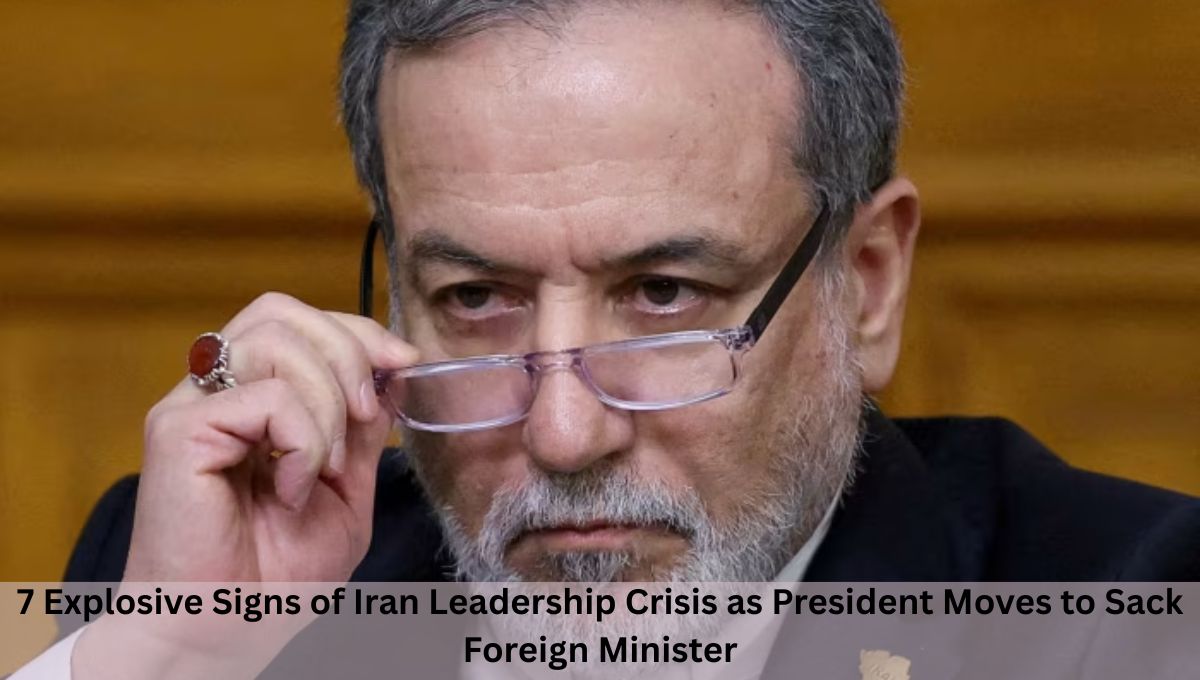
7 Explosive Signs of Iran Leadership Crisis as President Moves to Sack Foreign Minister Abbas Araghchi over IRGC tensions. Iran is facing a growing internal political crisis at one of the most critical moments in its recent history. Reports suggest a major rift within the country’s leadership, with President Masoud Pezeshkian and Parliament Speaker Mohammad Bagher Ghalibaf reportedly seeking the removal of Foreign Minister Abbas Araghchi.
At the center of the controversy are allegations that Araghchi has been operating independently of the elected government and aligning himself more closely with Iran’s powerful military establishment—the Islamic Revolutionary Guard Corps (IRGC).
While there has been no official confirmation from Tehran, the reports point to deepening fractures within Iran’s political system—fractures that could reshape the country’s diplomatic strategy, especially in its dealings with the United States.
7 Explosive Signs of Iran Leadership Crisis as President Moves to Sack Foreign Minister
What Triggered the Iran Leadership Crisis?
Allegations of “Parallel Decision-Making”
According to sources cited in multiple reports, the dispute centers on claims that Abbas Araghchi has:
- Coordinated directly with IRGC leadership
- Followed directives from military commanders
- Failed to inform the president about key decisions
Specifically, Araghchi is accused of acting under the influence of Ahmad Vahidi, a senior figure in Iran’s security establishment.
This has raised serious concerns within the civilian leadership about a “parallel decision-making structure” emerging inside the government.
Why President Pezeshkian Is Frustrated
A President Without Full Control?
Reports suggest that President Masoud Pezeshkian has grown increasingly frustrated with his inability to exercise authority over key state decisions.
Sources claim:
- He has been excluded from major diplomatic decisions
- His authority over appointments has been limited
- He feels trapped in a “political deadlock”
The alleged sidelining of the presidency highlights a broader issue within Iran’s political system—the balance of power between elected officials and military institutions.
The Role of the IRGC in Iran’s Power Structure
A State Within a State
The Islamic Revolutionary Guard Corps is not just a military entity—it is a powerful political and economic force within Iran.
It:
- Controls key security operations
- Influences foreign policy decisions
- Has significant sway over strategic negotiations
Wartime Justification for Control
According to reports, Ahmad Vahidi has argued that:
- Wartime conditions require centralized control
- Sensitive positions should be managed by the IRGC
- Civilian leadership should take a secondary role
This perspective appears to be a major source of tension with the president.
The Nuclear Talks Fallout
Diplomacy Meets Internal Conflict
The leadership crisis is closely tied to Iran’s ongoing negotiations with the United States.
Sources suggest that internal disagreements:
- Disrupted negotiations in mid-April
- Led to withdrawal from key talks
- Created confusion within the Iranian delegation
Araghchi’s “Flexibility” Sparks Backlash
During negotiations, Abbas Araghchi reportedly showed willingness to:
- Reduce support for regional allies
- Consider compromises on strategic issues
This triggered strong reactions from hardline figures, including:
- Mohammad Bagher Zolghadr
Such divisions highlight the clash between moderates favoring diplomacy and hardliners resisting concessions.
The US Perspective on Iran’s Internal Divide
“No Authority to Make a Deal”
US Vice President JD Vance reportedly stated that:
- The Iranian delegation lacked authority
- Decisions required approval from higher leadership
This observation reinforces concerns that:
- Iran’s negotiators are not fully empowered
- Internal divisions are hindering diplomacy
The Islamabad Talks Controversy
A Turning Point in the Crisis
The negotiations in Islamabad appear to have intensified internal tensions.
Key developments:
- Ghalibaf initially led the delegation
- Faced criticism from hardliners
- Eventually stepped back from the role
Araghchi Steps Forward
After Ghalibaf’s exit:
- Araghchi sought a larger role
- Traveled to Islamabad on April 24
- Presented Iran’s proposal
The proposal was later rejected by the US, further escalating tensions.
Growing Divide Between Moderates and Hardliners
Two Competing Visions
Iran’s leadership is increasingly split between:
Moderates:
- Support diplomacy
- Seek sanctions relief
- Aim to stabilize the economy
Hardliners:
- Resist concessions
- Prioritize military strength
- Maintain ideological stance
A System Under Strain
This divide is not new—but current geopolitical pressures have intensified it significantly.
Economic Pressure Driving Political Conflict
Impact of the War and Sanctions
Iran’s economy is under severe strain due to:
- Ongoing conflict
- International sanctions
- Disrupted trade routes
Public Discontent Rising
Reports suggest growing frustration among citizens over:
- Rising costs of living
- Economic instability
- Limited job opportunities
This adds pressure on leadership to resolve internal conflicts quickly.
Is Araghchi’s Position Still Secure?
Threat of Dismissal
Sources claim that President Pezeshkian has:
- Warned of possible dismissal
- Expressed dissatisfaction privately
- Considered action if situation continues
No Official Confirmation Yet
Despite widespread reports:
- No official statement has been issued
- Situation remains fluid
The Broader Geopolitical Impact
Implications for US-Iran Relations
The leadership crisis could:
- Delay or derail negotiations
- Increase mistrust
- Prolong conflict
Regional Stability at Risk
Iran plays a central role in Middle East geopolitics.
Internal instability could affect:
- Proxy conflicts
- Regional alliances
- Global security dynamics
The IRGC vs Civilian Leadership Debate
Who Really Runs Iran?
The current crisis raises a critical question:
Is Iran governed by elected officials—or by military power?
The growing influence of the IRGC suggests:
- Military dominance in strategic decisions
- Reduced role for civilian leadership
Why This Crisis Matters Globally
This is not just an internal Iranian issue.
It affects:
- Global oil markets
- Nuclear non-proliferation efforts
- International diplomacy
Possible Scenarios Ahead
Scenario 1 – Araghchi Removed
- Major shift in diplomacy
- Possible hardline dominance
Scenario 2 – Status Quo Continues
- Ongoing tensions
- Limited progress in talks
Scenario 3 – Power Compromise
- Shared decision-making
- Partial easing of tensions
Historical Context of Power Struggles in Iran
Iran has long experienced tension between:
- Elected leadership
- Religious and military authorities
The current crisis reflects this enduring dynamic.
Media and Information Challenges
Reliance on Unverified Reports
Many claims are based on:
- Anonymous sources
- External media outlets
Need for Caution
Without official confirmation:
- Information must be treated carefully
- Narratives may evolve rapidly
What to Watch Next
Key developments to monitor:
- Official statements from Tehran
- Changes in negotiating teams
- Progress in US-Iran talks
Conclusion: A Defining Moment for Iran
Iran’s leadership crisis represents more than a political dispute—it is a defining moment that could reshape the country’s future direction.
The tension between President Masoud Pezeshkian, Parliament Speaker Mohammad Bagher Ghalibaf, and Foreign Minister Abbas Araghchi reflects deeper structural challenges within Iran’s governance system.
At stake is not just one political position, but the broader question of who holds power in Iran—and how that power is exercised on the global stage.
Final Thought
In a world increasingly shaped by geopolitical uncertainty, internal political stability is just as crucial as external diplomacy.
For Iran, resolving this leadership crisis may be the key to navigating both.
Also Read: 7 Shocking Revelations About Mojtaba Khamenei’s Health Crisis and Iran’s Power Shift
Also Read: Iran President Wants To Sack Foreign Minister Amid US Talks? What Report Said
Related Posts:
- 7 Powerful Insights on Ghalibaf as Trump’s Iran Deal Partner
- 3 Explosive Conditions Iran Sets to End War with US…
- 7 Shocking Claims About the US Warning Iran of an…
- 10 Explosive Warnings as Donald Trump Calls Iran…
- 7 Powerful Facts About Ayatollah Ali Khamenei’s…
- 11 Explosive Developments as Iran Warns US Over…