
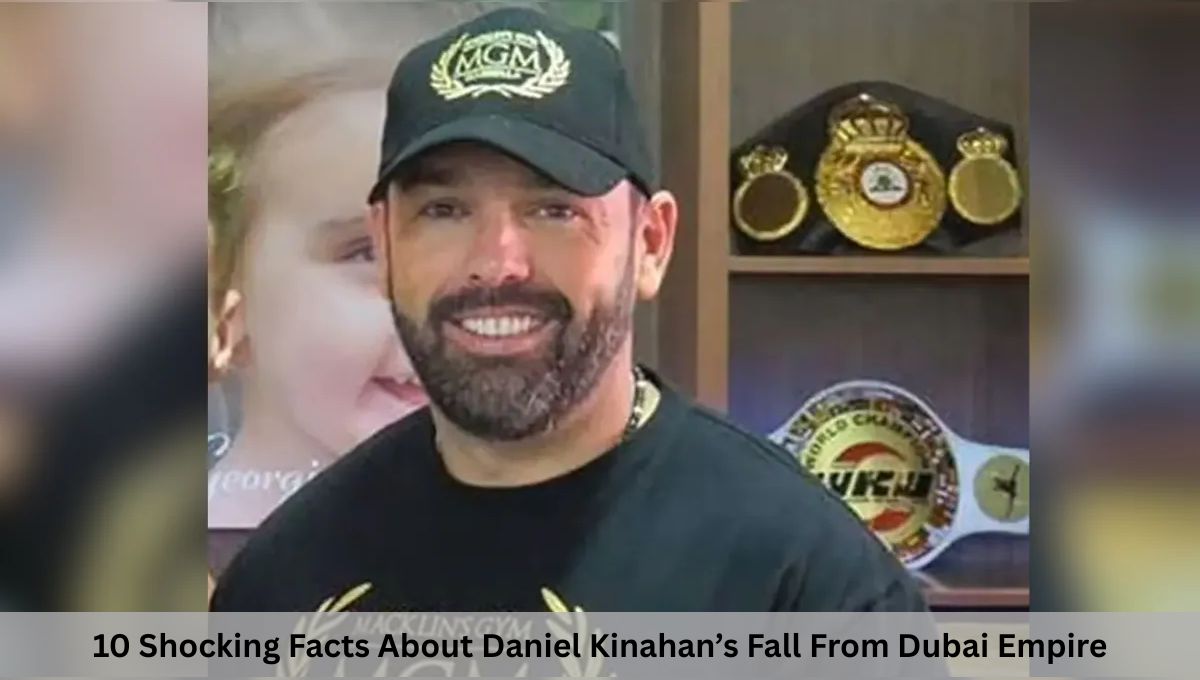
10 Shocking Facts About Daniel Kinahan’s Fall From Dubai Empire — One of Europe’s most powerful crime bosses. For years, Daniel Kinahan lived a life that seemed untouchable—luxury homes, global connections, and a polished public image in the world of boxing.
But beneath that façade, authorities allege, was one of Europe’s most powerful criminal enterprises.
That carefully constructed life came crashing down in April 2026, when Dubai police arrested him in a covert operation that marked the end of a years-long international manhunt.
This is the full story of how one of the world’s most wanted men built an empire—and how it finally unraveled.
10 Shocking Facts About Daniel Kinahan’s Fall From Dubai Empire
The Rise: From Dublin Streets to Global Power
Daniel Kinahan’s story begins far from the luxury of Dubai.
Raised in Dublin’s inner city, Kinahan grew up in modest circumstances. However, unlike many around him, he quickly moved into business.
By his early 20s, he was already listed as a company director. Behind this rapid rise stood his father, Christy Kinahan, widely known as the “Dapper Don.”
He was quietly building what investigators describe as a vast criminal network spanning multiple countries.
By the time Daniel reached his 30s, he had relocated to Spain—then a hub for international drug trafficking networks.
It was here that the foundations of the Kinahan cartel were solidified.
The Kinahan Cartel: A “Super Cartel” Powerhouse
Authorities across Europe and the United States have long described the Kinahan organisation as one of the most sophisticated criminal enterprises in operation.
The group is believed to have:
- Controlled significant cocaine trafficking routes across Europe
- Engaged in arms smuggling and money laundering
- Formed alliances with other major crime syndicates
Some investigators have linked it to a so-called “super cartel,” allegedly responsible for controlling a substantial share of Europe’s cocaine trade.
While exact figures vary, estimates place the organisation’s value in the hundreds of millions—or even billions—of euros.
Public Image vs Shadow Operations
What made Daniel Kinahan particularly unusual was his dual identity.
On the surface, he presented himself as a legitimate businessman:
- Involved in property and construction
- Connected to international trade
- Prominent in boxing promotion circles
Behind the scenes, however, authorities allege he was directing a criminal network responsible for drug trafficking and violence.
This contrast allowed him to operate in plain sight while maintaining plausible deniability.
The Feud That Changed Everything
The turning point came in 2016 with the eruption of the violent feud between the Kinahan cartel and the Hutch-linked faction.
The conflict, often referred to as the Hutch–Kinahan feud, resulted in at least 18 killings and shook Ireland’s criminal underworld.
One of the most notorious incidents occurred at Dublin’s Regency Hotel, where an assassination attempt targeted Kinahan but instead resulted in the death of associate David Byrne.
Following this, Kinahan fled Ireland permanently.
Dubai: A Safe Haven for Years
After leaving Europe, Kinahan settled in Dubai, a city known for its luxury and global connectivity.
There, he built what appeared to be a stable, affluent life:
- A luxury residence on Palm Jumeirah
- A family life with his wife and five children
- Continued involvement in international business
He even held a lavish wedding at the iconic Burj Al Arab, reportedly attended by figures linked to global crime networks.
For years, Dubai functioned as a de facto safe haven for the Kinahan family.
Why He Stayed Untouchable for So Long
Despite being on the radar of international law enforcement, Kinahan avoided arrest for years.
Several factors contributed to this:
- Strategic relocation across jurisdictions
- Use of intermediaries to handle finances
- Minimal reliance on formal banking systems
- Strong operational discipline within the cartel
Even when the United States imposed sanctions in 2022—including a $5 million bounty—Kinahan continued to operate.
The Turning Point: International Cooperation
The breakthrough came not through a single operation, but through sustained diplomatic and legal coordination.
A key development was the extradition treaty signed between Ireland and the UAE in 2024. This agreement fundamentally changed the legal landscape.
Soon after:
- Irish authorities built a comprehensive legal case
- A High Court warrant was issued
- A detailed dossier was sent to UAE officials
The earlier extradition of associate Sean McGovern demonstrated that the treaty could be enforced.
The Arrest: A Carefully Planned Operation
In April 2026, Dubai police moved in.
Plainclothes officers reportedly monitored Kinahan for 48 hours, tracking his movements with precision.
Then, in a swift operation, they arrested him at his residence—catching him off guard.
Dubai authorities confirmed the detention of an Irish national linked to organised crime, while Irish agencies, including Garda Síochána, confirmed the arrest was tied to an Irish court warrant.
Inside the Charges: What Kinahan Faces
Kinahan is expected to face serious charges in Ireland, including:
- Directing a criminal organisation
- Alleged involvement in murder plots
- Links to international drug trafficking
Among the allegations is involvement in attempts to target rival figure Gerry Hutch.
Authorities have reportedly built their case using encrypted communications and intelligence gathered over several years.
Life Behind Bars: Al Awir Central Jail
Following his arrest, Kinahan was detained at Al Awir Central Jail, one of the UAE’s most well-known detention facilities.
Conditions inside the prison have been described as harsh by former inmates. For someone accustomed to a life of luxury, the transition is expected to be severe.
Extradition Battle: What Comes Next
Kinahan’s legal team is expected to challenge extradition proceedings.
However, experts suggest his chances of avoiding transfer to Ireland are slim, given:
- The active extradition treaty
- The strength of the legal case
- Precedent set by earlier extraditions
If extradited, he is likely to face trial in Ireland’s Special Criminal Court.
The Role of Global Law Enforcement
Kinahan’s arrest highlights the increasing effectiveness of international cooperation in tackling organised crime.
Agencies involved include:
- Irish law enforcement
- UAE authorities
- U.S. financial and intelligence bodies
The case demonstrates how cross-border collaboration can dismantle even the most entrenched criminal networks.
The Digital Trail: How Mistakes Added Up
Interestingly, part of the investigation into the Kinahan network involved digital footprints.
Reports suggest that even senior figures inadvertently revealed details about their movements through:
- Online profiles
- Reviews of locations
- Public appearances
These fragments, when combined with intelligence data, helped authorities build a clearer picture of the network.
A Global Crime Network Under Pressure
The Kinahan cartel is not just an Irish issue—it is a global one.
Its operations span:
- Europe
- The Middle East
- Africa
- South America
By targeting its leadership, authorities aim to disrupt broader criminal ecosystems tied to drug trafficking and money laundering.
Security Concerns Ahead of Possible Transfer
If extradited, Kinahan’s arrival in Ireland will trigger major security preparations.
Authorities are expected to:
- Assess threats from rival groups
- Ensure prison security
- Monitor potential unrest
Given the history of violence linked to the feud, his presence could reignite tensions.
The Bigger Picture: Organised Crime in a Globalised World
Kinahan’s case reflects a broader trend:
organised crime has become increasingly globalised.
Modern criminal networks:
- Operate across borders
- Use technology to evade detection
- Integrate legal and illegal activities
This makes them harder—but not impossible—to dismantle.
Conclusion: The End of an Era
The arrest of Daniel Kinahan marks a significant milestone in the fight against international organised crime.
For nearly a decade, he lived openly in Dubai, projecting wealth and legitimacy while allegedly overseeing a vast criminal enterprise.
Now, that chapter has closed.
From luxury villas on Palm Jumeirah to a cell in Al Awir Central Jail, the contrast is stark.
His story serves as a reminder that even the most powerful figures in the criminal underworld are not beyond the reach of coordinated global law enforcement.
As extradition proceedings unfold, the world will be watching closely—not just for the outcome of one case, but for what it signals about the future of international justice.
Also Read: 11 Explosive Revelations: How Mexico Tracked El Mencho Through His Girlfriend
Related Posts:
- 7 Heartbreaking Facts About Venezuela's Earthquake Disaster

- 5 Major Takeaways from the US Supreme Court's…

- 7 Powerful Facts About Ayatollah Ali Khamenei’s…

- $102-Million Louvre Heist: 7 Key Twists from Arrests…

- 7 Shocking Facts About the Jenin Killings After…

- 5 Shocking Facts About the Racially Aggravated Rape…
