
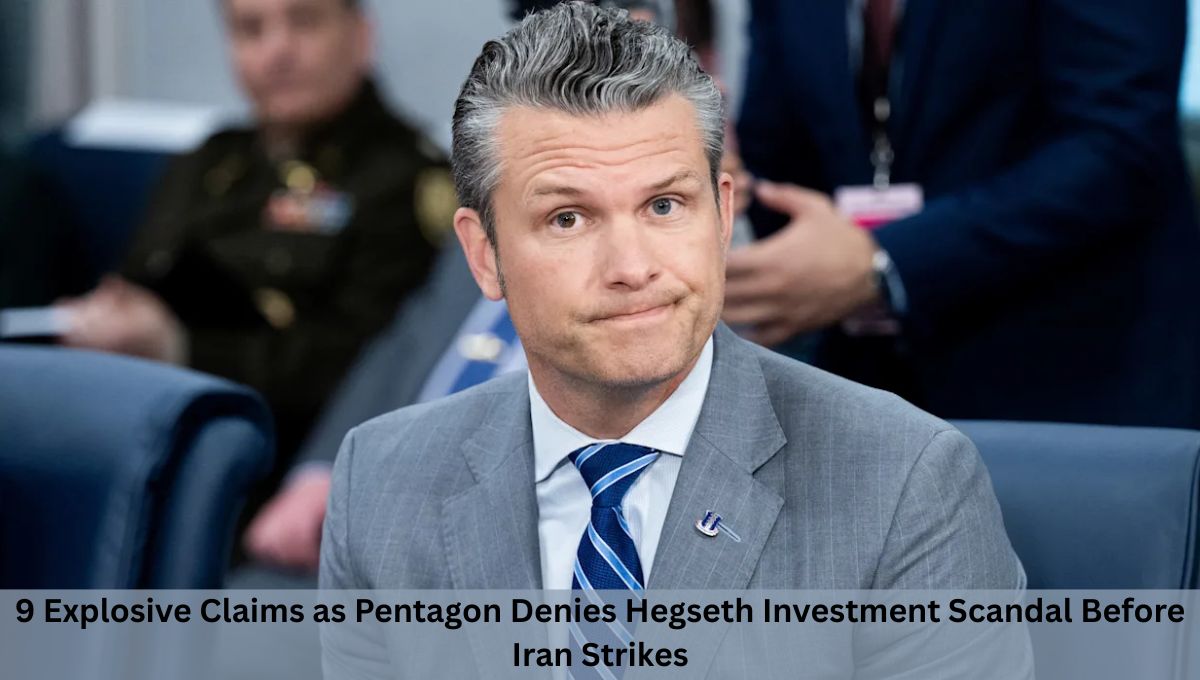
9 Explosive Claims as Pentagon Denies Hegseth Investment Scandal Before Iran Strikes — A New Controversy. A fresh controversy has erupted in Washington amid the ongoing Iran conflict, after a report alleged that a broker linked to US Defense Secretary Pete Hegseth explored a multimillion-dollar investment in defense-related assets shortly before the United States joined Israel in launching strikes on Iran.
Thank you for reading this post, don't forget to subscribe!The US Department of Defense has strongly rejected the claims, calling them “entirely false and fabricated” and demanding an immediate retraction.
The dispute has now triggered wider questions about transparency, ethics, and the intersection of financial markets with geopolitical decision-making.
Here’s a comprehensive breakdown of the allegations, the denial, and the broader implications.
9 Explosive Claims as Pentagon Denies Hegseth Investment Scandal Before Iran Strikes
1. What the Report Claimed
The controversy stems from a report published by the Financial Times, citing sources familiar with the matter.
Key Allegations:
- A broker affiliated with Morgan Stanley contacted BlackRock
- The inquiry was made in February
- It involved a multimillion-dollar investment
- The target: a defense-focused exchange-traded fund (ETF)
The timing raised eyebrows because the outreach reportedly occurred just weeks before US-Israeli military strikes on Iran began.
2. The Investment That Never Happened
Importantly, the report clarified that:
- The investment did not go through
- The ETF was not yet available on Morgan Stanley’s platform
- No transaction was completed
This detail is critical because it means:
- No profit was made
- No financial position was established
However, the timing alone was enough to spark scrutiny.
3. Pentagon’s Strong Denial
The Pentagon reacted swiftly and forcefully.
Official Response:
Sean Parnell, spokesperson for the Department of Defense, stated:
- The allegation is “entirely false and fabricated”
- Neither Hegseth nor his representatives contacted BlackRock
- The report is a “baseless, dishonest smear”
He also demanded an immediate retraction, emphasizing the department’s commitment to ethics and legal compliance.
4. What Remains Unclear
Despite the strong denial, several questions remain unanswered:
- Did the broker act independently?
- Was Hegseth aware of any such inquiry?
- Who was the “high-profile client” referenced in the report?
The Financial Times report did not clarify these points, leaving room for interpretation and debate.
5. The ETF at the Center of the Controversy
The fund mentioned in the report is a defense-focused ETF managed by BlackRock.
Key Characteristics:
- Tracks companies benefiting from defense spending
- Includes major firms such as:
- Lockheed Martin
- Northrop Grumman
- RTX
- Palantir
These companies are deeply tied to military contracts and government defense budgets.
6. Why Timing Matters
Even though no investment occurred, the timing has raised concerns.
Context:
- Inquiry reportedly made weeks before military action
- War decisions often influence defense stock performance
This has led to speculation about:
- Potential insider knowledge
- Market positioning ahead of policy decisions
7. Broader Scrutiny of Financial Markets
The controversy is part of a larger trend.
Recent Developments:
- Increased scrutiny of trading before major policy decisions
- Observations of “well-timed” market moves
- Growing debate over information leaks
Experts have questioned whether:
- Financial markets are reacting to public signals
- Or benefiting from non-public information
8. Pentagon’s Ethical Position
The Department of Defense has emphasized its adherence to strict ethical standards.
Key Points:
- Compliance with all laws and regulations
- Commitment to transparency
- Rejection of any conflict of interest
The strong wording of the denial suggests the Pentagon views the allegation as not just inaccurate—but damaging.
9. The Political Context
The controversy comes at a sensitive time.
Key Factors:
- Ongoing war with Iran
- Rising global tensions
- Domestic political pressure
Additionally, US President Donald Trump has publicly linked Hegseth to early advocacy for military action against Iran, adding another layer of political complexity.
Hegseth’s Role in the Iran Conflict
Pete Hegseth has emerged as a central figure in the current conflict.
Reported Role:
- Among the first to support military action
- Vocal about US military capabilities
- Key participant in strategic discussions
This prominence increases scrutiny of his actions—both political and financial.
Understanding Defense ETFs
Exchange-traded funds (ETFs) have become a popular investment vehicle.
Why Investors Use ETFs:
- Diversification
- Lower fees
- Easy trading
Defense ETFs Specifically:
- Track companies in defense and security sectors
- Often perform well during geopolitical tensions
However, their performance is not always predictable, especially in volatile conditions.
Market Reality: Defense Stocks Did Not Surge
Interestingly, the defense ETF mentioned in the report:
- Has gained over the past year
- But declined since the Iran war began
This suggests:
- The market did not react as expected
- Investors may have already priced in risks
The Insider Trading Debate
The controversy has revived discussions about insider trading.
Key Concerns:
- Access to sensitive information
- Timing of trades
- Ethical boundaries for officials
While no evidence has been presented in this case, the situation highlights ongoing concerns.
Wall Street and War: A Complex Relationship
Financial markets and geopolitical events are closely linked.
Key Dynamics:
- Wars can influence stock prices
- Defense companies often benefit from increased spending
- Investors monitor political signals
This creates a complex environment where:
- Information becomes highly valuable
- Timing becomes critical
Global Implications of the Controversy
The issue extends beyond the US.
Why It Matters Globally:
1. Trust in Institutions
Questions about ethics can affect confidence in government institutions.
2. Market Stability
Uncertainty can increase volatility in financial markets.
3. Geopolitical Perception
Allies and adversaries closely watch such developments.
BlackRock and Morgan Stanley: Silence Adds Mystery
Neither BlackRock nor Morgan Stanley has publicly commented on the report.
This silence leaves:
- Key details unverified
- Questions unanswered
In high-profile cases, lack of response often fuels speculation.
Media vs Government: A Familiar Clash
The situation reflects a broader pattern:
- Media publishes investigative report
- Government denies allegations
- Public left to interpret conflicting narratives
Such clashes are common in high-stakes geopolitical environments.
What Happens Next?
Several possible developments could follow:
1. Retraction or Clarification
The Financial Times may respond to the Pentagon’s demand.
2. Further Investigation
Additional reporting could shed more light.
3. Political Fallout
Opposition figures may use the issue to raise questions.
Key Takeaways
- A report alleged a defense investment inquiry before Iran strikes
- The Pentagon has strongly denied the claim
- No investment actually took place
- Timing has raised questions despite lack of evidence
- Broader concerns about market transparency persist
Conclusion: Allegations, Denials, and Uncertainty
The controversy surrounding Pete Hegseth highlights the complex intersection of politics, finance, and warfare.
While the Pentagon has categorically denied the allegations, the episode underscores how sensitive financial activity can become during times of conflict.
At this stage:
- There is no confirmed wrongdoing
- Key details remain unclear
- The story continues to evolve
For global audiences, the issue is not just about one report—it is about the broader question of how governments, markets, and information intersect in an increasingly complex world.
Also Read: 9 Critical Scenarios as US Plans Ground Ops in Iran — Pentagon’s Risky Strategy
Also Read: Analysis: Boat strike scandal shows the limits of Hegseth’s news media crackdown
Related Posts:
- 3 Explosive Conditions Iran Sets to End War with US…
- 9 Explosive Claims as Trump Says US Winning Iran War
- 7 Powerful Facts About Ayatollah Ali Khamenei’s…

- 10 Explosive Warnings as Donald Trump Calls Iran…
- 11 Explosive Warnings as Trump Vows to ‘Knock the…

- 10 Explosive Strikes: Israel Bombs Tehran Oil Depots…
