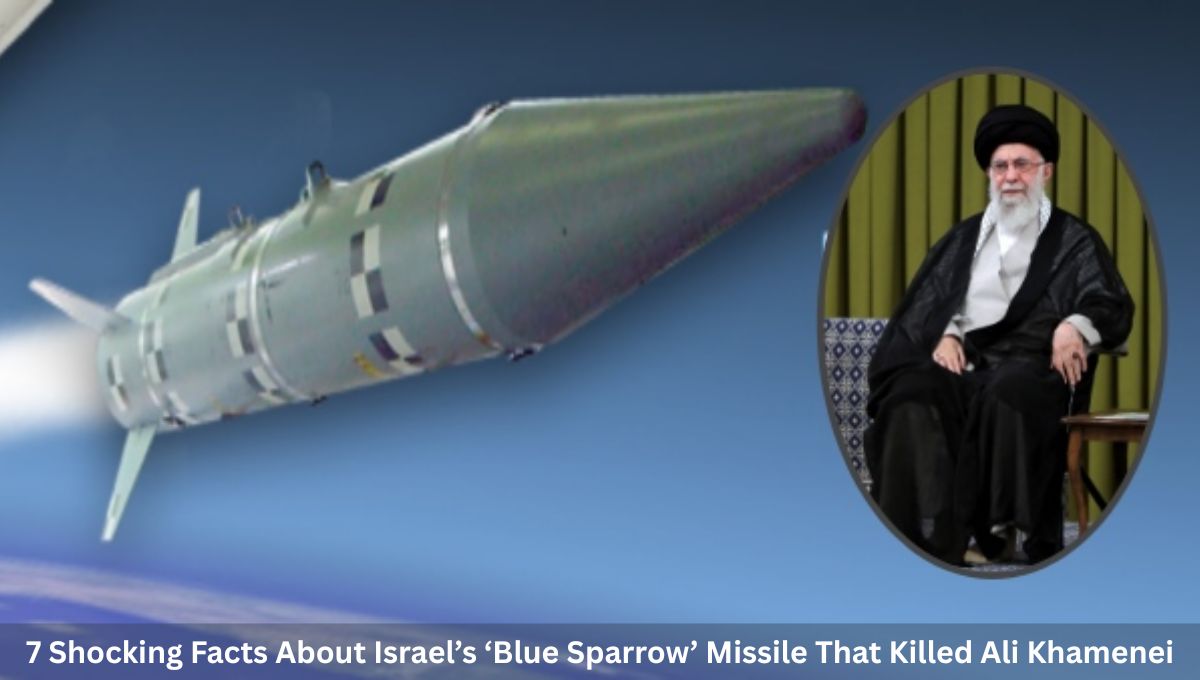
7 Shocking Facts About Israel’s ‘Blue Sparrow’ Missile That Killed Ali Khamenei — A ballistic weapon hard to intercept. The killing of Iran’s Supreme Leader Ali Khamenei on February 28, 2026, marked one of the most dramatic turning points in modern Middle Eastern geopolitics. The strike, reportedly carried out during a coordinated military operation by Israel and the United States, eliminated the 86-year-old cleric who had led Iran for more than three decades.
Thank you for reading this post, don't forget to subscribe!What made the attack especially notable was the weapon allegedly used:
the Blue Sparrow missile.
Often described as a “missile from space,” the weapon follows a trajectory that briefly takes it to the edge of Earth’s atmosphere before it plunges back toward its target at extreme speed.
According to several international media reports, including those citing defence analysts and intelligence officials, the missile was launched from Israeli fighter jets during a precision strike on a high-level leadership compound in Tehran.
The attack killed Khamenei and dozens of senior Iranian political and military figures, dramatically escalating tensions in West Asia and raising fears of a broader regional war.
This article explains what the Blue Sparrow missile is, how it works, and why it played a critical role in one of the most consequential targeted strikes in recent history.
7 Shocking Facts About Israel’s ‘Blue Sparrow’ Missile That Killed Ali Khamenei
What Is the Blue Sparrow Missile?
The Blue Sparrow is an advanced air-launched ballistic missile developed by Israel as part of the Sparrow family of missile systems.
The missile is typically launched from fighter aircraft and then follows a ballistic trajectory that propels it toward the edge of the Earth’s atmosphere before it descends toward its target.
Because of this unusual flight path, analysts often describe it as a “missile from space.”
The weapon has several notable specifications:
- Range: Approximately 1,240 miles (about 2,000 km)
- Length: Around 6.5 metres
- Weight: Roughly 1.9 tonnes
- Launch platform: Fighter aircraft, commonly Israeli F-15 jets
Once launched, the missile ascends rapidly using booster rockets. It climbs to high altitude before releasing a re-entry vehicle that dives toward its target at extremely high speed.
This combination of high altitude and steep descent dramatically reduces the reaction time available to air-defence systems, making the missile difficult to intercept.
Why the Blue Sparrow Is Called a “Missile From Space”
The nickname “missile from space” comes from the missile’s quasi-ballistic flight profile.
Unlike conventional cruise missiles, which fly at relatively low altitudes and follow terrain-hugging paths, the Blue Sparrow climbs sharply after launch.
At the peak of its flight, the missile can reach the edge of Earth’s atmosphere before beginning its descent.
This trajectory offers several advantages:
1. Reduced Interception Window
Air defence systems typically detect incoming threats at lower altitudes. By approaching from high altitude at steep angles, the missile reduces the time defenders have to respond.
2. Extremely High Impact Speed
When the missile re-enters the atmosphere, gravity accelerates it dramatically, increasing its terminal velocity and destructive potential.
3. Long-Range Precision Strike Capability
Aircraft launching the missile can remain hundreds or even thousands of kilometres away from the target, reducing the risk to pilots.
These characteristics make the weapon particularly useful for striking high-value targets deep inside heavily defended territory.
Origins of the Sparrow Missile Family
The Blue Sparrow is part of a broader family of missiles developed in Israel that includes:
- Black Sparrow
- Silver Sparrow
Interestingly, these systems were not originally designed as offensive weapons.
Instead, they were created to simulate Soviet Scud ballistic missiles during tests of Israel’s missile defence systems.
These tests were conducted as part of the development of the Arrow Missile Defense System, which is designed to intercept ballistic missiles threatening Israel.
Over time, however, the technology evolved.
Defence analysts say that modified versions of the Sparrow systems can now function as precision strike weapons, capable of delivering devastating payloads against strategic targets.
The Strike That Killed Ali Khamenei
The strike that killed Ali Khamenei reportedly occurred on the morning of February 28, 2026, during a coordinated Israeli-American operation targeting Iranian leadership and strategic facilities.
According to reports, Israeli fighter aircraft took off early in the morning and flew toward launch positions outside Iranian airspace.
Around 30 missiles were fired during the attack.
Some targeted the building where Iran’s senior national security officials were meeting. Others struck nearby structures, including the building where Khamenei himself was located.
The strike occurred at a government compound on Pasteur Street in Tehran, an area that houses offices linked to the Iranian presidency and national security leadership.
The impact killed Khamenei along with numerous senior officials, including members of the Islamic Revolutionary Guard Corps.
Intelligence Operation Behind the Strike
The military operation was reportedly the culmination of years of intelligence gathering.
According to reports citing intelligence sources, the operation relied heavily on data collected by the Central Intelligence Agency and Israel’s intelligence agency Mossad.
US intelligence had reportedly been tracking Khamenei’s movements for months.
Eventually, analysts learned that a high-level meeting of Iran’s political and military leadership would take place in Tehran — and that Khamenei would attend in person.
The information was shared with Israel, which adjusted its strike plans to exploit the opportunity.
How Surveillance Technology Helped Track the Target
Reports suggest that Israeli intelligence used a wide array of surveillance methods to monitor activity around Khamenei’s compound.
These included:
- Monitoring traffic cameras in central Tehran
- Intercepting communications among security personnel
- Tracking the movements of bodyguards and officials
Some reports claim that Israeli intelligence gained access to surveillance cameras around the compound, allowing analysts to observe the arrival of security teams and senior officials.
The data was transmitted to Israeli command centres, where analysts built a detailed picture of daily activity at the site.
This intelligence reportedly helped confirm the exact moment when Iran’s top leadership had gathered together.
Deception Tactics Before the Attack
In the days leading up to the strike, Israeli officials reportedly conducted a deception campaign designed to lower Iran’s guard.
According to officials quoted in several reports, Israeli military leaders deliberately created the impression that operations were slowing down ahead of the weekend.
Photos and messages were released suggesting that senior commanders were leaving headquarters to return home for the Shabbat dinner.
However, many of those officials quietly returned to their posts to continue preparations for the strike. The goal was to prevent Iran from detecting signs of a major military operation.
The Attack Timeline
Reports suggest the operation unfolded with precise timing.
6:00 am – Israel
Israeli fighter jets departed their bases carrying long-range precision weapons.
7:30 am – Iran time
Aircraft reached launch positions.
9:40 am – Tehran
Missiles struck the leadership compound.
The operation lasted just a few hours but had enormous geopolitical consequences.
Why the Strike Was So Significant
The killing of Ali Khamenei represented an unprecedented moment in modern warfare.
It was the first time in decades that a sitting national leader had been killed in a direct airstrike carried out by foreign militaries.
The strike also targeted multiple senior figures simultaneously, potentially crippling Iran’s command structure.
Analysts say such operations are designed to create strategic shock, disrupting leadership networks and decision-making structures.
Global Reaction to the Strike
The attack quickly triggered strong reactions from global powers.
Wang Yi, China’s foreign minister, condemned the strikes and called for an immediate halt to military operations.
China warned that the conflict could escalate rapidly and destabilise the wider region. Russia also criticised the attack.
Sergey Lavrov, Russia’s foreign minister, argued that the war could trigger a new wave of nuclear proliferation in the Middle East.
He warned that countries in the region might conclude that possessing nuclear weapons was the only way to avoid similar attacks.
Risks of Escalation
Following the strike, Iran launched retaliatory missile attacks targeting Israeli territory and US military installations in the region.
The escalation raised fears that the conflict could spread beyond Israel and Iran, potentially drawing in multiple regional powers.
Security analysts warn that a prolonged confrontation could disrupt energy markets, international shipping routes, and regional stability.
The Future of High-Altitude Precision Weapons
Weapons like the Blue Sparrow missile represent a growing trend in modern warfare:
long-range precision strikes launched from standoff distances.
These systems allow militaries to hit strategic targets without exposing aircraft to air defence systems.
As missile technology advances, more countries are developing weapons capable of high-altitude or quasi-space trajectories. Such capabilities could reshape how future conflicts are fought.
Conclusion
The Blue Sparrow missile has emerged as one of the most talked-about weapons in the aftermath of the strike that killed Ali Khamenei.
Originally designed as a test missile, the system appears to have evolved into a powerful precision strike weapon capable of hitting heavily defended targets from great distances.
Combined with years of intelligence gathering and carefully planned deception tactics, the missile reportedly played a decisive role in one of the most consequential military operations in recent Middle Eastern history.
The strike has already reshaped regional politics — and its long-term consequences are only beginning to unfold.
Also Read: 7 Explosive Revelations: How Israel’s Plans Pushed the US Into War with Iran
Also Read: What is Blue Sparrow? The ‘missile from space’ Israel used to kill Khamenei
Related Posts:
- 10 Explosive Strikes: Israel Bombs Tehran Oil Depots…

- 7 Stunning Strikes: Iran Claims Destruction of US…

- 10 Explosive Warnings as Donald Trump Calls Iran…

- 9 Explosive Signals as Netanyahu Says Israel Is…

- 11 Explosive Warnings as Trump Vows to ‘Knock the…

- Trump Relocates U.S. Space Command Headquarters from…