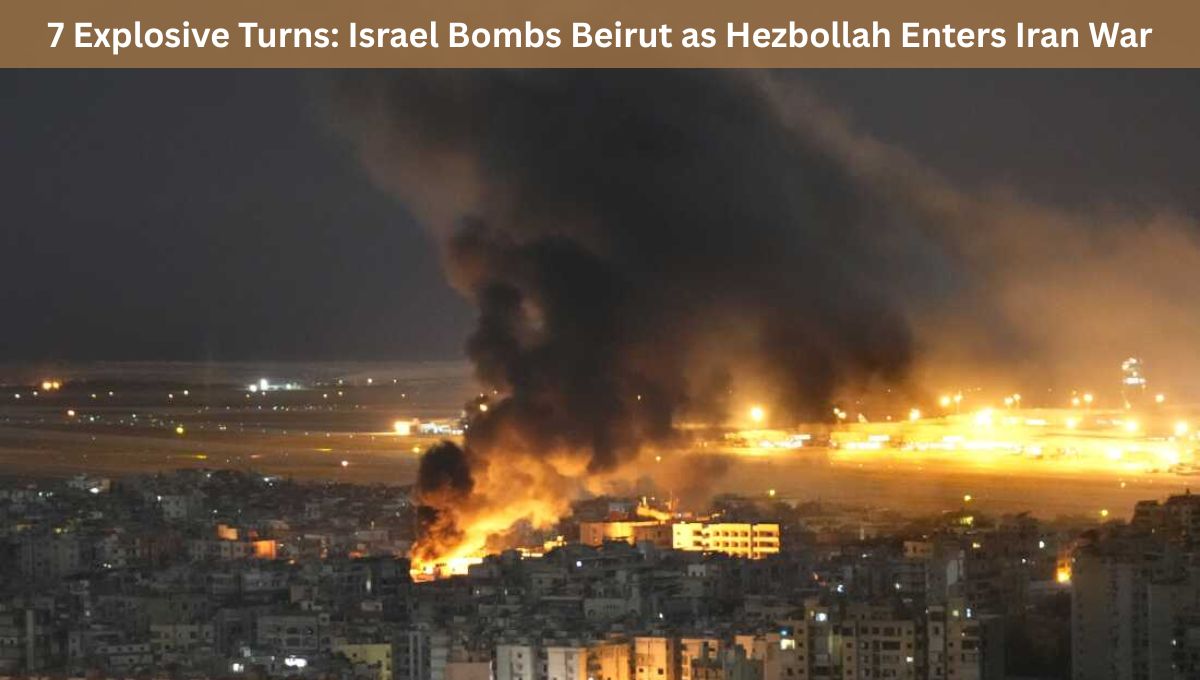
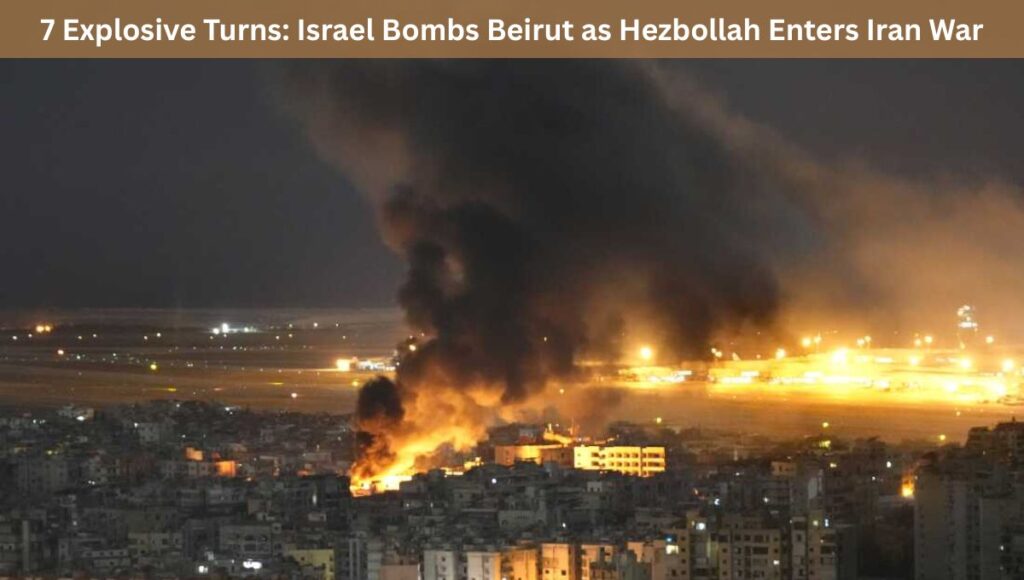
7 Explosive Turns: Israel Bombs Beirut as Hezbollah Enters Iran War following Khamenei’s death. Israel launched a major wave of airstrikes on Lebanon, including the capital Beirut, early Monday after Iran-backed Hezbollah fired rockets and drones into northern Israel.
The escalation comes amid a rapidly expanding regional conflict following the assassination of Ali Khamenei, Iran’s Supreme Leader, in joint US–Israeli strikes—an event that has fundamentally altered the strategic landscape of the Middle East.
An AFP journalist reported hearing multiple loud explosions across Beirut as Israeli warplanes struck Hezbollah-controlled areas, triggering mass displacement, panic, and fears that Lebanon is being pulled into a full-scale regional war.
7 Explosive Turns: Israel Bombs Beirut as Hezbollah Enters Iran War
Hezbollah Claims First Strike Since 2024 Ceasefire
Hezbollah confirmed responsibility for launching rockets and attack drones toward Israel, calling the strike a response to what it described as the “pure blood” of Ayatollah Ali Khamenei.
This marks Hezbollah’s first acknowledged attack on Israel since November 2024, when a ceasefire agreement brokered by international mediators brought an end to a year-long war along the Israel–Lebanon border.
In a statement, Hezbollah said the operation was conducted:
“In retaliation for the assassination of Imam Sayyid Ali al-Husseini Khamenei, in defense of Lebanon and its people, and in response to repeated Israeli aggressions.”
Israeli officials said most projectiles were intercepted, while others landed in open areas without immediate casualties.
Israel Responds With Heavy Bombardment of Beirut and Southern Lebanon
The Israel Defense Forces (IDF) confirmed it had launched strikes across Lebanon, stating that it was targeting “terrorist infrastructure and senior Hezbollah militants.”
Israeli jets bombed:
- Beirut’s southern suburbs
- Villages in southern Lebanon
- Areas in the Bekaa Valley
Lebanon’s state-run National News Agency (NNA) reported “major displacement” as thousands fled neighborhoods long considered Hezbollah strongholds.
Roads in Beirut were clogged as families escaped on foot and by car, while air raid sirens echoed across northern Israel, including near Haifa.
Senior Hezbollah Figure Mohammad Raad Killed
In a major blow to Hezbollah’s political structure, Mohammad Raad, head of Hezbollah’s parliamentary bloc, was killed in Israeli strikes.
Raad was one of the highest-ranking Hezbollah officials still operating in southern Lebanon and a close associate of former Hezbollah leader Hassan Nasrallah, who was killed in Israeli strikes in 2024.
Israeli officials described the operation as part of a broader campaign to decapitate Hezbollah’s remaining leadership, while Hezbollah vowed continued resistance.
Lebanon’s Government Rejects Escalation
Lebanese Prime Minister Nawaf Salam condemned Hezbollah’s actions, calling the attack on Israel:
“Irresponsible and suspicious, jeopardizing Lebanon’s security and providing Israel with pretexts to continue aggression.”
Salam reiterated that the decision of war and peace rests solely with the Lebanese state, echoing earlier remarks by President Joseph Aoun.
Lebanese authorities fear that renewed war could collapse an already fragile economy, worsen displacement, and plunge the country into deeper instability.
A Ceasefire in Name Only
The November 2024 ceasefire agreement stated clearly that:
- Hezbollah would halt all operations against Israel
- Israel would cease offensive actions inside Lebanon
Yet Lebanese officials have documented over 2,000 Israeli violations of Lebanese airspace and territory in the months following the truce.
Hezbollah had largely refrained from responding, instead urging Beirut and the international community to pressure Israel—efforts that yielded little result.
Iran Conflict Spills Into Lebanon
The Lebanon escalation is directly tied to the broader Iran–Israel war, which erupted after US–Israeli strikes killed Iran’s Supreme Leader.
Iran has since launched missile and drone attacks across:
- Israel
- The Gulf region
- Countries hosting US military bases
Tehran-backed groups—including Hezbollah—are now entering the conflict, raising fears of a multi-front war stretching from the Mediterranean to the Persian Gulf.
Israel Warns of Broader Campaign
The IDF warned residents of more than 50 villages in southern Lebanon and the Bekaa Valley to evacuate immediately, instructing civilians to stay at least one kilometer away from potential targets.
Israeli officials said Hezbollah’s entry into the war would be met with “forceful and sustained military action.”
Military analysts say Israel is attempting to:
- Prevent Hezbollah from opening a northern front
- Cripple remaining command-and-control structures
- Deter further regional escalation
Hezbollah Weakened but Still Dangerous
While Hezbollah has suffered devastating losses since 2024, analysts caution against underestimating its remaining capabilities.
The group retains:
- Precision-guided rockets
- Drone warfare experience
- Deeply entrenched networks in southern Lebanon
However, its ability to change the strategic balance in favor of Iran remains uncertain.
Regional and Global Implications
The strikes have already:
- Disrupted global air travel
- Driven oil prices sharply higher
- Raised alarms in Europe, Asia, and the Gulf
With the United States signaling that its campaign against Iran could continue for weeks, the risk of a prolonged Middle East war is growing.
European leaders have called for restraint, while Gulf states fear being dragged further into the conflict.
A Dangerous New Phase
Israel’s bombing of Beirut marks a historic escalation, shattering any remaining illusion that the Iran–Israel conflict could be contained.
With Hezbollah now openly engaged, Lebanon once again finds itself on the frontline of a regional struggle—caught between powerful forces and facing consequences it can ill afford.
Whether diplomacy can still halt this slide toward a wider war remains deeply uncertain.
What is clear is that the Middle East has entered one of its most volatile moments in decades.
Also Read: 12 Deadly Shockwaves as Israeli Strikes Rip Through Lebanon Despite Ceasefire
Also Read: 31 Killed As Israel Strikes Beirut After Hezbollah Fires Rockets, Drones
Related Posts:
- 10 Explosive Strikes: Israel Bombs Tehran Oil Depots…

- 3 Explosive Conditions Iran Sets to End War with US…
- 10 Explosive Warnings as Donald Trump Calls Iran…
- 10 Explosive Signals Trump Says Iran War Could End…
- 7 Powerful Facts About Ayatollah Ali Khamenei’s…
- 12 Explosive Updates from Day 12 of the US-Israel…