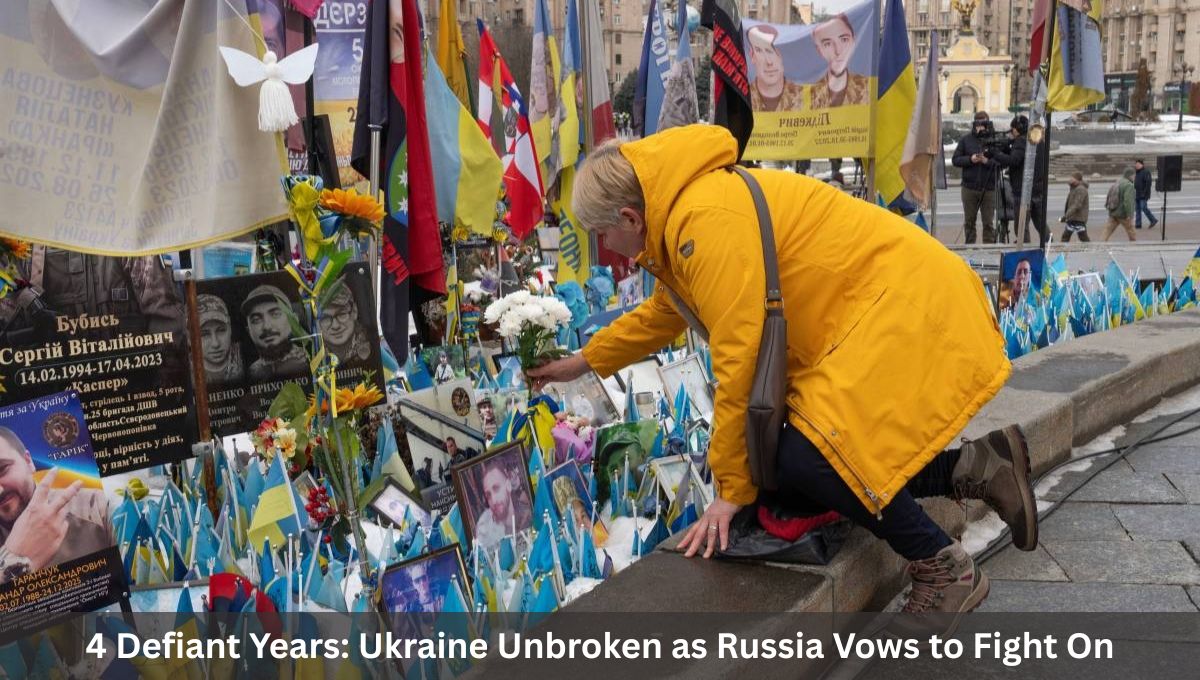
4 Defiant Years: Ukraine Unbroken as Russia Vows to Fight on until its goals are achieved. Four years after Russian troops crossed into Ukraine on February 24, 2022, Europe’s bloodiest conflict since World War II shows no sign of resolution. What Moscow expected to be a swift campaign culminating in the capture of Kyiv has instead hardened into a grinding war of attrition that has devastated Ukraine, reshaped European security, and unsettled the global order.
Marking the fourth anniversary of the invasion, Ukrainian President Volodymyr Zelensky delivered a defiant message:
Ukraine has not been broken.
Russia, he said, has failed to achieve its central objective of subjugating the country and crushing Ukrainian identity. The Kremlin, in turn, acknowledged that its goals remain unfulfilled — and vowed to keep fighting until they are achieved. The competing messages underscore a grim reality.
As the war enters its fifth year, neither side is ready to concede, diplomacy remains stalled, and the human and economic costs continue to mount for Ukraine, Russia, and the wider world.
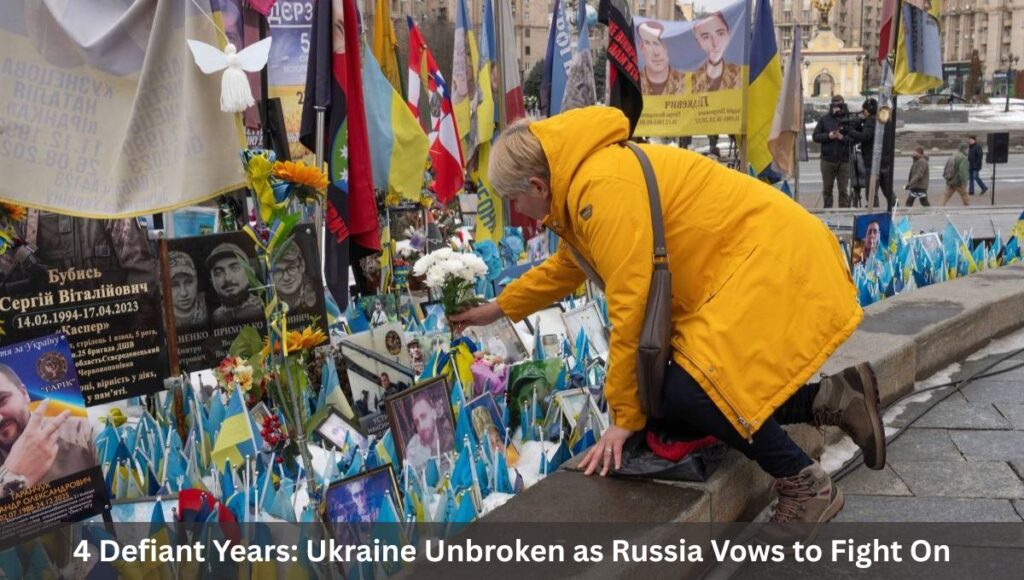
4 Defiant Years: Ukraine Unbroken as Russia Vows to Fight On
Zelensky’s Defiance: “Ukraine Stands”
In a video address released on the anniversary, Zelensky reflected on the opening days of the invasion, showing images of civilians confronting Russian troops and volunteers building defenses with bare hands. The message was as much about memory as it was about resolve.
“Putin has not achieved his goals,” Zelensky said. “He did not break Ukrainians. He did not win this war.”
For Zelensky, the war is not merely a territorial dispute but an existential struggle for Ukraine’s survival as a sovereign, democratic state.
He stressed that while Ukraine is ready to do everything possible to achieve peace, any settlement must respect the sacrifices made by millions of Ukrainians.
“Everything Ukraine has gone through must not be surrendered, forgotten, or betrayed,” he said, adding that any agreement must be accepted by Ukrainian society — not imposed under pressure.
Russia’s Position: Fighting Until the Goals Are Met
From Moscow, the tone was markedly different but no less resolute. Kremlin spokesperson Dmitry Peskov conceded that Russia has not yet achieved all its objectives, which he cited as the reason the so-called “special military operation” continues.
Russia currently occupies roughly 20 percent of Ukrainian territory, including large parts of the east and south.
Its immediate focus remains the Donbas region, particularly Donetsk, which Moscow has declared part of Russia but does not fully control.
The Kremlin insists that its actions are defensive, framing the war as a response to NATO expansion and a threat to Russia’s security.
Ukraine and its allies reject that narrative, viewing the invasion as a clear act of imperial aggression aimed at erasing Ukrainian sovereignty.
The Human Cost: A Generation Scarred
After four years of fighting, the human toll is staggering. Hundreds of thousands are believed to have been killed, with estimates of wounded and missing reaching into the millions.
Entire towns in eastern Ukraine lie in ruins, while millions of civilians have been forced to flee their homes, many seeking refuge across Europe.
In places such as Bucha and Irpin, once quiet suburbs near Kyiv, mass graves and accounts of atrocities shocked the world in 2022.
For residents who remained or later returned, the scars are both physical and psychological.
Ukrainians have learned to live with air raid sirens, power outages, and the constant fear of missile and drone attacks.
Yet daily life continues — schools reopen in basements, businesses adapt, and volunteers rush to clean up shattered streets after each strike.
Territory and the Battlefield Reality
On the battlefield, the war has settled into a brutal stalemate punctuated by incremental advances and devastating losses.
Despite heavy casualties, Russian forces have made gradual gains in eastern Ukraine, particularly in the Donbas.
According to independent conflict analysts, Russia captured more territory in the fourth year of the war than in the previous two combined — though at enormous cost.
Ukraine, meanwhile, has focused on defensive operations, long-range strikes, and degrading Russian logistics rather than large-scale offensives.
Neither side has launched a decisive breakthrough in recent months, reinforcing the sense that the war has entered a prolonged phase of attrition rather than maneuver.
The Diplomatic Deadlock
Efforts to end the war through diplomacy remain deadlocked. The United States and other mediators have facilitated talks, but the core disagreement over territory has proven insurmountable.
Russia demands recognition of its control over occupied regions. Ukraine categorically rejects this, insisting that no peace deal can involve surrendering territory without robust security guarantees to prevent future aggression.
For Kyiv, those guarantees must involve binding commitments from Western allies. For Moscow, such arrangements are unacceptable, as they would further entrench Ukraine within Western security structures.
Europe’s Role and Ukraine’s EU Ambitions
Speaking before the European Parliament, Zelensky urged Brussels to set out a clear and realistic timeline for Ukraine’s accession to the European Union.
For many Ukrainians, EU membership symbolizes not just economic opportunity but a definitive break from Russia’s sphere of influence.
European leaders have repeatedly expressed support for Ukraine’s future in the bloc, but the process remains complex and politically sensitive.
Enlargement fatigue, internal EU divisions, and the ongoing war itself complicate the path forward.
Still, high-profile visits to Kyiv by European leaders on the anniversary sent a strong signal of continued political and moral backing.
The War Economy and Global Impact
The economic consequences of the war extend far beyond Ukraine’s borders. Global food and energy markets were thrown into turmoil in the early stages of the conflict, and volatility remains a persistent risk.
Ukraine’s reconstruction costs are estimated at nearly $600 billion over the next decade — a staggering figure for a country whose economy has been shattered by war.
International donors, development banks, and private investors will all be critical, but funding at that scale remains uncertain.
For Europe, the war has accelerated shifts in energy policy, defense spending, and industrial strategy. For the Global South, it has highlighted vulnerabilities to supply shocks and geopolitical rivalries.
Civic Resistance: Why Ukraine Endures
One of the most striking aspects of Ukraine’s war effort is the resilience of its civil society.
Millions of ordinary citizens have taken on roles once reserved for the state:
supplying troops, caring for the wounded, rebuilding homes, and supporting displaced families.
Volunteer networks operate with remarkable efficiency, raising funds online, manufacturing equipment, and responding in real time to battlefield needs.
Women often lead these initiatives, while diaspora communities across Europe and North America remain deeply engaged.
This grassroots mobilization has helped sustain morale and compensate for the immense strains placed on Ukraine’s institutions.
Democracy Under Fire
Despite martial law and the suspension of elections, Ukraine’s democratic instincts remain visible.
Public outrage last year over attempts to weaken anti-corruption institutions forced the government to reverse course within days — a powerful reminder that civic pressure still matters.
For many Ukrainians, the war is inseparable from the struggle to build a transparent, accountable state.
That aspiration, they argue, is precisely what makes Ukraine incompatible with the authoritarian model promoted by Moscow.
Russia and the West: A Wider Confrontation
The Kremlin increasingly frames the war as a broader confrontation with the West, accusing the United States and Europe of seeking to weaken or destroy Russia.
This narrative plays a central role in sustaining domestic support for the conflict.
Western governments, meanwhile, view their support for Ukraine as a defense of the international order and a warning against aggression.
The resulting standoff has hardened into one of the defining geopolitical divides of the 21st century.
Fatigue, Fractures, and the Fifth Year
As the war drags on, fatigue is setting in — not in Ukraine, but among some of its partners. Political debates in Europe and North America increasingly focus on costs, risks, and the limits of support.
For Ukrainians, this wavering is deeply unsettling. Many fear that diplomatic pressure for “realism” could translate into demands for painful concessions, regardless of the human cost already paid.
Yet surveys suggest that a majority of Ukrainians remain prepared to endure the war as long as necessary to secure a just outcome.
Conclusion: An Unfinished Struggle
Four years on, the war in Ukraine defies simple narratives. Ukraine has not collapsed, as Moscow once predicted.
Russia has not achieved its ambitions, as it once hoped. Instead, Europe faces a prolonged conflict that continues to shape its future.
Zelensky’s message of defiance is rooted in lived experience:
a society that has adapted to war without surrendering its sense of dignity or purpose.
Russia’s vow to fight on reflects a leadership unwilling to accept failure or compromise.
As the conflict enters its fifth year, the central question remains unanswered:
whether the international community can help transform endurance into peace — or whether Ukraine, unbroken but battered, must continue to stand alone on the front line of Europe’s security.
Also Read: 7 Crucial Breakthrough Signals from Russia–Ukraine Talks That Still Fell Short
Also Read: Zelensky says Ukraine unbroken after 4 years, but Russia vows to fight on