9 Explosive Shockwaves as Donald Trump Defies the US Supreme Court and Reboots Global Tariff War using alternate legal powers. The global trading system was jolted on Friday when the United States Supreme Court delivered a decisive 6–3 ruling striking down a core pillar of US President Donald Trump’s tariff regime.
The decision ruled that Trump exceeded his constitutional authority by using the International Emergency Economic Powers Act (IEEPA) to impose sweeping tariffs without congressional consent. Trump’s response was immediate, furious, and defiant.
Calling the court’s ruling a “disgrace,” the US president accused the justices of being “swayed by foreign interests” and vowed to keep tariffs alive through alternative legal routes. Within hours, he announced a new 10 percent global tariff, re-igniting fears of a renewed global trade war.
The ruling has unleashed uncertainty across capitals—from New Delhi and Beijing to Ottawa and Brussels—raising profound questions about the future of US trade policy, tariff refunds, and geopolitical leverage.
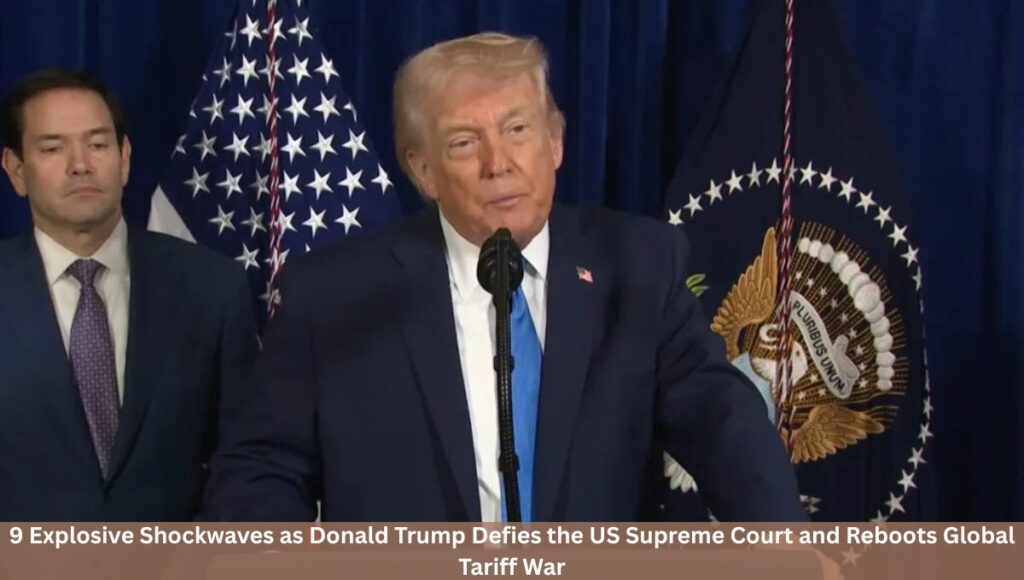
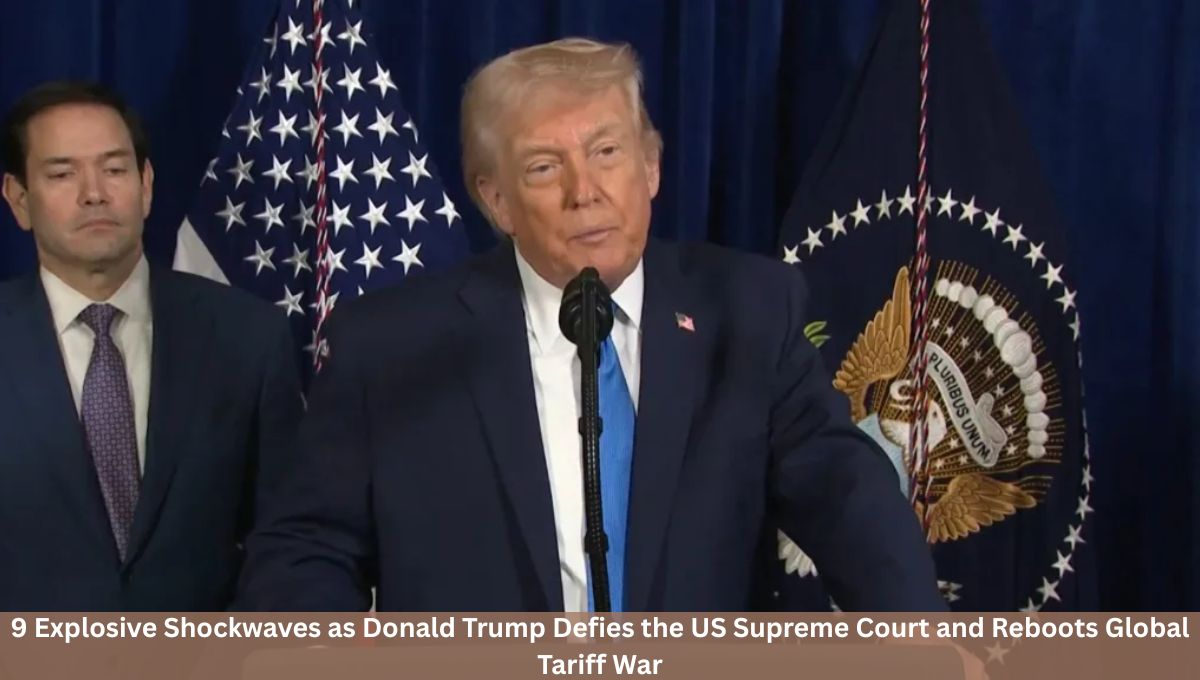
9 Explosive Shockwaves as Donald Trump Defies the US Supreme Court and Reboots Global Tariff War
What the Supreme Court Actually Ruled — and Why It Matters
The Supreme Court’s majority held that Congress alone has the power to levy tariffs in peacetime, and that the IEEPA—passed in 1977—does not explicitly authorize import taxes.
Chief Justice John Roberts, writing for the majority, warned that Trump’s interpretation would amount to a “transformative expansion” of presidential power over trade.
Key Takeaways from the Judgment
- IEEPA does not authorize tariffs
- Presidents cannot impose broad import duties without Congress
- No prior president had ever used IEEPA to levy tariffs
- Billions in collected tariffs may now face legal challenges
The ruling effectively dismantled Trump’s near-global “reciprocal tariff” system, which had become central to his second-term economic strategy.
Trump’s Counterattack — Switching Laws, Not Strategy
Far from retreating, Trump pivoted aggressively.
At a White House news conference, he declared that the Trade Expansion Act of 1962 and Section 122 of the Trade Act of 1974 provided alternative legal authority to impose tariffs.
“I have the right to do tariffs. I’ve always had the right to do tariffs,” Trump said, brushing aside the ruling.
Under Section 122, Trump ordered a 10 percent tariff on imports from all countries for 150 days, pending congressional approval.
The tariff is expected to take effect within days—sending shockwaves through global supply chains.
Why Trump’s Tariff ‘Cudgel’ Is Now Weaker
While Trump insists he can raise even more revenue under alternative statutes, experts say the Supreme Court ruling has significantly constrained his ability to move fast.
Rachel Ziemba of the Center for a New American Security described the ruling as a structural setback:
“It’s harder to announce and implement tariffs quickly. The uncertainty remains.”
Kimberly Clausing of the Peterson Institute added that while tariffs will persist, the president’s leverage has diminished.
In short, Trump lost his most flexible legal weapon—even if he still has others.
The Global Economic Stakes — Trillions on the Line
Before the ruling, Trump’s tariff regime was projected to generate $3.6 trillion in revenue between 2026 and 2035.
Following the decision:
- Effective US tariff rate fell from 12.7% to 8.3%
- Over $175 billion in already-collected tariffs may face refund litigation
- Businesses face renewed uncertainty over pricing and supply chains
Economists warn that the decision creates policy whiplash, rather than relief.
As ING economists put it:
“The scaffolding has come down, but the building remains.”
India at the Eye of the Storm — Tariff Math Turns Chaotic
Few countries feel the impact more acutely than India.
Just days earlier, Trump had announced a reduction in tariffs on Indian goods from 25% to 18% under a proposed trade framework. That deal now stands on shaky ground.
The Confusion Explained
- Pre-Trump MFN tariff: 3.5%
- Proposed reciprocal tariff: 18%
- New Section 122 tariff: 10%
Legally, India now appears to face a 13.5% effective tariff—but Trump insists the 18% deal still applies.
The White House later contradicted him, stating that all countries temporarily fall to 10%.
Trump on India — Praise, Pressure, and Power Politics
Despite the confusion, Trump insisted that “nothing changes” in US-India trade.
Praising Prime Minister Narendra Modi, Trump called him “a great man” while repeating claims that India had previously been “ripping off” the US.
He also claimed credit for:
- India scaling back Russian oil imports
- Preventing war between India and Pakistan
- Using tariffs as a coercive diplomatic tool
These remarks have sparked intense political backlash in India.
Indian Opposition Explodes — ‘Status Quo Ante’
Senior Congress leader P Chidambaram warned that the Supreme Court ruling could collapse the very basis of the US-India trade framework.
His key question:
“What happens to the concessions India already gave?”
Meanwhile, Rahul Gandhi accused the Modi government of surrendering national interests in haste.
The opposition argues that India may now be bound by promises—without the tariff relief it expected.
Refunds, Lawsuits, and a Legal Quagmire
The Supreme Court notably did not clarify whether businesses will receive refunds for tariffs already paid.
Hundreds of companies—including major retailers—have already filed lawsuits.
Justice Brett Kavanaugh warned that the refund process could become a “mess”, potentially dragging on for years.
Economists caution:
- Corporations may recover funds
- Consumers likely will not
- Treasury could face major fiscal strain
Canada, Mexico, and the Fragile USMCA Truce
Canada and Mexico received partial relief, with USMCA-compliant goods exempted from the new 10% tariff.
However, analysts warn that Trump could:
- Expand Section 232 tariffs
- Reopen or even scrap USMCA
- Use trade tools more aggressively
As one trade lawyer put it:
“The president didn’t lose leverage. He just lost a lever.”
Are Tariffs Here to Stay? Almost Certainly
Despite the court setback, few believe Trump’s tariff agenda is over.
He has already signaled:
- Expanded trade investigations
- Greater use of sanctions
- Even military pressure to enforce economic goals
Tariffs, Trump argues, are not just revenue tools—but instruments of geopolitical power.
Conclusion: A World Bracing for the Next Shock
The Supreme Court may have clipped Donald Trump’s wings—but it did not ground him.
Instead, the ruling has ushered in a new era of uncertainty, where tariffs persist, legal authority is contested, and global trade partners struggle to keep pace with Washington’s shifting strategy.
For India, the stakes are immediate. For the global economy, the consequences are systemic.
And for Trump, the message is clear:
the tariff war is far from over.
Also Read: US–Taiwan Trade Shock: 11 Powerful Takeaways from the Pivotal 15% Tariff Deal