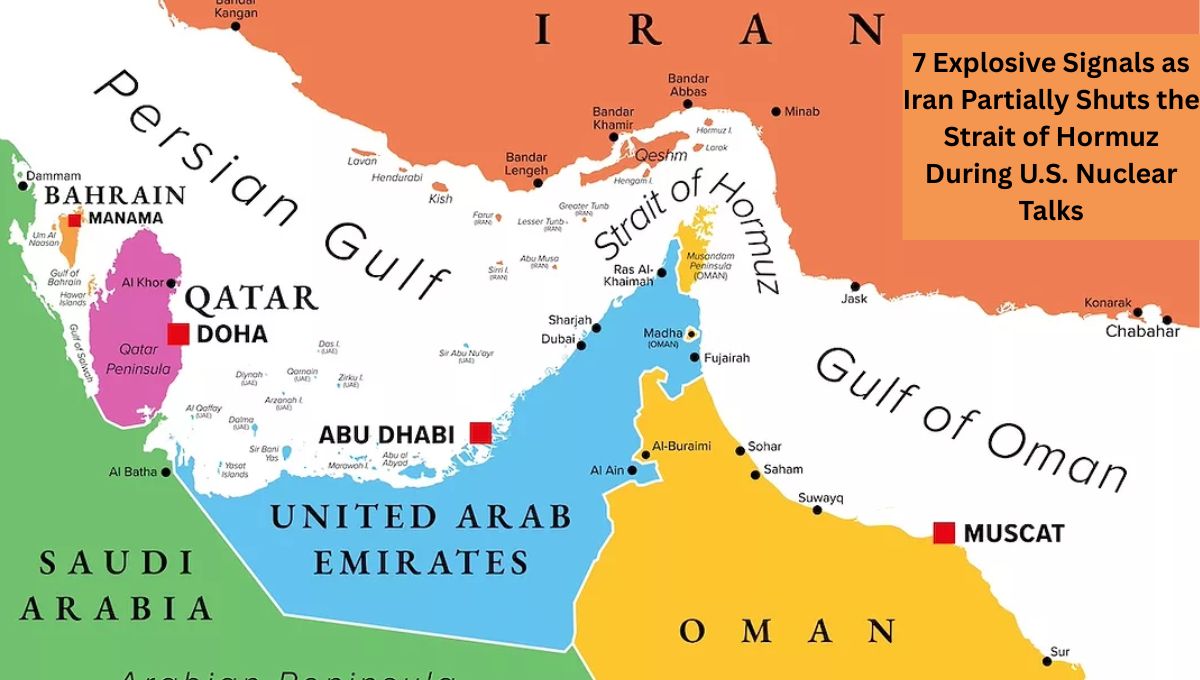
7 Explosive Signals as Iran Partially Shuts the Strait of Hormuz During U.S. Nuclear Talks and live-fire drills. Iran briefly shut down parts of the Strait of Hormuz, the world’s most critical energy chokepoint, on Tuesday as it conducted live-fire military drills while holding indirect nuclear talks with the United States in Geneva.
The rare move, announced by Iranian state media as a “security precaution,” underscored how diplomacy and brinkmanship are unfolding in parallel — with global markets watching every signal.
The partial closure came as negotiators from Tehran and Washington reported limited progress on “guiding principles” for a potential nuclear agreement, even as military deployments on both sides continued to escalate across the Middle East.
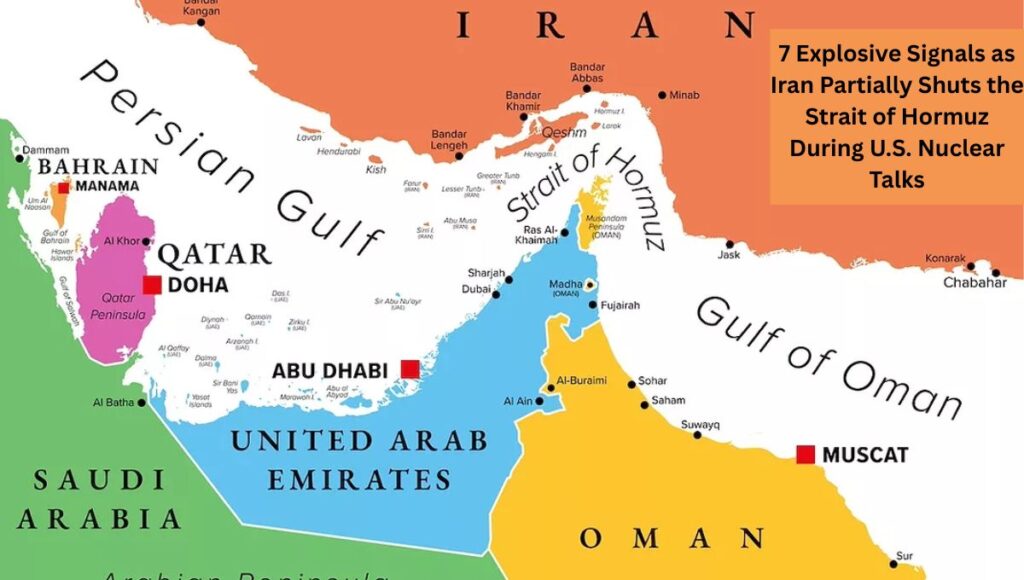
7 Explosive Signals as Iran Partially Shuts the Strait of Hormuz During U.S. Nuclear Talks
Why the Strait of Hormuz Matters to the World
The Strait of Hormuz is a narrow maritime corridor linking the Persian Gulf to the Gulf of Oman and the Arabian Sea. At its narrowest point, it spans just 33 kilometers, yet it carries an outsized share of global energy flows.
According to market intelligence firm Kpler, roughly 13 million barrels of crude oil per day transited the strait in 2025 — accounting for around 31% of global seaborne oil trade.
Energy exports from Saudi Arabia, Iran, Iraq, Kuwait, the United Arab Emirates, and Qatar depend heavily on the uninterrupted flow of traffic through this passage.
Any disruption, even temporary, immediately reverberates through global oil prices, shipping insurance rates, and broader financial markets.
Iran’s ‘Smart Control’ Drill and Partial Closure
Iran said the temporary closure was linked to a Revolutionary Guard naval exercise dubbed “Smart Control of the Strait of Hormuz.”
State-linked media reported that live missiles were fired from warships and coastal positions, striking designated targets at sea.
The drill, conducted by the Islamic Revolutionary Guard Corps, was framed as a defensive maneuver aimed at improving operational readiness and deterrence.
Shipping was warned to avoid specific lanes for several hours, particularly sections overlapping with the inbound traffic separation scheme.
Jakob Larsen, chief safety and security officer at Bimco, which represents global shipowners, described the impact as likely limited.
“This will cause minor nuisance and delays rather than major disruption,” Larsen said, noting that commercial vessels typically comply with such warnings during live-fire exercises.
Still, the symbolism was unmistakable.
First Such Closure Since Trump’s January Threats
Iranian officials and regional analysts emphasized that this marked the first announced partial closure of the Strait of Hormuz since US President Donald Trump escalated military threats against Tehran earlier this year.
While Iran has frequently harassed shipping or conducted drills in the strait during periods of tension, openly declaring a closure — even a temporary one — represents a significant escalation in signaling.
Danny Citrinowicz of Israel’s Institute for National Security Studies noted that Iran last took comparable action during the Iran-Iraq War in the 1980s, when the waterway was mined.
Nuclear Talks Resume in Geneva
The maritime maneuver unfolded as US and Iranian negotiators met indirectly in Geneva, with Oman acting as intermediary.
The talks aim to revive or reshape an agreement limiting Iran’s nuclear program in exchange for sanctions relief.
Iran’s delegation was led by Foreign Minister Abbas Araghchi, who struck a cautiously optimistic tone after nearly three hours of discussions.
“We have had serious and constructive discussions,” Araghchi told reporters. “We reached an understanding on some guiding principles. More work remains, but a path has opened.”
Washington: Progress, But Red Lines Remain
On the US side, officials described the talks as mixed. Vice President JD Vance said negotiations went well “in some ways,” but emphasized that Washington’s red lines — particularly on uranium enrichment — remain unresolved.
The Trump administration has insisted that Iran must not enrich uranium on its own soil and must eventually hand over its stockpile of highly enriched material.
Tehran has repeatedly rejected those demands as violations of its sovereignty and rights under international law.
Khamenei’s Warning: Rhetoric Meets Firepower
Even as diplomats talked, Iran’s Supreme Leader Ali Khamenei issued stark warnings aimed squarely at Washington.
In remarks broadcast by state television, Khamenei questioned US military supremacy and hinted at Iran’s ability to strike American assets in the region.
“A warship is a dangerous apparatus,” he said, “but more dangerous than that is the weapon that can send it to the bottom of the sea.”
The comments reinforced Tehran’s message:
negotiations will proceed, but not under coercion.
Oil Markets React — Then Pull Back
Energy markets initially jumped on news of the drills and closure, reflecting fears of supply disruption.
However, prices later retreated as traders assessed the limited duration and scope of the exercise.
- Brent crude fell around 2%, hovering near $67 per barrel
- West Texas Intermediate (WTI) slipped to roughly $62 per barrel
Analysts said markets remain caught between two opposing forces:
the risk of military escalation versus the possibility that a diplomatic breakthrough could eventually return Iranian oil to global markets.
The US Military Buildup Continues
Despite diplomatic engagement, Washington has continued to expand its military footprint in the region.
A second US aircraft carrier group is en route to the Middle East, joining existing naval and air assets positioned near Iran.
US officials argue the buildup is defensive and intended to deter Iranian attacks on US forces or allies. Tehran, however, views the deployments as preparation for potential strikes.
The result is a high-risk environment where miscalculation could trigger rapid escalation.
IAEA’s Role and Nuclear Uncertainty
A key parallel track in Geneva involved meetings with International Atomic Energy Agency Director General Rafael Grossi.
Iran suspended most cooperation with the IAEA following last year’s war with Israel and US strikes on Iranian nuclear sites.
Grossi has warned that inspectors currently lack full visibility into Iran’s uranium stockpiles, including material enriched up to 60% purity — a short technical step from weapons-grade.
While Grossi has stressed that enrichment alone does not equal weaponization, the lack of transparency remains a major concern for Western governments.
Why Iran Chose This Moment
Analysts see Iran’s Hormuz move as carefully calibrated rather than reckless.
Key Objectives Behind the Closure
- Signal deterrence without provoking outright conflict
- Strengthen Tehran’s negotiating leverage in Geneva
- Remind global powers that pressure on Iran has global consequences
- Reassure domestic audiences of military strength
By limiting the closure to several hours and framing it as a safety measure, Iran avoided crossing a threshold that might justify immediate retaliation — while still commanding international attention.
Global Stakes: Not Just a US-Iran Issue
The Strait of Hormuz is not merely a regional concern.
Any prolonged disruption would:
- Drive up global fuel prices
- Hit Asian economies dependent on Gulf energy
- Disrupt shipping insurance and logistics
- Risk pulling Gulf Arab states into wider conflict
Countries from Europe to East Asia are therefore watching the Geneva talks closely, even if they are not directly represented at the table.
What Comes Next
Both sides have agreed to continue discussions, with Iranian officials signaling they will return within two weeks with more detailed proposals. Yet expectations of a rapid breakthrough remain low.
Previous nuclear negotiations took years, not weeks. And today’s environment — marked by military buildup, sanctions, domestic unrest in Iran, and political calculations in Washington — is even more complex.
Conclusion: Diplomacy Under the Shadow of Force
Iran’s partial closure of the Strait of Hormuz encapsulates the current phase of US-Iran relations: talks backed by threats, diplomacy framed by deterrence. For now, missiles and negotiators are moving in parallel.
Whether one ultimately silences the other will determine not just the future of Iran’s nuclear program — but the stability of global energy markets and security across the Middle East.
Also Read: 9 Explosive Signals as Trump and Khamenei Edge Iran–US Toward War or Deal
Also Read: Iran temporarily closes Strait of Hormuz after ‘three warnings in 30 minutes’ to US – All we know
Related Posts:
- 7 Powerful Facts About Ayatollah Ali Khamenei’s…

- 7 Powerful Measures: Trump Sanctions Russian Oil…

- 5 Major Takeaways from the US Supreme Court's…

- 3 Explosive Conditions Iran Sets to End War with US…
- 9 Explosive Claims as Trump Says US Winning Iran War

- 7 Heartbreaking Facts About Venezuela's Earthquake Disaster