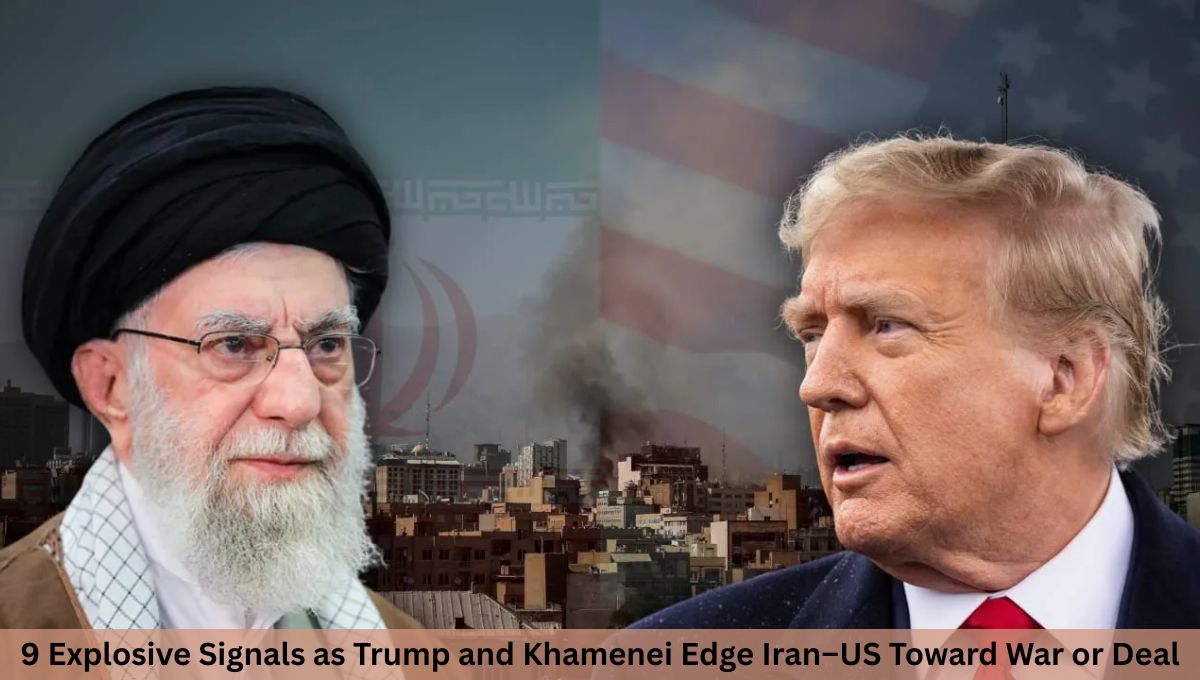
9 Explosive Signals as Trump and Khamenei Edge Iran–US Toward War or Deal, with both at a critical tipping point.The United States and Iran are once again locked in a dangerous confrontation, with diplomacy and military threats advancing side by side.
US President Donald Trump says Washington is “talking” with Tehran and that a deal could be imminent. Iran’s Supreme Leader Ayatollah Ali Khamenei, meanwhile, insists Iran does not seek war — but warns that any US attack would ignite a regional conflict.
At stake is far more than a revived nuclear agreement. Domestic unrest inside Iran, a US naval buildup near Iranian waters, Israel’s readiness for conflict, and the reactivation of Iran-backed proxy forces are converging into what analysts describe as one of the most volatile moments in West Asia in decades.
This article breaks down the nine defining signals shaping the current Iran–US standoff — and why the coming days may decide between war and diplomacy.
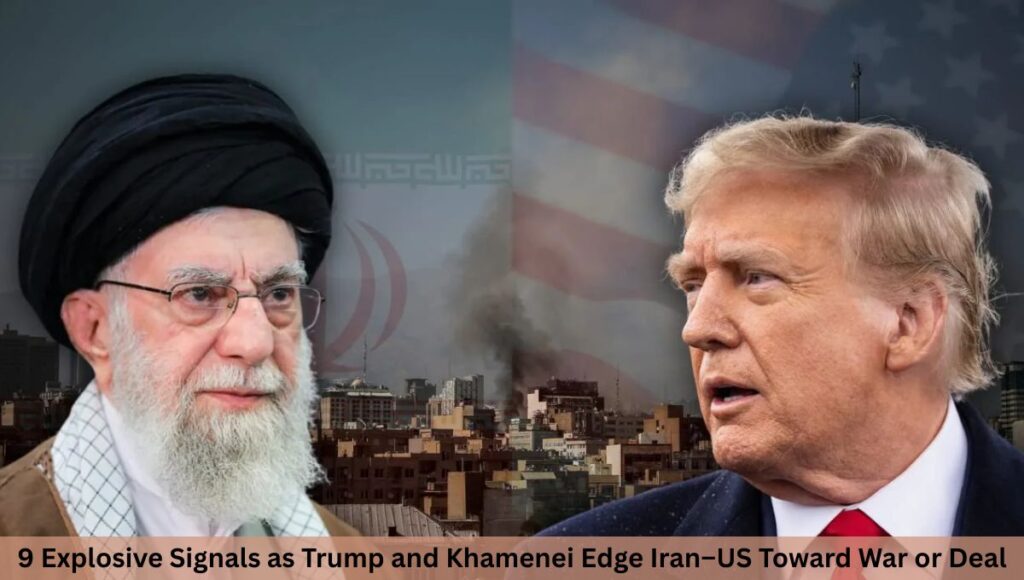
9 Explosive Signals as Trump and Khamenei Edge Iran–US Toward War or Deal
1. Trump’s Dual Message: ‘We’ll Make a Deal’ — or Else
President Trump’s rhetoric has followed a familiar pattern:
optimism laced with menace.
Speaking at his Mar-a-Lago residence and later at the White House, Trump said Iran “does want to make a deal” and expressed hope that negotiations could succeed.
At the same time, he repeatedly highlighted the deployment of “the biggest, most powerful ships in the world” close to Iran.
“If we don’t make a deal,” Trump warned, “we’ll find out what happens.”
The message is clear:
diplomacy remains open — but the threat of force is deliberately kept on the table.
This strategy of coercive diplomacy is designed to pressure Tehran into nuclear concessions without committing Washington to an immediate war.
2. Khamenei Rejects War — While Warning of One
Ayatollah Ali Khamenei has responded with defiance mixed with caution.
Addressing the Iranian public, the Supreme Leader accused the United States of seeking to “devour Iran” for its oil, gas, mineral wealth, and strategic geography.
He insisted Iran is not the initiator of war, but issued a stark warning:
“If America starts a war, this time it will be a regional war.”
Khamenei framed US threats as psychological warfare, saying Iran would not be intimidated by aircraft carriers or naval armadas.
Yet his remarks also underscore Tehran’s belief that any US strike would inevitably draw in Israel, US bases, and regional allies, expanding the conflict far beyond Iran’s borders.
The arrival of a US carrier strike group, along with aircraft and air-defense systems, has significantly expanded Washington’s military options.
Trump has described the deployment as a “massive armada”, signaling both deterrence and readiness. US officials say the buildup is defensive, but Iranian leaders see it as an attempt to negotiate “under gunpoint.”
Military analysts warn that such proximity increases the risk of miscalculation — particularly in contested waters like the Strait of Hormuz, through which a fifth of the world’s oil supply passes.
4. Nuclear Talks Resume — Under Extreme Pressure
Despite the hostile rhetoric, Iran and the US are preparing to resume nuclear talks, with Turkish mediation placing negotiations in Istanbul.
US Special Envoy Steve Witkoff and Iranian Foreign Minister Abbas Araghchi are expected to meet, alongside representatives from regional powers including Saudi Arabia, Egypt, Qatar, and the UAE.
Trump’s reported demands include:
- Zero uranium enrichment
- Limits on Iran’s ballistic missile program
- An end to support for regional proxy groups
Iran has rejected most of these conditions as violations of sovereignty, but officials suggest Tehran may show flexibility on uranium enrichment under international frameworks, provided sanctions are lifted.
5. Iran’s Internal Crisis Shapes External Calculations
Behind Iran’s defiant posture lies deep domestic anxiety.
Following a bloody crackdown on anti-government protests in January — the deadliest since the 1979 revolution — Iranian leaders fear renewed unrest.
Reuters reporting indicates that senior officials warned Khamenei that public anger has reached a point where fear is no longer a deterrent.
A US strike, even a limited one, could reignite mass protests, potentially threatening the regime’s survival.
One former official put it bluntly:
“An attack combined with demonstrations could lead to collapse.”
This internal vulnerability explains Tehran’s careful balancing act:
resisting US pressure while avoiding a war that could destabilize the system from within.
6. The ‘Axis of Resistance’ Re-Mobilizes
As tensions rise, Iran-backed groups across the region have rallied behind Tehran.
- Hezbollah has vowed to defend Iran’s Supreme Leader
- Kataib Hezbollah in Iraq warned of “total war”
- Houthi rebels threatened renewed attacks in the Red Sea
This coordinated rhetoric signals that any US-Iran conflict would not be bilateral. Instead, it could trigger multi-front instability, threatening shipping lanes, energy infrastructure, and US allies across the Middle East.
7. Israel Prepares for All Scenarios
Israel remains a central, complicating factor.
IDF Chief of Staff Lt. Gen. Eyal Zamir said Israel is in a “period of improving readiness for war”, while Prime Minister Benjamin Netanyahu warned that any attack on Israel would bring “unbearable consequences.”
Israeli officials have reportedly pressed Washington to maintain hardline demands on Iran’s nuclear and missile programs.
Given Israel’s history of pre-emptive strikes, analysts fear unilateral action could drag the US into a broader conflict even if diplomacy remains underway.
8. Global Powers Warn of Regional Collapse
Major international actors have urged restraint.
China warned that “military adventurism” would push the region into an abyss of unpredictability. Russia said a US strike would destabilize the Middle East. Turkey, Egypt, and Gulf states are actively mediating to prevent war.
Even the Vatican weighed in, with Pope Leo XIV calling for dialogue to avoid violence.
The broad international consensus is clear:
a war between Iran and the US would not stay contained.
9. War or Deal: A Narrow Window
The current standoff reflects a paradox. Both Washington and Tehran say they prefer diplomacy. Both also believe military pressure strengthens their negotiating position.
Trump insists he wants “no nuclear weapons” and claims a deal is within reach. Iran says it is open to “fair and just talks”, but refuses negotiations dictated by force.
With warships sailing, talks resuming, protests simmering, and proxies mobilized, the margin for error is dangerously thin.
What Happens Next
Three outcomes appear possible:
- A limited nuclear deal, easing sanctions and reducing tensions
- Prolonged brinkmanship, with talks dragging on under threat
- Military escalation, triggered by miscalculation or unilateral action
The coming days — not months — are likely to determine which path prevails.
Bottom Line
The confrontation between Donald Trump and Ayatollah Ali Khamenei is not just a clash of personalities, but a collision of strategy, ideology, and survival instincts.
For now, diplomacy and war preparations are advancing together. Whether one overtakes the other will shape the future of Iran, the Middle East, and global security. The world is watching — and holding its breath.
Also Read: Khamenei’s Feminist Tweets Resurface Amid Israel-Iran War
Also Read: Iran FM Araghchi says Trump being ‘dragged’ toward war by ‘certain elements’
Related Posts:
- 3 Explosive Conditions Iran Sets to End War with US…
- 11 Explosive Warnings as Trump Vows to ‘Knock the…

- 10 Explosive Warnings as Donald Trump Calls Iran…
- 9 Explosive Claims as Trump Says US Winning Iran War

- 10 Explosive Signals: Trump Rates Iran War “15/10”…
- Trump's 3 Blunt Warnings to China and Russia Over…