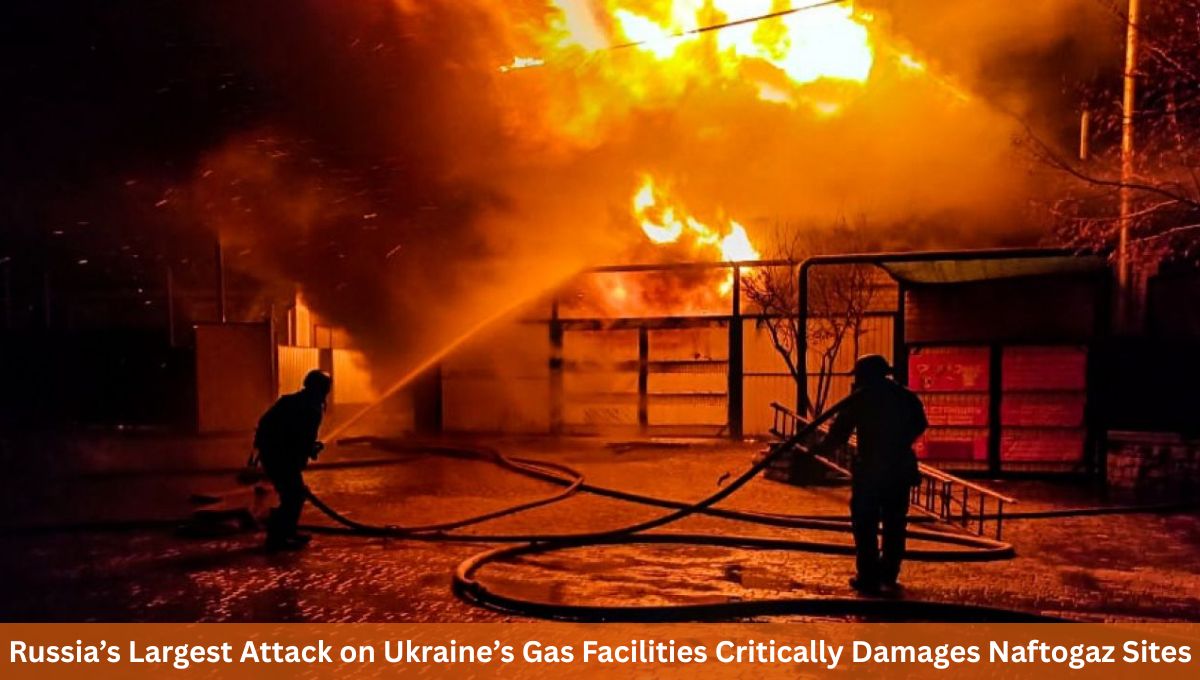
Russia’s Largest Attack on Ukraine’s Gas Facilities Critically Damages Naftogaz Sites ahead of winter heating season. In what Ukrainian officials described as the biggest assault on energy infrastructure since the war began, Russia launched a devastating overnight strike targeting Ukraine’s state-owned gas company Naftogaz.
The attack, carried out with 35 missiles and 60 drones, struck production and processing facilities in the Kharkiv and Poltava regions, leaving behind critical damage and raising fears of energy shortages as the heating season approaches. “This is deliberate terror against civilian facilities that provide gas extraction and processing for the normal life of people.
It has no military purpose,” Naftogaz CEO Sergii Koretskyi said on Friday. The Russian Defence Ministry confirmed the strikes, claiming its forces targeted both “military-industrial facilities” and energy infrastructure. Ukrainian officials, however, argued that the sole objective was to cripple energy supplies and weaponize winter against civilians.
Russia’s Largest Attack on Ukraine’s Gas Facilities Critically Damages Naftogaz Sites
Scale of the Assault: Missiles and Drones
According to Ukraine’s Air Force, the attack was part of a massive wave of 381 drones and 35 missiles fired across six regions overnight.
- Targets hit: Kharkiv and Poltava gas production facilities.
- Critical damage: Several sites rendered inoperable.
- Casualties: In Poltava, two women and an eight-year-old child were injured.
- Cultural loss: A blast shattered windows at the historic St. Nicholas Church in Poltava.
Despite Ukraine’s air defenses intercepting roughly half of the missiles, many drones and ballistic weapons penetrated, overwhelming systems already strained from months of attacks.
“Critical” Damage to Naftogaz
Naftogaz confirmed that a significant portion of its facilities were damaged, with some sites sustaining irreversible destruction. Koretskyi called it the largest strike on gas infrastructure since the 2022 invasion.
He accused Russia of deliberately targeting civilian energy assets to disrupt heating before winter:
“Just before the heating season, Russians are looking for ways to inflict more harm on our people.”
Earlier this year, Russian strikes had already cut Ukraine’s domestic gas output by 40%. The latest assault threatens to further destabilize supplies, forcing Ukraine to rely on gas imports and reserves.
Ukraine Prepares for Winter Heating Season
Ukraine’s government has scrambled to shore up energy reserves ahead of what is expected to be a harsh winter.
- Gas imports: Ukraine intends to stockpile 13.2 billion cubic meters (bcm) of gas in underground facilities by mid-October.
- Imported share: 4.6 bcm will come from external suppliers, including 500 million cubic meters of U.S. LNG via Europe.
- Emergency measures: Power providers such as DTEK have suspended operations at several damaged facilities in Poltava.
President Volodymyr Zelenskyy, in his evening address, warned that Russia is deliberately trying to leave millions without heating:
“Today was another Russian strike on our gas infrastructure. This is not a fight for the battlefield—it is Russia’s terror against our people.”
Blackouts and Energy Crisis Loom
The strikes triggered immediate blackouts and outages:
- Over 8,000 households lost power in Poltava.
- The frontline city of Kostiantynivka in Donetsk faced prolonged power loss after additional strikes.
- Earlier in the week, drone attacks had disrupted electricity in Chernihiv, Sumy, and Kyiv regions.
Perhaps most alarming was a temporary blackout at the Chornobyl nuclear power plant, where a drone strike knocked out power to the containment vessel built after the 1986 disaster. While electricity was restored within three hours, the incident underscored the grave risks of targeting nuclear infrastructure.
Hybrid Warfare: Russia’s Energy Weapon
Since the start of its invasion, Moscow has systematically targeted Ukraine’s energy grid in winter months. The strategy is clear: degrade civilian morale by depriving Ukrainians of heat, light, and water.
Prime Minister Yulia Svyrydenko described the latest assault as a “massive attack” aimed at terrorizing civilians.
Military analysts believe Russia is pursuing a dual objective:
- Strain Ukraine’s economy by forcing reliance on expensive imports.
- Pressure European allies with the looming threat of an energy spillover crisis.
This hybrid strategy—mixing military strikes, sabotage, disinformation, and energy coercion—has been flagged by Western intelligence as Russia’s hallmark weapon.
Also Read: Hybrid threats: Russia’s shadow war escalates across Europe
Ukraine Strikes Back at Russia’s Oil Facilities
Kyiv has not remained passive. In September alone, Ukrainian drones struck 19 oil refineries and storage sites inside Russia and in occupied territories.
Notable strikes include:
- Orsknefteorgsintez refinery in Orsk, near Kazakhstan’s border, which caught fire after a drone hit.
- Azot chemical plant in Berezniki, one of Russia’s largest, briefly shut down by a Ukrainian drone.
These retaliatory attacks aim to undermine Russia’s own energy sector, which funds much of its war machine. They have already caused fuel shortages in some Russian regions.
Also Read: Ukraine’s Operation Spider Web Destroys 41 Russian Warplanes, Sparks Nuclear Fears
Escalating Risks: Putin’s Warning
The timing of Russia’s strikes is no coincidence. Just days earlier, President Vladimir Putin warned Donald Trump that the U.S. risked a “new stage of escalation” if it delivered long-range Tomahawk missiles to Ukraine.
Western officials view the gas strikes as part of Moscow’s pressure campaign to deter further U.S. and European military aid.
Putin also scoffed at accusations of hybrid warfare against NATO states, joking in Sochi:
“I won’t do it again. Not to France, not to Denmark, not to Copenhagen.”
But his humor quickly gave way to menace:
“We are carefully watching the growing militarization of Europe. No one should doubt that Russia’s countermeasures will not take long to come.”
Denmark, NATO, and Baltic Provocations
Russia’s hybrid tactics extend beyond Ukraine. Denmark has accused Russian warships of:
- Sailing on collision courses with Danish naval vessels.
- Pointing weapons at Danish ships.
- Conducting GPS jamming and sonar interference in the Danish straits.
Danish Prime Minister Mette Frederiksen recently described drone incursions over airports and military bases as a “hybrid attack.”
Poland has also raised alarms, with its intelligence services claiming Russia’s GRU intelligence directorate may be orchestrating drone strikes in Poland, Germany, and Lithuania.
NATO, in response, has strengthened Baltic operations, while Sweden proposed new laws to expand maritime surveillance.
Civilian Suffering Amid Escalation
The human toll of the latest strikes is mounting. Beyond the injured civilians in Poltava, many families across Ukraine now face another winter of fear, cold, and darkness.
Agency photos showed residents huddling in shelters as explosions rocked Kharkiv and Poltava. Emergency crews raced to restore power, while volunteers distributed blankets and food.
Naftogaz said it would work to repair facilities but admitted some losses were beyond immediate recovery.
International Response: Calls for Stronger Air Defenses
Ukraine has renewed pleas for Western allies to accelerate deliveries of air defense systems, particularly to defend against ballistic missiles and swarms of drones.
So far, Kyiv has received Patriot batteries, NASAMS, and IRIS-T systems, but officials warn they remain insufficient against hundreds of drones launched nightly.
European leaders meeting in Copenhagen this week discussed a “drone wall” initiative—a coordinated defense system to track and destroy Russian drones across EU states.
Energy as the New Battleground
The assault on Naftogaz underscores a grim truth: energy is now the central battleground in the Russia-Ukraine war.
- For Ukraine: It’s about surviving winter without mass blackouts.
- For Russia: It’s about using energy terror to break civilian resolve.
- For Europe: It’s about preventing the conflict from spilling into NATO territory through drones, hybrid attacks, and sabotage.
As Zelensky warned:
“This is not just about Ukraine. Russia is showing that it will attack the energy systems of Europe, NATO, and beyond. Winter is their weapon.”
Conclusion: A Winter of Uncertainty
With critical gas sites destroyed, millions at risk of blackouts, and hybrid threats spreading into NATO states, Europe faces one of its most volatile winters since the Cold War.
Ukraine continues to fight back with drone strikes deep inside Russia, but the balance remains precarious.
The question looming over Kyiv, Brussels, and Washington is whether Western support—both military and financial—will be enough to weather Moscow’s energy war.
For Ukrainians, the stakes are immediate: Will the lights stay on this winter? Will the heat return? Or will Russia’s missiles and drones succeed in turning the cold into another weapon of war?