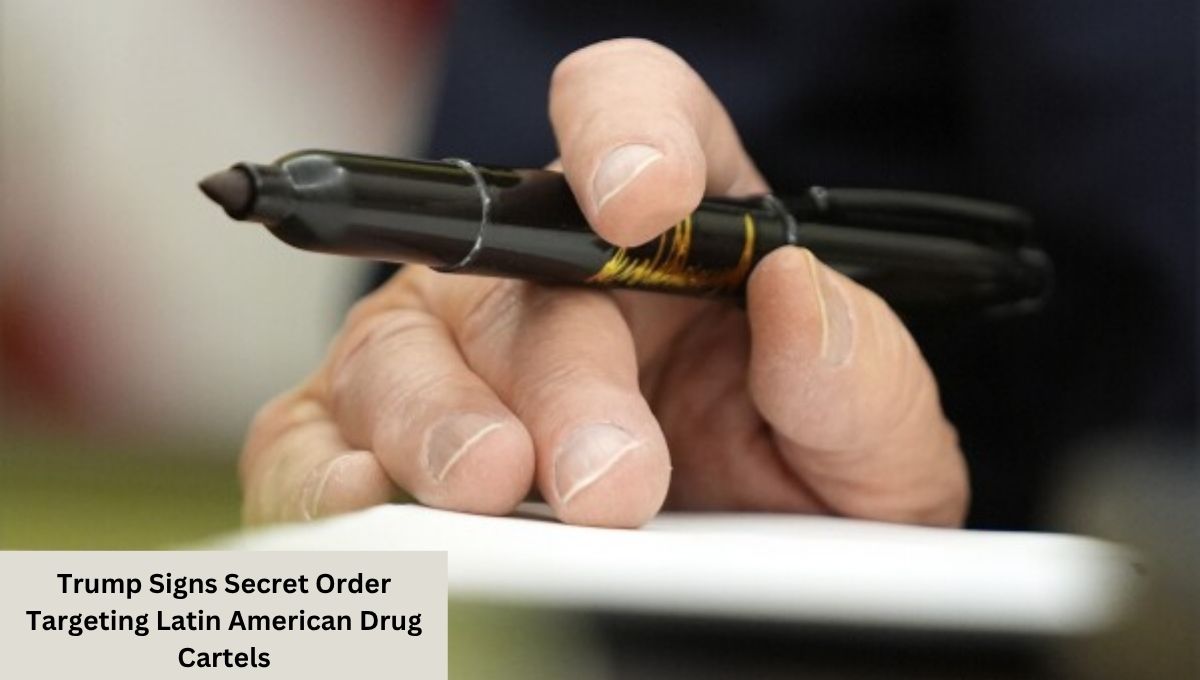
Escalating the war on narcotics, Trump Signs Secret Order Targeting Latin American Drug Cartels. President Donald Trump has secretly signed an executive order empowering the U.S. military to take aggressive action against Latin American drug cartels, marking one of the most dramatic shifts in American counter-narcotics policy in decades.
According to The New York Times, the directive designates several notorious criminal organizations as foreign terrorist organizations (FTOs), giving the Pentagon and U.S. law enforcement expanded powers to target them both at sea and potentially on foreign soil.
Trump Signs Secret Order Targeting Latin American Drug Cartels
A New Phase in Trump’s War on Cartels
Sources close to the administration confirm that Trump’s secret order allows U.S. forces to conduct operations beyond America’s borders if deemed necessary.
The list of designated groups referred to by insiders as Trump’s “hit list” includes nine powerful criminal organizations:
- Tren de Aragua (Venezuela)
- Mara Salvatrucha (MS-13)
- Cártel de Sinaloa (Mexico)
- Cártel de Jalisco Nueva Generación (Mexico)
- Cártel del Noreste (formerly Los Zetas)
- La Nueva Familia Michoacana
- Cártel del Golfo (Gulf Cartel)
- Cárteles Unidos
- Cartel of the Suns (Venezuela)
Secretary of State Marco Rubio has publicly backed the move, saying, “We have to start treating them as armed terrorist organizations, not simply drug-dealing organizations.”
Designating Cartels as Terrorist Organizations
The formal designation of these cartels as foreign terrorist organizations occurred earlier this year.
The U.S. State Department argued that this classification is a crucial step in disrupting the financial, logistical, and operational networks that allow cartels to thrive.
By categorizing these groups alongside organizations like ISIS and al-Qaeda, the Trump administration aims to give law enforcement and the military additional legal tools, including asset freezes, travel bans, and expanded surveillance authority.
Mexico Pushes Back on Sovereignty Concerns
Mexican President Claudia Sheinbaum addressed the matter head-on, assuring citizens that U.S. troops will not operate within Mexican borders.
“There will be no invasion of Mexico,” Sheinbaum declared. “Our territory is inviolable, our sovereignty is not for sale.”
Sheinbaum has consistently opposed foreign military involvement in Mexico’s anti-cartel operations.
She previously rejected Trump’s offer to send American troops to combat drug gangs inside Mexican territory, calling it a violation of sovereignty.
Pentagon Preparing Military Options
Reports from the Wall Street Journal indicate that the Pentagon has been instructed to prepare multiple operational scenarios. These include:
- Naval interdiction of drug shipments in international waters.
- Targeted strikes against cartel infrastructure.
- Special forces raids coordinated with foreign partners.
- Expanded intelligence-sharing with regional allies.
While no immediate military deployment has been announced, the Pentagon’s planning signals that Trump is ready to act if conditions escalate.
Legal and Diplomatic Grey Areas
The move raises significant legal challenges. Domestically, the Posse Comitatus Act prohibits the U.S. military from acting as a policing force inside the United States.
Internationally, the United Nations Charter bars the use of force against another nation’s territorial integrity except in self-defense.
Using military force in countries like Mexico or Venezuela without their consent could be viewed as an act of war, potentially breaching international law and igniting diplomatic crises.
Strong Reactions Across Latin America
Reactions from Latin American governments have been swift. In Brazil, President Luiz Inácio Lula da Silva labeled the decision “unacceptable” and accused Trump of attempting to interfere with sovereign nations.
In Venezuela, Defense Minister Vladimir Padrino López denied the existence of active criminal gangs like Tren de Aragua, accusing Washington of fabricating threats as a pretext for intervention.
Ecuador, however, appears more open to U.S. cooperation, with its government considering a referendum that could allow foreign military installations in the country potentially reviving a U.S. base in a region plagued by cartel violence.
Risks of Escalation and Cartel Retaliation
Security analysts warn that cartels could retaliate directly against U.S. interests.
Unlike foreign terrorist groups operating far from American borders, cartels have deep cross-border networks capable of launching attacks inside the United States.
James Bosworth, a political risk consultant, cautioned: “These organizations could take the fight to U.S. territory through targeted attacks or increased smuggling operations.”
The Fentanyl Crisis Driving U.S. Policy
Central to Trump’s decision is the growing fentanyl crisis. U.S. officials blame Mexican cartels for trafficking the synthetic opioid, which has been linked to tens of thousands of deaths annually in America.
Many cartels source precursor chemicals from China, making them a critical focus of U.S. counter-narcotics strategy.
By designating these cartels as terrorist organizations, the administration hopes to disrupt supply chains and dismantle their operational capacity.
Humanitarian and Civilian Impact
Human rights organizations have raised alarms about the potential humanitarian fallout.
Civilians living in cartel-controlled regions are often coerced into paying extortion fees, and military strikes could unintentionally harm innocent residents.
Critics warn that a militarized approach could destabilize communities, cause mass displacement, and inadvertently strengthen recruitment for the very groups the U.S. seeks to destroy.
A Historical Echo of U.S. Intervention
The policy shift has drawn comparisons to past U.S. interventions in Latin America during the Cold War.
From covert operations in Guatemala to military actions in Panama, such interventions often left deep political and social scars that still influence regional perceptions of the United States.
Geoff Ramsey of the Atlantic Council noted: “Military action in Venezuela could destabilize not just that country but the region itself.”
Impact on U.S.-Mexico Security Agreement
An emerging U.S.-Mexico security agreement focusing on joint intelligence sharing may be at risk if the Trump administration proceeds with unilateral military action.
Victoria Dittmar of Insight Crime emphasized: “If the U.S. breaks the understanding that there will be no military intervention, it will shatter the trust underpinning the agreement.”
Trump’s Public Remarks and Political Strategy
While Trump has stopped short of confirming imminent action, his public statements suggest a willingness to escalate. Speaking at the White House, he remarked:
“Latin America has got a lot of cartels. They’ve got a lot of drugs flowing. So, you know, we want to protect our country.”
His approach signals a broader shift in U.S. policy toward Latin America one that favors hard power over diplomacy.
Conclusion: A Gamble with Global Consequences
President Trump’s secret military authorization against Latin American drug cartels could redefine the U.S. approach to counter-narcotics and reshape hemispheric relations. Supporters see it as a bold move to protect American lives and dismantle violent criminal networks. Critics, however, warn that it risks triggering diplomatic conflicts, legal challenges, and humanitarian crises.
As the Pentagon finalizes its operational plans and Latin American governments weigh their responses, the coming months will determine whether this order remains a symbolic show of force or the start of a new era in U.S. military engagement in the region.
Also Read: Trump Doubles Maduro Bounty to $50 Million Amid Drug Trafficking Charges
Also Read: Trump says declaration of war not needed on drug cartels