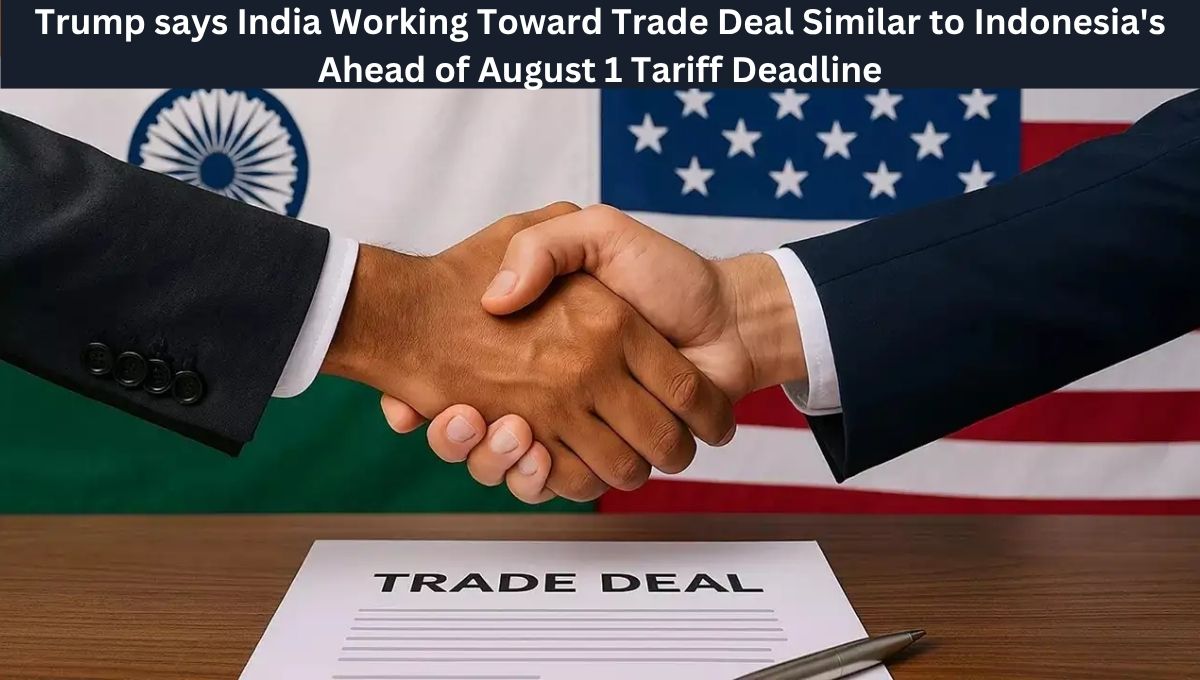
As part of his sweeping efforts to reset American trade policy, Trump says India Working Toward Trade Deal Similar to Indonesia’s Ahead of August 1 Tariff Deadline. US President Donald Trump has confirmed that India is negotiating a bilateral trade agreement with the United States that could mirror the just-finalized Indonesia-US deal. With the August 1 deadline looming, India is under increasing pressure to finalize terms or risk facing steep tariffs possibly as high as 35%.
Trump made the announcement during a press briefing in Washington on Tuesday, saying, “India basically is working along that same line. We’re going to have access into India.” This statement came just hours after the president touted the US-Indonesia trade pact a deal that levies a 19% tariff on Indonesian exports to the US, while allowing US goods to enter Indonesia duty-free.
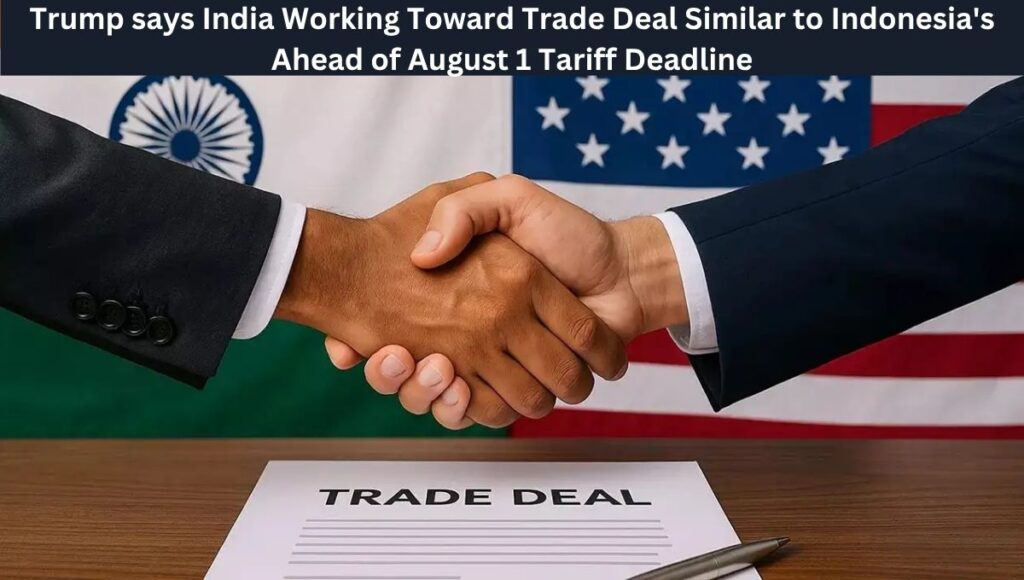
Trump says India Working Toward Trade Deal Similar to Indonesia’s Ahead of August 1 Tariff Deadline
India Faces a High-Stakes Deadline
Negotiators in New Delhi and Washington are scrambling to reach an agreement before the August 1 cutoff.
If no deal is reached, Indian exporters could be hit with high, across-the-board tariffs, echoing the White House’s warnings to more than 20 nations, including the EU, Canada, Japan, and Mexico.
The current proposal under discussion is widely expected to replicate the structure of the US-Indonesia deal.
That would involve India accepting a 19% tariff on its exports to the United States, while US exporters would receive full, unrestricted access to India’s domestic market.
Critics in India are already voicing concern over such a one-sided deal, warning it could damage Indian manufacturing, agriculture, and small businesses.
What the Indonesia Deal Means for India
The US-Indonesia deal, finalized after a direct call between Trump and Indonesian President Prabowo Subianto, includes:
- A 19% US tariff on all Indonesian exports
- Zero tariffs and non-tariff barriers on US goods entering Indonesia
- A $15 billion purchase of US energy by Indonesia
- A $4.5 billion commitment to US agricultural products
- An order of 50 Boeing aircraft, many being the 777 model
Trump has described this agreement as “a landmark deal” and is pushing to replicate it with India, Vietnam, and potentially China.
India’s Trade Balancing Act
India’s trade negotiators are walking a tightrope. On one hand, aligning with the US could open doors to advanced technologies, defense cooperation, and energy deals.
On the other hand, accepting a 19% tariff on Indian exports especially pharmaceuticals, textiles, rice, and machinery could lead to domestic backlash.
Worse still, Trump has warned that nations failing to agree to a deal by August 1 could face tariffs as high as 35%, and even up to 100% in certain sectors including those seen as supporting Russia’s economy amid the Ukraine war.
Trump’s Tariff Strategy: Leveraging Deadlines
Trump has made tariff threats the centerpiece of his foreign economic policy. The strategy is designed to force foreign governments to the table by threatening punitive duties unless they agree to favorable trade terms.
Since returning to office, he has raised the average US tariff rate to 20.6%, the highest since 1933. Letters threatening new tariff schedules have been sent to over 20 countries.
India, like Indonesia, was warned last month about a potential 32% tariff on its goods starting August 1.
As with Indonesia, that number could drop to 19% if India agrees to Trump’s terms. But if talks fail, blanket tariffs could be imposed on a wide range of Indian goods.
Strategic Trade or Political Gamble?
While Trump touts his deals as wins for American workers and industries, many trade experts call it a risky strategy.
Yale Budget Lab economists caution that unpredictable tariffs can destabilize global supply chains, inflate consumer prices, and discourage long-term investment.
Businesses also remain uneasy. Companies fear placing orders overseas, knowing Trump can change tariff rates at any time, creating uncertainty in contracts and delivery schedules.
“Tariffs are leverage,” Trump told reporters. “They get people to the table who never wanted to talk before.”
India’s Energy and Russia Dilemma
Further complicating India’s position is its continued purchase of Russian oil and gas, which Trump says violates US sanctions tied to the war in Ukraine.
He has warned that India and other countries could face 100% secondary tariffs if they don’t stop trading with Russia by his 50-day ceasefire deadline.
India, a long-standing strategic partner of Russia, now risks being caught in collateral damage if it doesn’t align with US geopolitical goals.
Trump hinted that such extreme tariffs would be avoided if Putin agreed to peace, but stopped short of offering any guarantees.
Global Markets React to Tariff News
Asian and global markets responded cautiously. The Nikkei 225 opened flat, while the Kospi in South Korea fell 0.5%. Australia’s ASX 200 dropped 0.82%.
Investors cited Trump’s Indonesia deal and impending India negotiations as contributing factors to regional uncertainty.
Meanwhile, in the US, the Nasdaq Composite closed at a record high, driven by tech giants like Nvidia, despite the broader market’s lukewarm response to inflation data and Trump’s trade threats.
Vietnam, UK, and Others Follow Indonesia’s Path
So far, the Trump administration has finalized trade pacts with Vietnam, the United Kingdom, Indonesia, and an interim deal with China.
Most of these agreements have high US tariffs on imports, but tariff-free access for US exports a strategy Trump calls “rebalancing trade.”
The UK and Vietnam have yet to release full details, but insiders confirm they follow the Indonesia model, with reciprocal purchases of energy, aerospace equipment, and agriculture.
Former Vice Minister of Foreign Affairs of Indonesia Dino Patti Djalal said the Jakarta deal was viewed internally as a necessary compromise to avoid worse outcomes.
EU Plans $84 Billion in Tariff Retaliation
While India negotiates with Washington, the European Union is preparing for battle. In response to Trump’s proposed 30% tariff on EU goods, the European Commission has readied an €72 billion ($84.1 billion) retaliation list targeting US aircraft, electronics, agriculture products, whiskey, and medical devices.
If implemented, this tit-for-tat escalation could lead to a breakdown in US-EU trade, with potential long-term consequences for businesses and consumers on both sides.
US-Indonesia Trade Snapshot
Indonesia, America’s 23rd largest trade partner, exported about $28 billion worth of goods to the US in 2024, including palm oil, electronics, apparel, tires, frozen shrimp, and rubber.
The US sent $10 billion in exports, mostly grain, oilseeds, LNG, and petroleum products.
Commerce Secretary Howard Lutnick noted that Indonesia’s export profile was “highly relevant” to US supply chains and said tariff reciprocity would now favor the US.
Could India Accept the Indonesia Model?
If India agrees to similar terms, the trade implications are massive. US exports from natural gas and soybeans to aircraft, chips, and pharmaceuticals would flood the Indian market without tariff barriers.
In exchange, Indian goods such as auto parts, textiles, tea, leather, and IT components would face a 19% tariff, effectively curbing their competitiveness in the US.
Indian domestic producers, especially in agriculture and small-scale manufacturing, have already begun lobbying the Commerce Ministry in New Delhi to reject a one-sided agreement.
Final Thoughts: Concession or Confrontation?
With just two weeks left until the August 1 deadline, India must decide whether to accept Trump’s offer or risk facing even more punishing tariffs. The government’s choice could reshape India’s bilateral relationship with the US, its economic trajectory, and its global trade positioning for years to come.
Whether Trump’s tariff-first diplomacy yields long-term gains or backfires remains to be seen. But for now, one thing is certain: the pressure is on, and the clock is ticking.
Also Read: EU Delays U.S. Tariffs, Aims for Trade Deal by August 1
Also Read: Big relief for India soon? US mulls interim trade deal, may cut tariff below 20%
Related Posts:
- What’s Next for Donald Trump After Court Rules His…

- 5 Key Takeaways from Trump–Carney Meet: Trade,…
- Trump Urges EU to Slap 100% Tariffs on China and…

- Trump’s 2025 Gaza Peace Plan Signing and Historic…

- 10 Big Takeaways from Trump’s 155% Tariff Warning to China

- Trump Targets Sri Lanka, BRICS with Sweeping Tariffs