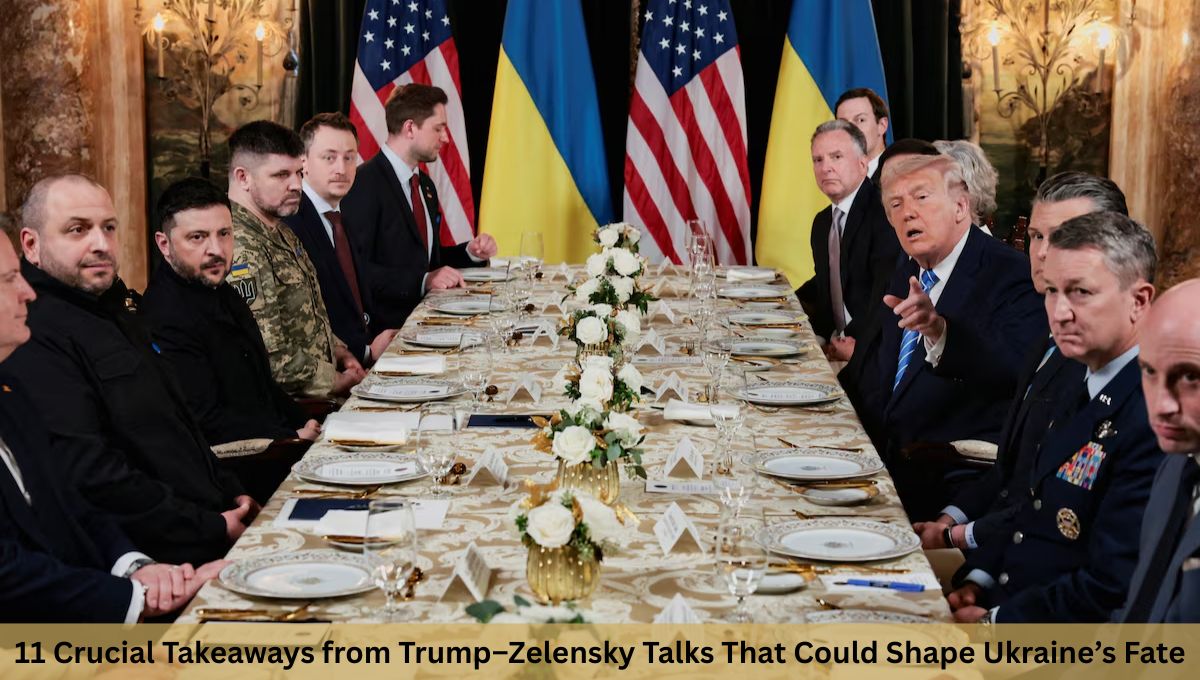
11 Crucial Takeaways from Trump–Zelensky Talks That Could Shape Ukraine’s Fate as Donbas, land concessions and Russia’s demands remain unresolved.United States President Donald Trump and Ukrainian President Volodymyr Zelensky met for more than three hours at Trump’s Mar-a-Lago estate in Florida in what both sides described as one of the most intensive diplomatic engagements yet aimed at ending Russia’s nearly four-year war against Ukraine.
Zelensky traded a missile-scarred Kyiv for the ornate dining room of Trump’s Florida residence, carrying with him a revised 20-point peace plan that Ukrainian officials say is largely complete. While no final agreement was announced, both leaders struck an optimistic tone and suggested negotiations are entering a decisive phase.
Yet behind the positive language lies a stark reality:
the most difficult issues — territory, Donbas, and Russia’s demands — remain unresolved.
Below are the most important takeaways from the meeting and what they mean for the future of the war.
11 Crucial Takeaways from Trump–Zelensky Talks That Could Shape Ukraine’s Fate
1. No Breakthrough — But Momentum Is Building
Despite three hours of closed-door discussions, Trump and Zelensky emerged without announcing a final deal. Instead, they emphasized progress rather than resolution.
Trump said the process was “very complicated” and warned against expecting instant results. Still, he stressed that talks are further along than at any point since Russia launched its full-scale invasion in 2022.
“I do think we’re getting a lot closer, maybe very close,” Trump told reporters.
The absence of a breakthrough highlights how difficult the remaining issues are, even as negotiations intensify.
2. Trump Sets No Deadline, but Signals Urgency
Trump rejected the idea of a fixed timeline for ending the war, saying peace cannot be rushed. However, his comments strongly suggested that he sees the current moment as a rare opportunity.
With US envoy Steve Witkoff and Trump’s son-in-law Jared Kushner deeply involved, Trump said talks are in their “final stages,” warning that failure could mean years more bloodshed.
“It’ll either end, or it’s going to go on for a long time, and millions of additional people are going to be killed,” he said.
The contrast between urgency and caution reflects Trump’s growing frustration with the pace of diplomacy.
3. The 20-Point Peace Plan Is ‘90% Agreed’
Both Trump and Zelensky said a revised 20-point peace framework is largely complete.
Zelensky stated that 90% of the plan has been agreed upon, echoing figures previously cited by US officials. Trump, while less fond of percentages, acknowledged that most elements are settled.
The unresolved 10% includes the most politically explosive issues — territory, Donbas, and the fate of key infrastructure.
4. Security Guarantees Are the Closest to Resolution
One of Kyiv’s core demands — security guarantees — appears to be the least contentious part of the talks.
Zelensky said US–Ukraine security guarantees are “100% agreed,” describing them as the foundation of any lasting peace. Trump offered a slightly lower estimate but confirmed that guarantees are close to final.
Under current proposals, European nations would shoulder much of the long-term security burden, with US backing similar to guarantees offered to NATO allies.
5. Donbas Remains the Central Sticking Point
The fate of eastern Ukraine’s Donbas region continues to block a final agreement. Russia wants full control of Donetsk and Luhansk, including areas its forces have not captured.
Ukraine rejects those demands and insists any settlement must respect current front lines or be decided by Ukrainians themselves.
Trump acknowledged the issue remains unresolved:
“It’s unresolved, but it’s getting a lot closer. That’s a very tough issue.”
The US has floated a proposal to create a “free economic zone” in parts of Donbas, potentially involving Ukrainian troop withdrawals — a deeply controversial idea in Kyiv.
6. Trump Presses Ukraine on Land Concessions
Trump openly suggested Ukraine may be better off making territorial compromises now rather than risking further losses later.
“Some of that land has been taken… and it may be taken over the next period of a number of months,” he said.
This argument aligns closely with Moscow’s position and has alarmed many of Ukraine’s supporters, who fear concessions could reward aggression and invite future attacks.
7. Zelensky Signals Flexibility — With Conditions
Zelensky entered the talks showing more flexibility than before. He said Ukraine could put elements of any peace deal — including territorial questions — to a national referendum, as required by Ukraine’s constitution.
However, he stressed that a ceasefire would be essential to hold such a vote safely.
Russia has repeatedly rejected ceasefire proposals, arguing they would only allow Ukraine to regroup militarily.
8. Trump’s Call With Putin Loomed Over the Talks
Hours before Zelensky arrived, Trump held a lengthy phone call with Russian President Vladimir Putin — a move that reportedly caught Ukrainian officials off guard.
The Kremlin said Trump and Putin “generally share similar views” that a temporary truce would only prolong the war. Trump described the call as “very good” and “productive.”
Although the call did not derail the Zelensky meeting, it reinforced concerns in Kyiv that Washington is giving Moscow significant influence over the process.
9. Trump Praises Putin on Nuclear Plant Issue
Trump singled out Russia’s handling of the Zaporizhzhia nuclear power plant — Europe’s largest — as a positive step.
“President Putin is actually working with Ukraine on getting it open,” Trump said, calling it “a big step.”
Negotiators have discussed shared control or international monitoring of the plant, which remains a key bargaining chip in talks.
10. Improved Personal Tone Between Trump and Zelensky
Unlike their disastrous February meeting, Sunday’s talks were notably cordial.
Trump praised Zelensky’s bravery, while the Ukrainian leader repeatedly thanked the US president — a significant gesture given earlier tensions.
The Mar-a-Lago setting provided a less formal backdrop than the White House, helping reset the personal dynamic between the two leaders.
11. Europe Drawn Deeper Into the Process
Following the meeting, Trump and Zelensky held a joint call with European leaders including France, the UK, Germany, and Poland.
Zelensky said Trump agreed to host further talks with European leaders in January, possibly in Washington.
Europe’s role will be crucial, particularly in funding reconstruction, enforcing security guarantees, and maintaining pressure on Moscow.
War Continues as Diplomacy Advances
Even as talks progressed, Russia launched heavy missile and drone attacks on Kyiv and other Ukrainian cities, knocking out power and heating in freezing temperatures.
Zelensky described the strikes as Russia’s response to US-brokered peace efforts — a reminder that diplomacy and violence are unfolding in parallel.
Conclusion: Closer Than Ever, But Far from Done
Trump and Zelensky left Florida projecting confidence that peace is within reach. Yet their own statements make clear that the hardest decisions — land, sovereignty, and trust — remain unresolved.
As Trump put it, the next few weeks will determine whether the war ends or grinds on. For Ukraine, the stakes could not be higher: peace may finally be near, but the price of achieving it remains painfully uncertain.
Also read: 7 Explosive Lines as Zelensky’s Christmas Message Takes Aim at Putin
Also Read: It’s easy to get lost in multi-point plans and spin – but Zelenskyy’s reaction to Trump said it all